My Cart
Your Cart 0

    Your cart is empty.

  • Total (Amount) ₹0.00
NCERT · Class 12 · Accountancy

Unit 5: Accounting Ratios

Practice each question, then open the answer or worked solution.

Short Questions for NCERT Accountancy Solutions Part 2 Class 12 Chapter 5

5 questions
Q1Written answer

What do you mean by Ratio Analysis?

Show solutionHide solution
Worked solution

It is a quantitative analysis of data present in a financial statement. It shows the relationship between items present in the Balance sheet and the Income Statement. It helps in calculating operational efficiency and solvency and in determining the profitability of a firm. Ratio is a statistical measure which helps in comparing relationships between two or more figures. Analyzing ratios presents vital pieces of information to accounting users about the firm’s financial position, performance and viability. It also helps in setting up new policies and frameworks by the management.

Q2Written answer

What are the various types of ratios?

Show solutionHide solution
Worked solution

Ratios can be classified into two types:

1. Traditional Classification

2. Functional Classification

Traditional Classification: Traditional classification is based on financial statements such as Balance sheets and P & L accounts. The ratios are divided on the basis of accounts of financial statements and are as follows:

i. Income Statement Ratios such as Gross Profit Ratios

ii. Balance Sheet Ratios such as Debt Equity Ratio, Current Ratio

iii. Composite Ratio: Ratios that contain elements from both Trading and P & L Account.

Functional Classification: These ratios are based on the functional need of calculating ratios. This ratio helps calculate the solvency, liquidity, profitability and financial performance of a business. Such ratios are:

i. Liquidity Ratio: Ratios used to determine the solvency of short term

ii. Solvency Ratio: Ratios used to determine the solvency of long term

iii. Activity Ratio: Ratios used for determining the operating efficiency of the business. These ratios are related to sales and the cost of goods sold.

iv. Probability Ratio: Ratios used to determine the financial performance and viability of the firm.

Q3Written answer

What relationships will be established to study:

a. Inventory Turnover

b. Trade Receivables Turnover

c. Trade Payables Turnover

d. Working Capital Turnover

Show solutionHide solution
Worked solution

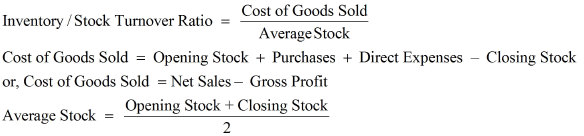
a. Inventory Turnover Ratio: This ratio is a relationship between the cost of goods sold and the average inventory maintained during a particular time period. It determines the efficiency with which a firm is able to manage its inventory.

NCERT Act Class 12 Chp 5-1

b. Trade Receivables Turnover Ratio: Debtors turnover ratio, also known as the Receivables Turnover Ratio, is a measure used to check how quickly a credit sale is converted into cash. It shows the efficiency of a business firm in collecting debts from customers.

NCERT Act Class 12 Chp 5-2

c. Trade Payables Turnover Ratio: It is also known as Creditor’s turnover ratio or account payable turnover ratio and is a liquidity ratio that measures the average number of times a firm pays its creditors in the course of an accounting period. It is used to measure the short-term liquidity of the firm.

NCERT Act Class 12 Chp 5-3

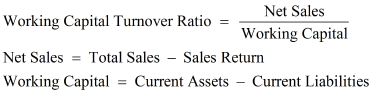
d. Working Capital Turnover Ratio: The working capital turnover ratio is used to measure the efficiency of a company in using its working capital to support sales. It is a ratio based on which a firm’s operations are funded, and the corresponding revenue generated from the business is calculated.

NCERT Act Class 12 Chp 5-4

Q4Written answer

The liquidity of a business firm is measured by its ability to satisfy its long-term obligations as they become due. What are the ratios used for this purpose?

Show solutionHide solution
Worked solution

A firm’s liquidity is measured by its capability to pay long-term dues. These dues include principal amount payment on the due date and interest payment on a regular basis. Long term solvency of a firm can be determined by the following ratios:

a. Debt-Equity Ratio: This ratio shows the relationship between owner funds (equity) and borrowed funds (debt). A lower debt-equity ratio provides more security to the people who are lending to the business. It also shows that a company is able to meet long-term dues or responsibilities.

NCERT Act Class 12 Chp 5-5

b. Total Assets to Debt Ratio- It is based on the relationship between total assets and long-term loans. It shows what percentage of the company’s total assets are financed by creditors. A higher total assets to debt ratio makes the firm able to meet long-term requirements and provides more security to lenders.

NCERT Act Class 12 Chp 5-6

c. Interest Coverage Ratio: This ratio is used to determine the easiness with which a company is able to pay interest on outstanding debts. It is calculated by dividing earnings before interest and taxes with interest payments. Having a higher interest coverage ratio means that company is able to meet its obligations skilfully.

NCERT Act Class 12 Chp 5-7

Q5Written answer

The average age of inventory is viewed as the average length of time inventory is held by the firm or as the average number of day’s sales in inventory. Explain with reasons.

Show solutionHide solution
Worked solution

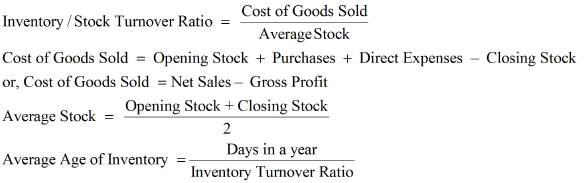
Inventory Turnover Ratio: This ratio is a relationship between cost of goods sold and the average inventory maintained during a particular time period. It determines the efficiency with which a firm is able to manage its inventory.

NCERT Act Class 12 Chp 5-8

It shows the average length for which the firm holds the inventory.