My Cart
Your Cart 0

    Your cart is empty.

  • Total (Amount) ₹0.00
NCERT · Class 12 · Accountancy

Unit 4: Analysis of Financial Statements

Practice each question, then open the answer or worked solution.

Long Questions for NCERT Accountancy Solutions Part 2 Class 12 Chapter 4

5 questions
Q1Written answer

Describe the different techniques of financial analysis and explain the limitations of financial analysis.

Show solutionHide solution
Worked solution

The following different techniques are used for financial analysis:

1. Cash Flow Analysis: This analysis focuses on the inflow and outflow of cash and cash equivalents from the various activities of a business, namely investing, operating and financing activities during an accounting period. This helps in analysing cash payments and the reason for receipt, and the respective changes in cash balances during the accounting year.

2. Ratio Analysis: This method highlights the relationship between items of the Balance Sheet and Income Statements. It is helpful in determining the efficiency, profitability and solvency of a firm. This analysis expresses the financial items as fractions, percentages or proportions. Also, it determines the qualitative relationship among different financial variables. It also serves as a source of information regarding the performance, viability and financial position of a firm.

3. Trend Analysis: This technique studies the trends in operating performance and financial position of the business over a period of many years in succession. In such a study, any particular year is considered as the base year, and the rest years are expressed as a percentage of the base year’s figures. It helps in identifying problems and inefficiency along with detecting operating efficiency and the financial position of the firm.

4. Comparative Statements: These statements use figures from two accounting periods that help determine financial position and profitability. It also enables to do intra and inter-firm comparisons and, therefore, determines the efficiency of the firm in relative terms. It uses both percentages as well as absolute terms. This analysis is known as Horizontal analysis.

5. Common Size Statements: Common Size Statements are those statements where the items are displayed as percentages of a common base figure instead of absolute figures. It is helpful for proper analysis between companies (inter-firm comparison) or between time periods of the same company (intra-firm comparison). In these statements, the relationship between items present in financial statements and common items like balance sheet, total and net sales are highlighted in percentage. The analysis based on these statements is called Vertical Analysis.

It has the following limitations:

1. It fails to depict changes in accounting policy and procedures.

2. These statements provide the interim report and hence have incomplete information.

3. These statements lack qualitative aspects like growth prospects and managerial efficiency and express only in monetary terms.

4. Financial analysis is based on accounting concepts and conventions and hence is unreliable as it does not take the current market value of items.

5. It involves personal bias and judgements of the accountant; for example, in the case of depreciation, different methods can be charged for the same item.

6. It does not take into account the change in the price level. Only nominal values are considered.
Q2Written answer

Explain the usefulness of trend percentages in the interpretation of the financial performance of a company.

Show solutionHide solution
Worked solution

Trend analysis is a form of analysing financial data, and it is expressed as a percentage for each year. It helps the accounting user in evaluating the financial performance of the business and also forms an opinion of various tendencies by which businesses can predict future trends.

The importance of trend analysis is as follows:

1. Predicting the trends of business which is forecasting future trends in business.

2. Trends are expressed as percentages which are less time-consuming and easy to follow.

3. It becomes a popular financial analysis method due to trends being expressed in percentages which makes evaluating the financial performance and operating efficiency of the firm relatively simpler.

4. It presents a broader picture of the performance of the company in terms of finance, viability and efficiency.

Q3Written answer

What is the importance of comparative statements? Illustrate your answer with particular reference to the comparative income statement.

Show solutionHide solution
Worked solution

Comparative statements have the following importance:

1. It presents financial data in a simple form, with year-wise data being presented in a side-by-side fashion, making the presentation neat and enabling intra and inter-firm comparisons more conclusive.

2. Presentation is very effective for drawing insights quickly and easily

3. It assists the management in drafting future plans and forecast trends which is achieved by analysing the profitability and operating efficiency of a business over time.

4. Comparative analysis helps the easy detection of problems. Early detection helps take corrective measures and align the business to meet the desired target.

Q4Written answer

What do you understand by analysis and interpretation of financial statements? Discuss its importance.

Show solutionHide solution
Worked solution

Financial analysis is of great importance for the various users of accounting information. Financial statements such as balance sheets, income sheets and other sources of financial data provide ample information on the various expenses and sources of profit, loss and income, which is helpful in determining the financial status of a business. Financial data is not making any meaningful contribution until it is analysed. There are various methods which help in analysing financial statements and make them useful for various accounting users.

The following reasons are essential for performing financial analysis:

1. It is very helpful in determining the financial viability and profit-earning capacity of the firm

2. It is helpful in evaluating the solvency of the business in the long term

3. It is useful in comparing the financial status of a firm in comparison to other competitor firms

4. It helps management in decision-making, drafting plans and also in establishing a robust and effective control mechanism

Q5Written answer

Explain how common size statements are prepared, giving an example.

Show solutionHide solution
Worked solution

Common size statements are of two types:

1. Common Size Income Statements

2. Common Size Balance Sheet

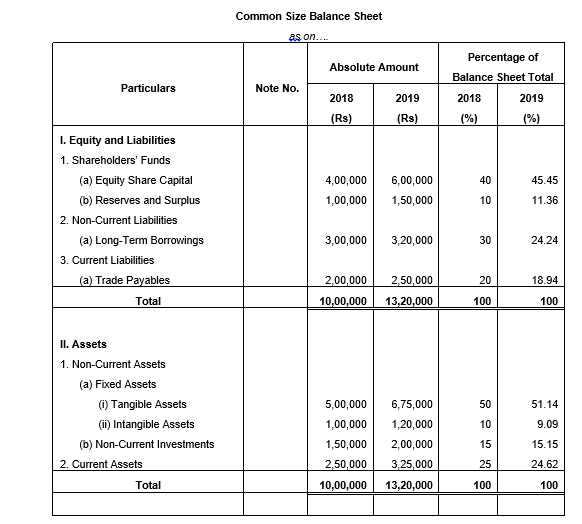
A common size statement is prepared as a columnar form for performing analysis. In such a statement, each item of the available financial statement is compared to a common item. Such analysis is called vertical analysis.

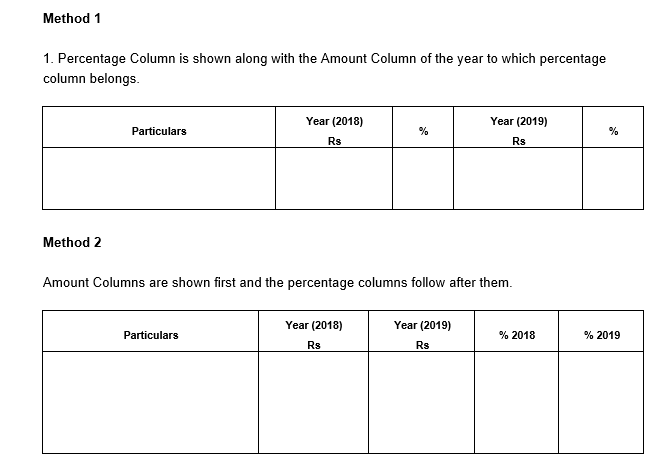
The following columns are present in a common size statement:

1. Particulars: It shows the various financial item under each respective heading

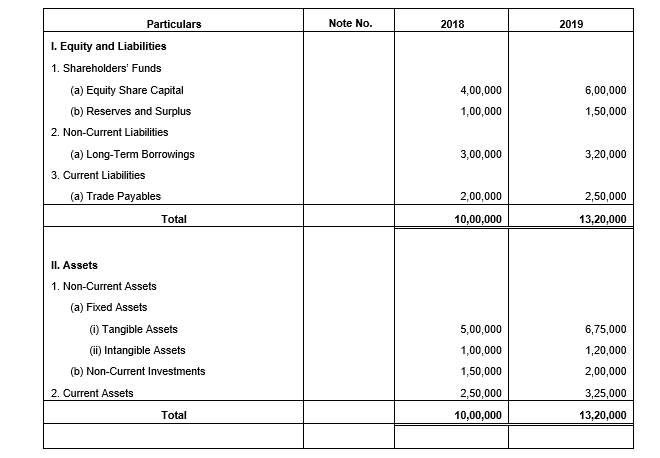
2. Amount Columns: Under these columns, the amount of each item is depicted along with sub-totals and the gross total of a particular year.

3. Percentage/Ratio Columns: Under these columns, the proportion of each item is shown as a percentage or ratio with reference to the common item.

It is prepared in the following two ways:

Class 12 Chp 4-1

The following example will help get a better understanding of the preparation

Class 12 Chp 4-2

Class 12 Chp 4-3

Working Note:

Class 12 Chp 4-4

For example,

Class 12 Chp 4-5