My Cart
Your Cart 0

    Your cart is empty.

  • Total (Amount) ₹0.00
NCERT · Class 12 · Accountancy

Unit 3: Reconstitution of a Partnership Firm – Retirement/Death of a Partner

Practice each question, then open the answer or worked solution.

Long Questions for NCERT Accountancy Solutions Class 12 Part 1 Chapter 4

4 questions
Q1Written answer

Explain the modes of payment to a retiring partner.

Show solutionHide solution
Worked solution

The modes of payment to a retiring partner are listed below:

i. When the amount due to the retiring partner is paid back in a lump sum amount on the day of retirement, journal entries are as mentioned below:

Retiring Partner’s Capital A/c Dr.
To Cash/Bank A/c
(Payment made to the retired partner)

ii. The amount to be paid to the retiring partner can be paid in instalments to the loan account, which helps the partner earn interest on the loan.

Retiring Partner’s Capital A/c Dr.
To Retiring Partner’s Loan A/c
(Capital account balance of retiring partner transferred to account to the loan account of retiring partner).

iii. Part payment: When the retiring partner needs to be paid some amount in cash and some as equal instalments, then a certain sum of money is paid on the day of retirement, and the rest of the sum is paid on a monthly basis to the partner’s loan account. The following entries show this type of transaction:

Retiring Partner’s Capital A/c (total due amount payable to partner) Dr.

To Retiring Partner’s Loan A/c (amount transferred to loan account)

To Cash A/c (part payment in the form of cash)

(Part payment to retiring partner in cash as well as transfer to loan account)

Q2Written answer

How will you compute the amount payable to a deceased partner?

Show solutionHide solution
Worked solution

To determine the amount payable to the deceased partner, the legal executor is entitled to calculate it. It is arrived at posting these items in debit and credit side respectively.

Items to be posted on the debit side are as follows:

i. Credit balance of deceased partner’s capital account.

ii. Profit share of the partner till their death

iii. Share of goodwill of the partner.

iv. Any gain on revaluation of liabilities and assets

v. Any salary or commission earned till the date of demise.

vi. Share in accumulated reserves and profit account

vii. Any interest earned on capital

viii. Share in a life insurance policy

Items to be posted on the credit side are as follows:

i. Deceased partner’s debit balance from the capital account.

ii. Total drawings done till the death of a partner

iii. Interest charged on drawings, if any, till the day of death.

iv. Reduction in profit share or loss up to the date of death.

v. Share of accumulated loss for the partner and firm

A legal executor balances excess credit over the debit side of a deceased partner.

Deceased Partner’s Capital Account
Dr.         Cr.
Date Particulars J.F. Amount

₹

Date Particulars J.F. Amount

₹

Revaluation A/c (Loss) Balance b/d
Profit and Loss Suspense A/c

(Loss share till the date of death)

Profit and Loss Suspense A/c

(Share of profit up to the date of the death)

Goodwill
Accumulated Losses A/c Reserves and Profits
Goodwill A/c (Written off) Revaluation A/c (gain)
Partner Executor’s A/c Joint Life Policy A/c
(Balancing Figure) Interest on Capital A/c
Salary A/c
Commission A/c
Q3Written answer

Explain the treatment of goodwill at the time of retirement or in the event of the death of a partner?

Show solutionHide solution
Worked solution

Goodwill is subjected to treatment on the following two conditions:

i. When goodwill is present in the books of the firm.

ii. When goodwill is not present in the books of the firm

i. When goodwill is present in books

The first step is to write off the goodwill if it is present in the books and must be distributed among the partners in the firm in the agreed profit-sharing ratio. The journal entry will be like the following:

All Partners’ Capital A/c Dr.

To Goodwill A/c

(Goodwill written off among partners)

The next step will be adjusting goodwill using the partners’ capital account with the share of goodwill of the deceased or retired partner

Remaining Partner’s Capital A/c Dr.

To Retiring/Deceased Partner’s Capital A/c (partners’ capital account debited and retiring/deceased partners account credited)

ii. When goodwill is not present in the books of the firm

As goodwill is not present in the books of the firm, it gets adjusted from the partners’ capital account along with the deceased/retired partners’ share. The following entry is passed:

Remaining Partner’s Capital A/c Dr.

To Retiring/Deceased Partner’s Capital A/c

(Partners’ capital account debited and retiring/deceased partners account credited)

Q4Written answer

Discuss the various methods of computing the share in profits in the event of the death of a partner.

Show solutionHide solution
Worked solution

In the unlikely event of the death of a partner during the year, the executor is entitled to a profit-sharing up to the date of the death of the partner. Profit sharing can be calculated by two methods:

i. On the time basis: In this method, profit earned till the date of the partner’s death is considered for calculation on the basis of last year/year’s profit or average profit earned in the last few years. It is assumed that profit will remain constant throughout the year, and the deceased partner will be eligible for a profit share, which is proportionate till the date of the partner’s death.

Share of Deceased Partner in Profit =

Chp 4-1

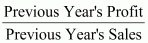
ii. On the sale basis: The calculation of profit is based on last year’s sales as per this method, and also, it is assumed that the net profit of the current year is similar to last year’s profits.

Share of Deceased Partner’s Profit =
Chp 4-2× Sales counted from the beginning of the current year up to the date of death × Share of the deceased partner