My Cart
Your Cart 0

    Your cart is empty.

  • Total (Amount) ₹0.00
NCERT · Class 11 · Physics

Chapter 2: Motion in a Straight Line

Practice each question, then open the answer or worked solution.

Questions

28 questions
Q11Written answer

Read each statement below carefully and state with reasons and examples, if it is true or false; A particle in one-dimensional motion
(a) with zero speed at an instant may have non-zero acceleration at that instant
(b) with zero speed may have non-zero velocity
(c) with constant speed must have zero acceleration
(d) with positive value of acceleration must be speeding up

Show solutionHide solution
Worked solution

(a) True

(b) False

(c) True (if the particle rebounds instantly with the same speed, it implies infinite acceleration, which is unphysical)

(d) False (true only when the chosen positive direction is along the direction of motion)
Q12Written answer

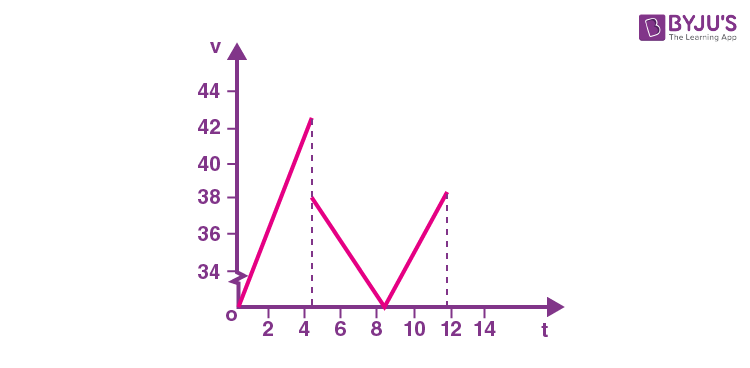
A ball is dropped from a height of 90 m on a floor. At each collision with the floor, the ball loses one-tenth of its speed. Plot the speed-time graph of its motion between t = 0 to 12 s.

Show solutionHide solution
Worked solution

Height from which the ball is dropped = 90 m

The initial velocity of the ball, u = 0

Let v be the final velocity of the ball

Using the equation

v2 – u2 = 2as ——–(1)

v12 – 0 = 2 x 10 x 90

v1= 42.43 m/s

Time taken for the first collision can be given by the equation

v = u + at

42.43 = 0 + (10) t

t1 = 4.24 s

The ball losses one-tenth of the velocity at collision. So, the rebound velocity of the ball is

v2= v – (1/10)v

v2 = (9/10) v

v2= (9/10) (42.43)

= 38.19 m/s

Time taken to reach maximum height after the first collision is

v = u + at

38.19 = 0 + (10)t2

t2 = 3.819 s

The total time taken by the ball to reach the maximum height is

T = t1 + t2

T = 4.24 + 3.819  = 8.05 s

Now the ball will travel back to the ground in the same time as it took to reach the maximum height = 3.819 s

Total time taken will be, T = 4.24 + 3.819 + 3.819 = 11.86

Velocity after the second collision

v3 = (9/10) (38.19)

v3 = 34.37 m/s

Using the above information, the speed time graph can be plotted

Motion in a straight line Image 4

Q13Written answer

Provide clear explanations and examples to distinguish between:

(a) The total length of a path covered by a particle and the magnitude of displacement over the same interval of time.

(b) The magnitude of average velocity over an interval of time, and the average speed over the same interval. [Average speed of a particle over an interval of time is defined as the total path length divided by the time interval].

In (a) and (b), compare and find which of the two quantities is greater.

When can the given quantities be equal? [For simplicity, consider one-dimensional motion only].      

Show solutionHide solution
Worked solution

( a ) Let us consider an example of a football; it is passed to player B by player A and then instantly kicked back to player A along the same path. Now, the magnitude of displacement of the ball is 0 because it has returned to its initial position. However, the total length of the path covered by the ball = AB +BA = 2AB. Hence, it is clear that the first quantity is greater than the second.

( b ) Taking the above example, let us assume that football takes t seconds to cover the total distance. Then,

The magnitude of the average velocity of the ball over time interval t = Magnitude of displacement/time interval

= 0 / t = 0.

The average speed of the ball over the same interval = total length of the path/time interval

= 2AB/t

Thus, the second quantity is greater than the first.

The above quantities are equal if the ball moves only in one direction from one player to another (considering one-dimensional motion).

Q14Written answer

A man walks on a straight road from his home to a market 2.5 km away at a
speed of 5 km/h. Finding the market closed, he instantly turns and walks back
home with a speed of 7.5 km h–1. What is the
(a) Magnitude of average velocity, and
(b) Average speed of the man over the interval of time (i) 0 to 30 min, (ii) 0 to
50 min, (iii) 0 to 40 min? [Note: You will appreciate from this exercise why it
is better to define average speed as total path length divided by time and not
as the magnitude of average velocity. You would not like to tell the tired man on
his return home that his average speed was zero !]

Show solutionHide solution
Worked solution

Distance to the market = 2.5 km = 2500 m

Speed of the man  walking to the market= 5 km/h = 5 x (5/18) = 1.388 m/s

Speed of the man walking when he returns back home = 7.5 km/h = 7.5  x (5/18) = 2.08 m/s

(a) Magnitude of the average speed is zero since the displacement is zero

(b)

(i) Time taken to reach the market = Distance/Speed = 2500/1.388 = 1800 seconds = 30 minutes

So, the average speed over 0 to 30 minutes is 5 km/h or  1.388 m/s

(ii) Time taken to reach back home = Distance/Speed = 2500/2.08 = 1200 seconds = 20 minutes

So, the average speed is

Average speed over a interval of 50 minutes= distance covered/time taken = (2500 + 2500)/3000 = 5000/3000 = 5/3 = 1.66 m/s

= 6 km/h

(ii) Average speed over an interval of 0-40 minutes = distance covered/ time taken = (2500+ 1250)/2400 = 1.5625 seconds = 5.6 km/h

Q15Written answer

In Exercises 3.13 and 3.14, we have carefully distinguished between average speed and the magnitude of average velocity. No such distinction is necessary when we consider the instantaneous speed and the magnitude of velocity. The instantaneous speed is always equal to the magnitude of instantaneous velocity. Why?

Show solutionHide solution
Worked solution

Instantaneous velocity and instantaneous speed are equal for a small interval of time because the magnitude of the displacement is effectively equal to the distance travelled by the particle.

Q16Written answer

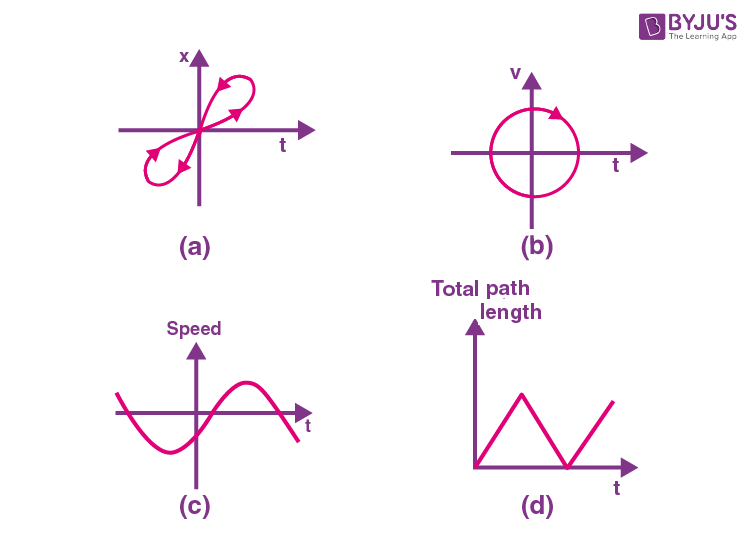
Look at the graphs (a) to (d) carefully and state, with reasons, which of these cannot possibly represent the one-dimensional motion of a particle? 

Motion in a straight line Image 5

Show solutionHide solution
Worked solution

None of the four graphs shows a one-dimensional motion. 

(a) Shows two positions at the same time, which is not possible. 

(b) A particle cannot have velocity in two directions at the same time.

(c) Graph shows negative speed, which is impossible. Speed is always positive.

(d) Path length decreases in the graph; this is also not possible.

Q17Written answer

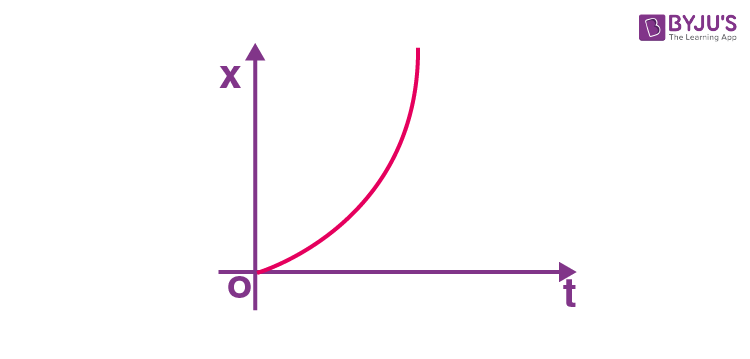
The figure shows the x-t plot of the one-dimensional motion of a particle. Is it correct to say from the graph that shows that the particle moves in a straight line for t < 0 and on a parabolic path for t >0? If not, suggest a suitable physical context for this graph.

Motion in a straight line Image 6

Show solutionHide solution
Worked solution

It is not correct to say that the particle moves in a straight line for t < 0 (i.e., -ve) and on a parabolic path for t > 0 (i.e., + ve) because the x-t graph does not represent the path of the particle.

A suitable physical context for the graph can be the particle is dropped from the top of a tower at t =0.

Q18Written answer

A police van moving on a highway with a speed of 30 km h–1 fires a bullet at a thief’s car speeding away in the same direction with a speed of 192 km h–1. If the muzzle speed of the bullet is 150 m s–1, with what speed does the bullet hit the thief’s car? (Note: Obtain that speed which is relevant for damaging the thief’s car).

Show solutionHide solution
Worked solution

Speed of the police van = 30 km/h = 30 x (5/18) = 25/3 m/s

Speed of a thief’s car = 192 km/h = 192 x (5/18) = 160/3 m/s

Muzzle Speed of  the bullet = 150 m/s

Speed of the bullet = speed of the police van + muzzle speed of  the bullet

= (25/3)+ 150 = 475/3 m/s

The relative velocity of the bullet w.r.t. the thief’s car is

v = Speed of the bullet – Speed of a thief’s car

= (475/3) – (160/3) = 105 m/s

The bullet hits the thief’s car at a speed of 105 m/s

Q19Written answer

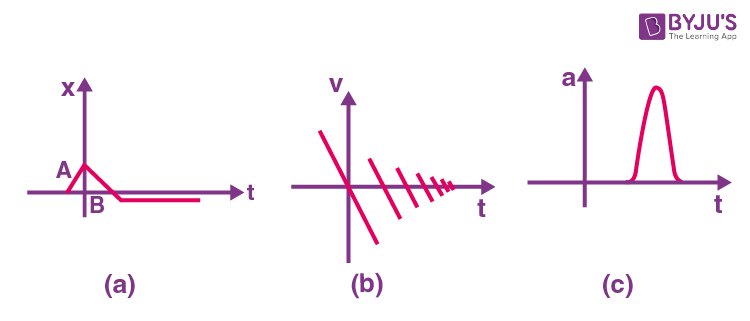
Suggest a suitable physical situation for each of the following graphs.

Motion in a straight line Image 6

Show solutionHide solution
Worked solution

(a)The graph is similar to kicking a ball, and then it hits the wall and rebounds with a reduced speed. The ball then moves in the opposite direction and hits the opposite wall, which stops the ball.
(b) The graph shows a continuous change in the velocity of the object, and at some instant, it losses some velocity. Therefore, it may represent a situation where a ball falls on the ground from a certain height and rebounds with a reduced speed.
(c) A cricket ball moving with a uniform speed is hit by a bat for a very short time interval.

Q20Written answer

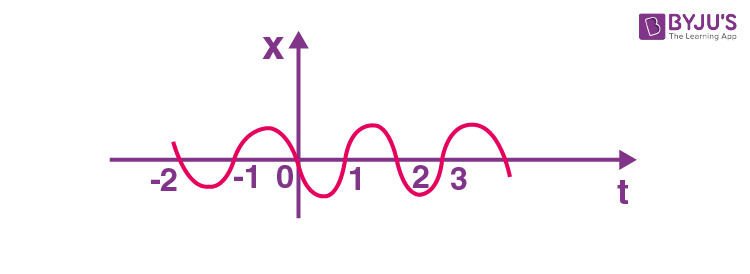
The following figure gives the x-t plot of a particle executing one-dimensional simple harmonic motion. Give the signs of position, velocity and acceleration variables of the particle at t = 0.3 s, 1.2 s, – 1.2 s.

Motion in a straight line Image 7

Show solutionHide solution
Worked solution

In S.H.M., acceleration, a = – ω2 x , ω is the angular frequency —-(1)
(i) At t = 0.3 s, x < 0, i.e. position is negative. Moreover, as x becomes more negative with time, it shows that velocity is negative (i.e., v < 0). However, using equation (1), acceleration will be positive.
(ii) At t = 1.2 s,  Positions and velocity will be positive. Acceleration will be negative.
(iii) At t = -1.2 s, Position, x is negative.  Velocity and acceleration will be positive.