My Cart
Your Cart 0

    Your cart is empty.

  • Total (Amount) ₹0.00
NCERT · Class 11 · Physics

Chapter 2: Motion in a Straight Line

Practice each question, then open the answer or worked solution.

Questions

28 questions
Q1Written answer

In which of the following examples of motion can the body be considered
approximately a point object?
(a) A railway carriage moving without jerks between two stations.
(b) A cap on top of a man cycling smoothly on a circular track.
(c) A spinning cricket ball that turns sharply on hitting the ground.
(d) A tumbling beaker that has slipped off the edge of a table.

Show solutionHide solution
Worked solution

(a), (b) The size of the railway carriage and the cap is very small as compared to the distance they’ve travelled, i.e. the distance between the two stations and the length of the race track, respectively. Therefore, the cap and the carriage can be considered as point objects.

The size of the cricket ball is comparable to the distance through which it bounces off after hitting the floor. Thus, the cricket ball cannot be treated as a point object. Likewise, the size of the beaker is comparable to the height of the table from which it drops.  Thus, the beaker cannot be treated as a point object.
Q2Written answer

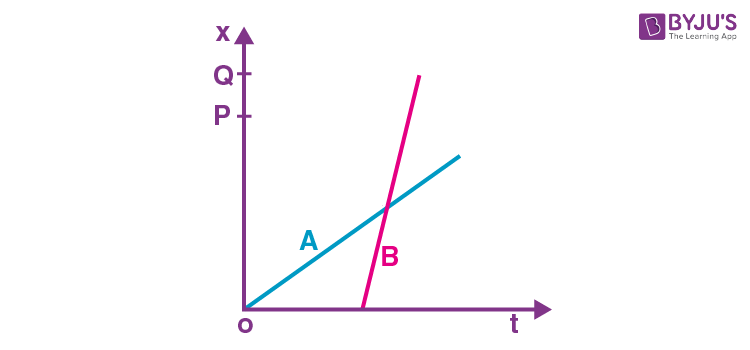
The position-time (x-t) graphs for two children, A and B, returning from their school O to their homes, P and Q, respectively, are shown in Fig. Choose the correct entries in the brackets below:
(a) (A/B) lives closer to the school than (B/A)
(b) (A/B) starts from the school earlier than (B/A)
(c) (A/B) walks faster than (B/A)
(d) A and B reach home at the (same/different) time
(e) (A/B) overtakes (B/A) on the road (once/twice).

Motion in a straight line image 1

Show solutionHide solution
Worked solution

(a) A lives closer to the school than B, because A has to cover shorter distances [OP < OQ].
(b) A starts from school earlier than B, because for x= 0, t = 0 for A but for B, t has some finite time.
(c) The slope of B is greater than that of A; therefore, B walks faster than A.
(d) Both A and B will reach their home at the same time.
(e) At the point of intersection, B overtakes A on the roads once.

Q3Written answer

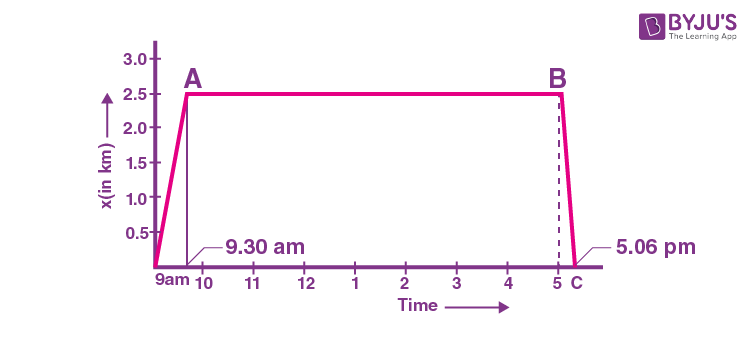
A woman starts from her home at 9.00 am, walks at a speed of 5 km/h on a straight road up to her office 2.5 km away, stays at the office up to 5.00 pm, and returns home by auto at a speed of 25 km/h. Choose suitable scales and plot the x-t graph of her motion.

Motion in a straight line Image 2

Show solutionHide solution
Worked solution

Distance to her office = 2.5 km.
Walking speed the woman = 5 km/h
Time taken to reach office while walking = (2.5/5 ) h=(1/2) h = 30 minutes

Speed of auto = 25 km/h

Time taken to reach home in auto = 2.5/25 = (1/10) h = 0.1 h = 6 minutes

In the graph, O is taken as the origin of the distance and the time, then at  t = 9.00 am, x = 0
and at t = 9.30 am, x = 2.5 km

OA is the portion on the x-t graph that represents her walk from home to the office. AB represents her time of stay in the office from 9.30 to 5. Her return journey is represented by BC.

Q4Written answer

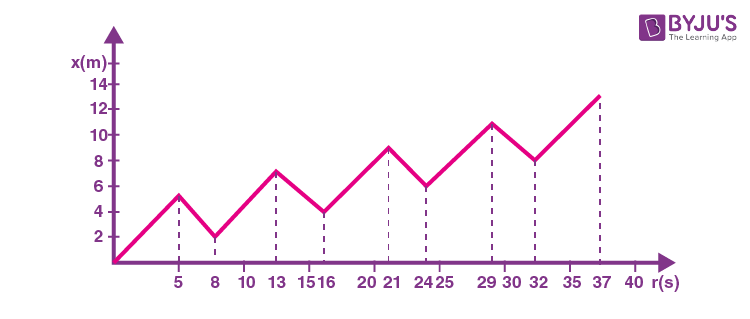
A drunkard walking in a narrow lane takes 5 steps forward and 3 steps backwards, followed again by 5 steps forward and 3 steps backwards, and so on. Each step is 1 m long and requires 1 s. Plot the x-t graph of his motion. Determine graphically and otherwise how long the drunkard takes to fall in a pit 13 m away from the start.

Motion in a straight line Image 3

Show solutionHide solution
Worked solution

The time taken to go one step is 1 second. In 5 s, he moves forward through a distance of 5 m, and then in the next 3s, he comes back by 3 m. Therefore,  in 8 s, he covers 2 m. So, to cover a distance of 8 m, he takes 32 s. He must take another 5 steps forward to fall into the pit. So, the total time taken is 32 s + 5 s = 37 s to fall into a pit 13 m away.

Q5Written answer

A jet aeroplane travelling at the speed of 500 km/h ejects its products of combustion at the speed of 1500 km/h relative to the jet plane. What is the speed of the latter with respect to an observer on the ground?

Show solutionHide solution
Worked solution
Speed of the jet aeroplane, VA= 500 km/h
The speed at which the combustion products are ejected relative to the jet plane, VB – VA
= – 1500 km/h
(The negative sign indicates that the combustion products move in a direction opposite to that of the jet)
Speed of combustion products w.r.t. observer on the ground, VB – 500 = – 1500
VB = – 1500 + 500 = – 1000 km/h
Q6Written answer

A car moving along a straight highway with a speed of 126 km h–1 is brought to a stop within a distance of 200 m. What is the retardation of the car (assumed uniform), and how long does it take for the car to stop?

Show solutionHide solution
Worked solution

The initial velocity of the car = u

The final velocity of the car = v

Distance covered by the car before coming to rest = 200 m

Using the equation,

v = u + at

t = (v – u)/a = 11.44 sec.

Therefore, it takes 11.44 sec for the car to stop.

Q7Written answer

Two trains, A and B, of length 400 m each, are moving on two parallel tracks with a
uniform speed of 72 km h–1 in the same direction, with A ahead of B. The driver of
B decides to overtake A and accelerates by 1 m s–2. If, after 50 s, the guard of B just
brushes past the driver of A, what was the original distance between them?

Show solutionHide solution
Worked solution

Length of trains A and B = 400 m

Speed of both the trains = 72 km/h = 72 x (5/18) = 20m/s

Using the relation, s = ut + (1/2)at2

Distance covered by the train B

SB = uBt + (1/2)at2

Acceleration, a = 1 m/s

Time = 50 s

SB = (20 x 50) + (1/2) x 1 x (50)2

= 2250 m

Distance covered by the train A

SA = uAt + (1/2)at2

Acceleration, a = 0

SA = uAt  = 20 x 50 = 1000 m

Therefore, the original distance between the two trains = SB – SA = 2250 – 1000 = 1250 m

Q8Written answer

On a two-lane road, car A is travelling at a speed of 36 km/h. Two cars, B and
C, approach car A in opposite directions with a speed of 54 km/h each. At a
certain instant, when the distance AB is equal to AC, both being 1 km, B decides
to overtake A before C does. What is the minimum acceleration of car B required to
avoid an accident?

Show solutionHide solution
Worked solution

The speed of car A = 36 km/h = 36 x (5/8) = 10 m/s

Speed of car B = 54 km/h = 54 x (5/18) = 15 m/s

Speed of car C = – 54 km/h = -54 x (5/18) = -15 m/s (negative sign shows B and C are in opposite directions)

Relative speed of A w.r.t. C, VAC = VA – VB = 10 – (-15) = 25 m/s

Relative speed of B w.r.t. A, VBA = VB – VA = 15 – 10 = 5 m/s

Distance between AB = Distance between AC = 1 km = 1000 m

Time taken by the car C to cover the distance AC, t = 1000/VAC = 1000/ 25 = 40 s

If a is the acceleration, then

s = ut + (1/2) at2

1000 = (5 x 40) + (1/2) a (40) 2

a = (1000 – 200)/ 800 = 1 m/s2

Thus, the minimum acceleration of car B required to avoid an accident is 1 m/s2

Q9Written answer

Two towns, A and B, are connected by regular bus service, with a bus leaving in either direction every T minutes. A man cycling with a speed of 20 km h–1 in the direction A to B notices that a bus goes past him every 18 min in the direction of his motion and every 6 min in the opposite direction. What is the period T of the bus service, and with what speed (assumed constant) do the buses ply on the road?

Show solutionHide solution
Worked solution

Speed of each bus = Vb

Speed of the cyclist = Vc = 20 km/h

The relative velocity of the buses plying in the direction of motion of the cyclist is Vb – Vc.
The buses playing in the direction of motion of the cyclist go past him after every 18 minutes, i.e. (18/60) s.

Distance covered = (Vb – Vc ) x 18/60

Since the buses are leaving every T minutes. Therefore, the distance is equal to Vb x (T/60)

(Vb – Vc ) x 18/60 = Vb x (T/60) ——(1)

The relative velocity of the buses plying in the direction opposite to the motion of the cyclist is Vb + Vc
The buses go past the cyclist every 6 minutes, i.e. (6/60) s.

Distance covered = (Vb + Vc ) x 6/60

Therefore, (Vb +Vc ) x 6/60 = Vb x (T/60)——(2)

Dividing (2) by (1)

bcbcbb

(Vb – Vc ) 18/(Vb +Vc ) 6 = 1

(Vb – Vc )3 = (Vb +Vc )

Substituting  the value of Vc

(Vb – 20 )3= (Vb + 20 )

3Vb – 60 = Vb + 20

2Vb = 80

Vb = 80/2 = 40 km/h

To find the value of T, substitute the values of Vb and Vc in equation (1)

(Vb – Vc ) x 18/60 = Vb x (T/60)

(40 – 20) x (18/60) = 40 x (T/60)

T = (20 x 18) /40 = 9 minutes

Q10Written answer

A player throws a ball upwards with an initial speed of 29.4 m/s.
(a) What is the direction of acceleration during the upward motion of the ball?
(b) What are the velocity and acceleration of the ball at the highest point of its motion?
(c) Choose the x = 0 m and t = 0 s to be the location and time of the ball at its highest point, vertically downward direction to be the positive direction of the x-axis, and give the signs of position, velocity and acceleration of the ball during its upward and downward motion.
(d) To what height does the ball rise, and after how long does the ball return to the player’s hands? (Take g = 9.8 m s–2 and neglect air resistance).

Show solutionHide solution
Worked solution

(a) The acceleration due to gravity always acts downwards towards the centre of the Earth.
(b) At the highest point of its motion, the velocity of the ball will be zero, but the acceleration due to gravity will be 9.8 m s–2  acting vertically downward.
(c) If we consider the highest point of ball motion as x = 0, t = 0, and vertically downward direction to be +ve direction of the x-axis, then
(i) During the upward motion of the ball before reaching the highest point position, x = +ve, velocity, v = -ve and acceleration, a = +ve.
(ii) During the downward motion of the ball after reaching the highest point position, velocity and acceleration, all three quantities are positive.
(d) Initial speed of the ball, u= -29.4 m/s

The final velocity of the ball, v = 0

Acceleration = 9.8 m/s2

Applying in the equation v2 – u2 = 2gs

0 – (-29.4)2 = 2 (9.8) s

s = – 864.36/19.6 = – 44.1

Height to which the ball rises = – 44.1 m (negative sign represents upward direction)

Considering the equation of motion

v = u + at

0 = (-29.4) + 9.8t

t = 29.4/9.8 = 3 seconds

Therefore, the total time taken for the ball to return to the player’s hands is 3 +3 = 6 s.