An aircraft is flying at a height of 3400 m above the ground. If the angle subtended at a ground observation point by the aircraft positions 10.0 s apart is 30°, what is the speed of the aircraft?
Ans:
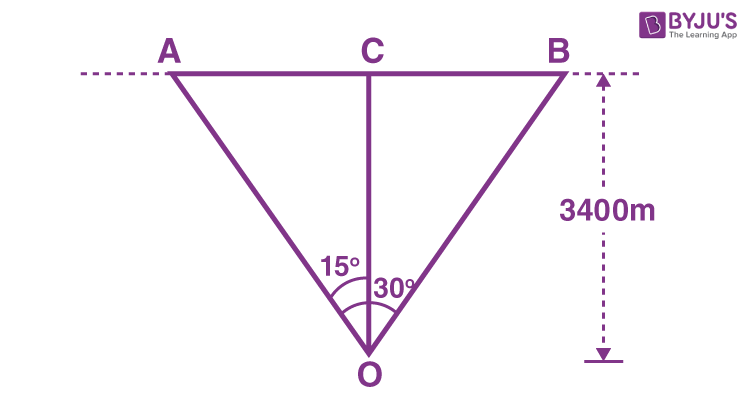
Height at which the aircraft is flying = 3400 m
Let A and B be the positions of the aircraft, making an angle ∠AOB = 300. The perpendicular OC is drawn on AB. Here, OC is the height of the aircraft, which is equal to 3400 m and ∠AOC = ∠COB = 150.
In the ΔAOC, AC = OC tan 150 = 3400 x 0.267 = 910.86 m
AB = AC + CB = AC + AC = 2 AC = 2 x 910.86 m
Speed of the aircraft = distance AB/time = (2 x 910.86)/10= 182.17 m/s =182.2 m/s
Q-26: Does a vector have a location in space? Will it fluctuate with time? Can two equivalent vectors, x and y, at various locations in space fundamentally have indistinguishable physical effects? Give cases in support of your answer.
Ans:
No, Yes and No.
A vector in space has no distinct location. The reason behind this is that a vector stays invariant when it displaces in a way that its direction and magnitude do not change. Although, a position vector has a distinct location in space.
A vector changes with time. For instance, the velocity vector of a ball moving with a specific speed fluctuates with time.
Two equivalent vectors situated at different locations in space do not generate the same physical effect. For instance, two equivalent forces acting at different points on a body tend to rotate the body, but the combination will not generate the equivalent turning effect.
Q-27: As a vector is having both direction and magnitude, then is it necessary that if anything is having direction and magnitude, it is termed as a vector? The rotation of an object is defined by the angle of rotation about the axis and the direction of rotation of the axis. Will it be a rotation of a vector?
Ans:
No and no
A physical quantity which is having both direction and magnitude is not necessarily a vector. For instance, in spite of having direction and magnitude, the current is a scalar quantity. The basic necessity for a physical quantity to fall in a vector category is that it ought to follow the “law of vector addition”.
As the rotation of a body about an axis does not follow the basic necessity to be a vector, i.e., it does not follow the “law of vector addition”, so it is not a vector quantity. Although in some cases, rotation of a body about an axis by a small angle follows the law of vector addition, so it is termed a vector.
Q-28: Can we associate a vector with
(i) a sphere
(ii) the length of a wire bent into a loop
(iii) a plane area
Clarify for the same.
Ans.
No, No, Yes
(i) We can’t associate the volume of a sphere with a vector, but the area of a sphere can be associated with an area vector.
(ii) We can’t associate the length of a wire bent into a loop with a vector.
(iii) We can associate a plane area with a vector.
Q. 29. A bullet fired at an angle of 30° with the horizontal hits the ground 3.0 km away. By adjusting its angle of projection, can one hope to hit a target 5.0 km away? Assume the muzzle speed to be fixed, and neglect air resistance.
Ans:
A bullet is fired at an angle = 30°
The bullet hits the ground at a distance of 3km = 3000 m
Horizontal range, R = u2 sin2θ/g
3000 = u2 sin 600/9.8
u2 = (3000 x 9.8)/(√3/2)
= 2 (3000 x 9.8)/√3 = 58800/1.732 = 33949
Also, R’ = u2 sin 2θ/g ⇒ 5000 = (33949 x sin2θ)/9.8
Sin 2θ = (5000 x 9.8)/33949 = 49000/33949 =1.44
The sine of an angle cannot be more than 1. Therefore, a target 5 km away cannot be hit
Q. 30. A fighter plane flying horizontally at an altitude of 1.5 km with a speed of 720 km/h passes directly overhead an anti-aircraft gun. At what angle from the vertical should the gun be fired for the shell with muzzle speed 600 m s-1 to hit the plane? At what minimum altitude should the pilot fly the plane to avoid being hit? (Take g = 10 m s-2 ).
Ans:
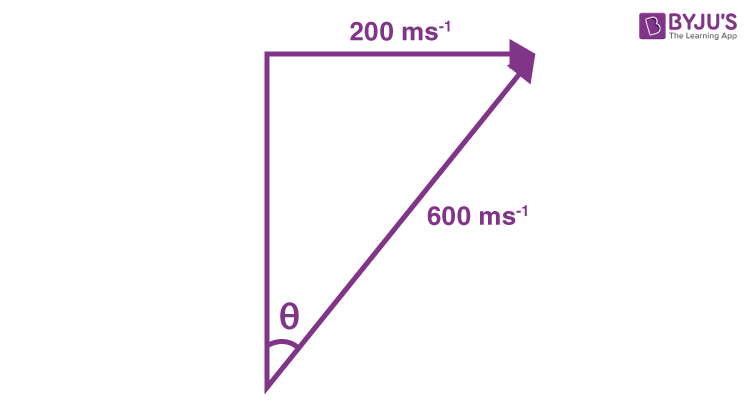
Speed of the fighter plane = 720 km/h = 720 x (5/18) = 200 m/s
The altitude of the plane = 1.5 km
Velocity of the shell = 600 m/s
Sin θ = 200/600 = 1/3
θ = sin-1 (1/3) = 19.470
Let H be the minimum altitude.
Using equation,
H = u2 sin2 (90 – θ)/2g
= (6002 cos2θ)/2g
= 6002 cos 2θ/(2 x 9.8)= {360000[(1+cos 2θ)/2]}/2g
= 360000[1+cos2 (19.470)/2]/2g
= 360000[ (1 + cos 38.94)/2]/(2 x 9.8)
= 360000 [ (1 + 0.778)/2]/19.6
= 360000 [(1.778/2)]/19.6
= (360000 x 0.889) /19.6
= 320040/19.6
= 16328 m = 16.328 km
Q. 31. A cyclist is riding with a speed of 27 km/h. As he approaches a circular turn on the road of a radius of 80 m, he applies brakes and reduces his speed at the constant rate of 0.50 m/s every second. What is the magnitude and direction of the net acceleration of the cyclist on the circular turn?
Ans:
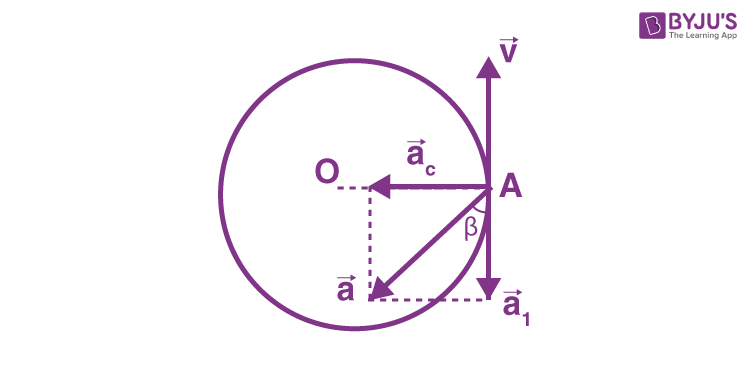
Speed of the cyclist = 27 km/h = 27 x (5/18) = 7.5 m/s
The radius of the road = 80 m
The net acceleration is due to the braking and the centripetal acceleration.
Due to braking, a = 0.50 m/s2
Centripetal acceleration, a = v2/2 = (7.5)2/80 = 0.70 m/s2
Since the angle between ac and aT is 90o, the resultant acceleration is given by
= 0.86 m/s2
and tan β = ac/at = 0.7/0.5 = 1.4
β = tan -1 (1.4) = 54.50 from the direction of velocity
Q.32. (a) Show that for a projectile, the angle between the velocity and the x-axis as a function of time is given by
(b) Shows that the projection angle θ0 for a projectile launched from the origin is given by
where the symbols have their usual meaning
Ans:
(a) Let θ be the angle at which the projectile is fired w.r.t the x-axis
θ depends on t
Therefore, tan θ(t) = vx/vy = (voy – gt)/v0x (since vy = v0y -gt and vx =vox)
θ(t) = tan -1 ((voy – gt)/v0x)
(b) Since, hmax = u2 sin2θ/2g —–(1)
R = u2sin2θ/g——–(2)
Dividing (1) by (2)
(hmax/R) = [u2 sin2θ/2g]/[ u2sin2θ/g] = tan θ/4
θ = tan-1 (4 hmax/R)
Show solutionHide solution
Solution coming soon.