My Cart
Your Cart 0

    Your cart is empty.

  • Total (Amount) ₹0.00
NCERT · Class 11 · Physics

Chapter 2: Motion in a Straight Line

Practice each question, then open the answer or worked solution.

Questions

28 questions
Q21Written answer

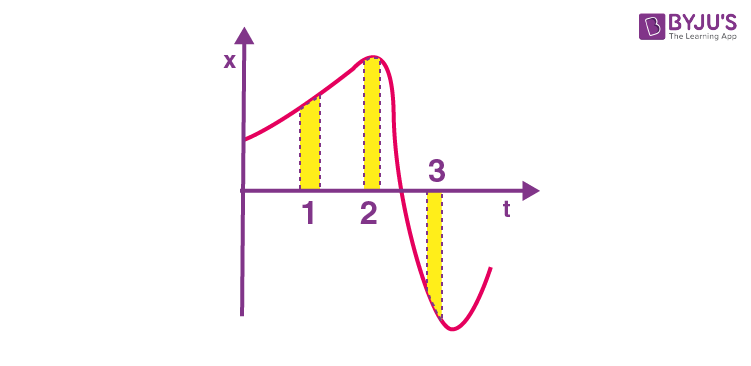
The figure gives the x-t plot of a particle in one-dimensional motion. Three different equal intervals of time are shown. In which interval is the average speed greatest, and in which is it the least? Give the sign of average velocity for each interval.

Motion in a straight line Image 8

Show solutionHide solution
Worked solution

Interval 3 is the greatest, and 2 is the least. The average velocity is positive for intervals 1 and 2, and it is negative for interval 3.

Q22Written answer

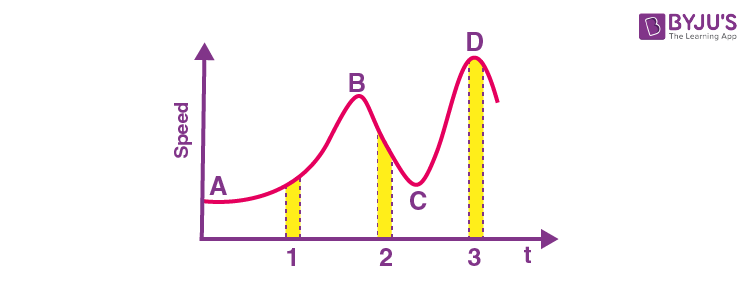
The following figure gives a speed-time graph of a particle in motion along a constant direction. Three equal intervals of time are shown. In which interval is the average acceleration greatest in magnitude? In which interval is the average speed greatest? Choosing the positive direction as the constant direction of motion gives the signs of v and a in the three intervals. What are the accelerations at points A, B, C and D?

Motion in a straight line Image 9

Show solutionHide solution
Worked solution

The change in the speed with time is maximum in interval 2. Therefore, the average acceleration is greatest in magnitude in interval 2.

The average speed is maximum in interval 3.

The sign of velocity is positive in intervals 1, 2 and 3. The acceleration depends on the slope. The acceleration is positive in intervals 1 and interval 3, as the slope is positive. The acceleration is negative in interval 2, as the slope is negative.

Acceleration at A, B, C and D is zero since the slope is parallel to the time axis at these instants.

Q23Written answer

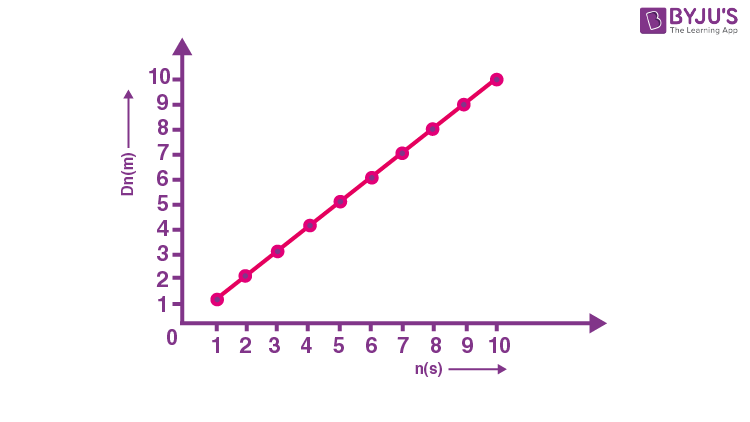
A three-wheeler starts from rest, accelerates uniformly with 1 m s–2 on a straight road for 10 s, and then moves with uniform velocity. Plot the distance covered by the vehicle during the nth second (n = 1,2,3….) versus n. What do you expect this plot to be during accelerated motion: a straight line or a parabola?

Show solutionHide solution
Worked solution

For a straight line, the distance covered by a body in nth second is:
SN = u + a (2n – 1)/2     . . . . . . . . ( 1 )
Where,

a = Acceleration

u = Initial velocity
n = Time = 1, 2, 3, . . . . . , n
In the above  case,
a = 1 m/s2 and u = 0.
∴ SN = (2n – 1) / 2     . . . . . . . . . . .( 2 )
This relation shows that:
SN ∝ n                             . . . . .. . . . . ( 3 )

Now substituting different values of n in equation ( 2 ) we get:

n 1 2 3 4 5 6 7 8 9
SN 0.5 1.5 2.5 3.5 4.5 5.5 6.5 7.5 8.5

NCERT Solutions for Class 11 Physics Chapter 3 Motion in A Straight Line Question 23 Solution
This plot is expected to be a straight line.

Q24Written answer

A boy, standing on a stationary lift (open from above), throws a ball upwards with the maximum initial speed he can, equal to 49 m s-1. How much time does the ball take to return to his hands? If the lift starts moving up with a uniform speed of 5 m s-1 and the boy again throws the ball up with the maximum speed he can, how long does the ball take to return to his hands?


Show solutionHide solution
Worked solution

The initial velocity of the ball, u = 49 m/s

Case: I

The boy throws the ball upwards when the lift is stationary. The vertically upward direction is taken as the positive direction. The displacement of the ball is zero.

Considering the equation of motion

s=ut + (1/2)at2

0 = (49)t + (1/2) (-9.8)t2

t = (49 x 2)/9.8 = 98/9.8 = 10 sec

Case: II

As the lift starts moving with a speed of 5 m/s, the initial speed of the ball will be 49 m/s + 5 m/s = 54 m/s

The displacement of the ball will be s =  5t’

Therefore, the time taken can be calculated using the formula

s = ut + (1/2) at2

5t’ = (54) t’ + (1/2)(-9.8) t’2

t’ = 2(54 – 5)/9.8 = 10 sec

The time taken will remain the same in both cases.

Q25Written answer

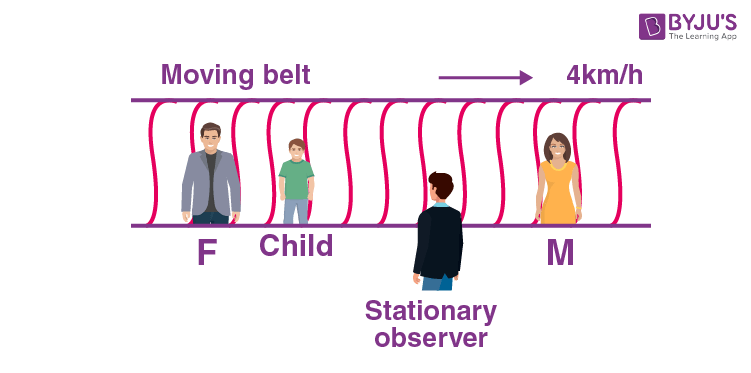
On a long, horizontally moving belt figure, a child runs to and fro with a speed 9 km h–1 (with respect to the belt) between his father and mother located 50 m apart on the moving belt. The belt moves at a speed of 4 km h–1. For an observer on a stationary platform outside, what is the
(a) speed of the child running in the direction of motion of the belt?
(b) speed of the child running opposite to the direction of motion of the belt?
(c) time taken by the child in (a) and (b)?
Which of the answers alter if motion is viewed by one of the parents?

Motion in a straight line Image 10

Show solutionHide solution
Worked solution

Speed of child = 9 km h-1

Speed of belt = 4 km h-1
(a) When the boy runs in the direction of motion of the belt, then his speed as observed by the stationary observer = (9 + 4) km h-1 = 13 km h-1.

(b) When the boy runs opposite to the direction of motion of the belt, then speed of the child as observed by the stationary observer = (9 – 4) km h-1 = 5 km h-1

(c) Distance between the two parents = 50 m = 0.05 km

The speed of the boy, as observed by both the parents, is 9 km h-1

Time taken by the boy to move towards one of the parents =0.05 km/9k h-1=0.0056 h =20 S

Q26Written answer

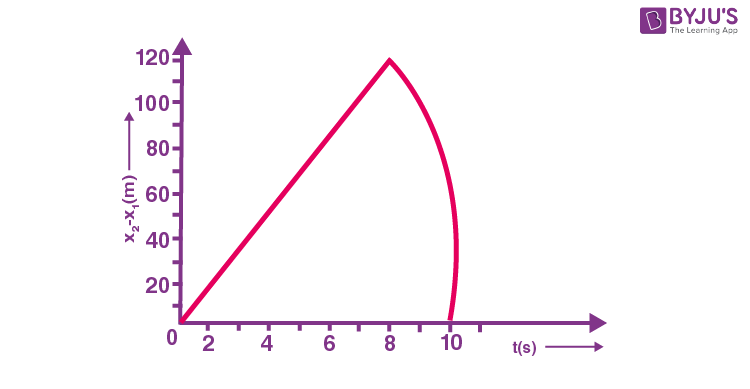
Two stones are thrown up simultaneously from the edge of a cliff 200 m high with initial speeds of 15 m s–1 and 30 m s–1. Verify that the graph shown in Fig. 3.27 correctly represents the time variation of the relative position of the second stone with respect to the first. Neglect air resistance and assume that the stones do not rebound after hitting the ground. Take g = 10 m s–2. Give the equations for the linear and curved parts of the plot.

NCERT Solutions for Class 11 Physics Chapter 3 Motion in A Straight Line Question 26


Show solutionHide solution
Worked solution

For the first stone:

Given,

Acceleration, a = –g = – 10 m/s2
Initial velocity, uI = 15 m/s

Now, we know
s1 = s0 + u1t + (1/2)at2
Given, the height of the tree, s0 = 200 m
s1 = 200 + 15t – 5t2      . . . . . . . . .  . ( 1 )
When this stone hits the jungle floor, s1 = 0
∴– 5t2 + 15t + 200 = 0
t2 – 3t – 40 = 0
t2 – 8t + 5t – 40 = 0
t (t – 8) + 5 (t – 8) = 0
t = 8 s or t = – 5 s
Since the stone was thrown at time t = 0, the negative sign is not possible
∴t = 8 s
For the second stone:

Given,

Acceleration, a = – g = – 10 m/s2
Initial velocity, uII = 30 m/s

We know,
s2 = s0 + uIIt + (1/2)at2
= 200 + 30t – 5t2 . . . . . . . . .  . . .  . ( 2 )
when this stone hits the jungle floor; s2 = 0
– 5t2 + 30 t + 200 = 0
t2 – 6t – 40 = 0
t2 – 10t + 4t + 40 = 0
t (t – 10) + 4 (t – 10) = 0
(t – 10) (t + 4) = 0
t = 10 s or t = – 4 s
Here again, the negative sign is not possible
∴ t = 10 s
Subtracting equation (1) from equation (2), we get
s2 – s1 = (200 + 30t -5t2) – (200 + 15t -5t2)
s2 – s1 =15t                                           . . .  . . . . . . . . . .. . . . . . ( 3 )
Equation (3) represents the linear trajectory of the two stones because to this linear relation between (s2 – s1) and t,  the projection is a straight line till 8 s.
The maximum distance between the two stones is at t = 8 s.
(s2 – s1)max = 15× 8 = 120 m
This value has been depicted correctly in the above graph.
After 8 s, only the second stone is in motion, whose variation with time is given by the quadratic equation:
s2 – s1 = 200 + 30t – 5t2
Therefore, the equation of linear and curved path is given by:
s2 – s1 = 15t (Linear path)

s2 ­– s1 = 200 + 30t – 5t2 (Curved path)

Q27Written answer

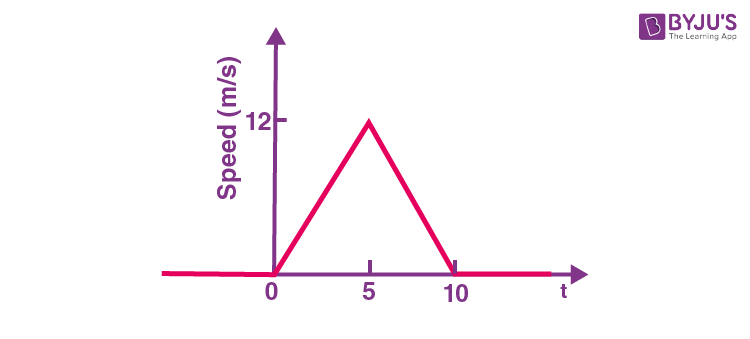
The speed-time graph of a particle moving along a fixed direction is shown in the figure. Obtain the distance traversed by the particle between

(a) t = 0 s to 10 s,
(b) t = 2 s to 6 s.

Motion in a straight line Image 11

Show solutionHide solution
Worked solution

(a) Distance traversed by the particle between t = 0 s and t = 10 s

= area of the triangle = (1/2) x base x height

= (1/2) x 10 x x12 = 60 m

The average speed of the particle is 60 m/ 10 s = 6 m/s

(b) The distance travelled by the particle between t = 2 s and t = 6 s

= Let S1 be the distance travelled by the particle in time 2 to 5 s and S2 be the distance travelled by the particle in time 5 to 6 s.

For the motion from 0 sec to 5 sec

Now, u = 0 , t = 5 , v = 12 m/s

From the equation v = u + at, we get

a = (v – u)/t = 12/ 5 = 2.4 m/s2

Distance covered from 2 to 5 s, S1 = distance covered in 5 sec – distance covered in 2 sec

= (1/2) a (5)2 – (1/2) a (2)2 = (1/2) x 2.4 x (25 – 4) = 1.2 x 21 = 25.2 m

For the motion from 5 sec to 10 sec, u = 12 m/s and a = -2.4 m/s2

and t = 5 sec to t = 6 sec means n = 1 for this motion

Distance covered in the 6 the sec is S2 = u + (1/2) a (2n – 1)

= 12 – (2.4/2) (2 x 1 – 1) = 10.8 m

Therefore, the total distance covered from t = 2 s to 6 s = S1 + S2

= 25.2 + 10.8 = 36 m
Q28Written answer

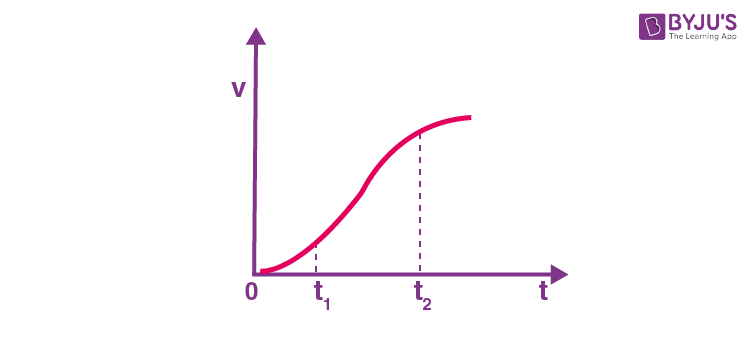
The velocity-time graph of a particle in one-dimensional motion is shown in the figure.

(a) x (t2) = x (t1) + v (t1) (t2 – t1) + (1/2) a(t2 – t1)2

(b) v(t2) = v(t1) + a(t2 – t1)

(c) Vaverage =  [ x(t2) – x (t1)] /(t2 – t1)

(d)  aaverage =  [ v(t2) – v (t1)] /(t2 – t1)

(e) x (t2) = x (t1) + vav (t2 – t1) + (1/2) aav (t2 – t1)2

(f) x(t2) – x (t1) = Area under the v-t curve bounded by t- axis and the dotted lines.

Motion in a straight line Image 12

Show solutionHide solution
Worked solution

The graph has a non-uniform slope between the intervals t1 and t2 (since the graph is not a straight line). The equations (a), (b) and (e) does not describe the motion of the particle. Only the relations (c), (d) and (f) are correct.