My Cart
Your Cart 0

    Your cart is empty.

  • Total (Amount) ₹0.00
NCERT · Class 11 · Maths

Chapter 9: Sequences and Series Exercise 9.2

Practice each question, then open the answer or worked solution.

Questions

18 questions
Q11Written answer

Sum of the first p, q and r terms of an A.P. are a, b and c, respectively. Prove that 

NCERT Solutions Class 11 Mathematics Chapter 9 ex.9.2 - 11

Show solutionHide solution
Worked solution

Let a1 and d be the first term and the common difference of the A.P., respectively.

Then according to the question, we have
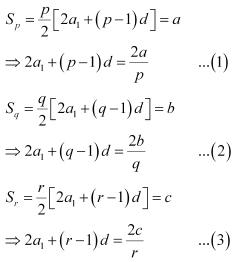
NCERT Solutions Class 11 Mathematics Chapter 9 ex.9.2 - 12

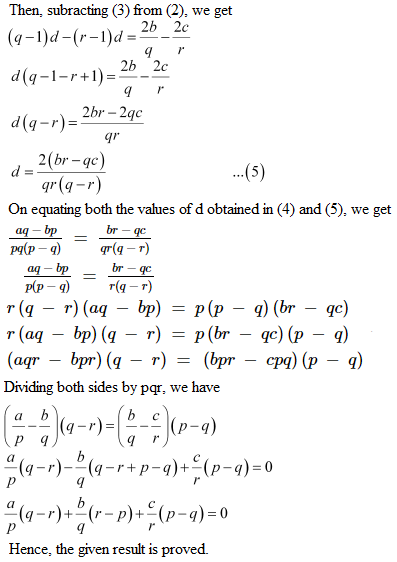
Now, subtracting (2) from (1), we get
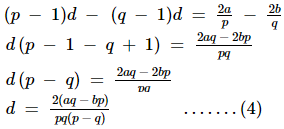
NCERT Solutions Class 11 Mathematics Chapter 9 ex.9.2 - 13

NCERT Solutions Class 11 Mathematics Chapter 9 ex.9.2 - 14

Q12Written answer

The ratio of the sums of m and n terms of an A.P. is m2: n2. Show that the ratio of mth and nth term is (2m – 1): (2n – 1).

Show solutionHide solution
Worked solution

Let’s consider a and b to be the first term and the common difference of the A.P., respectively.

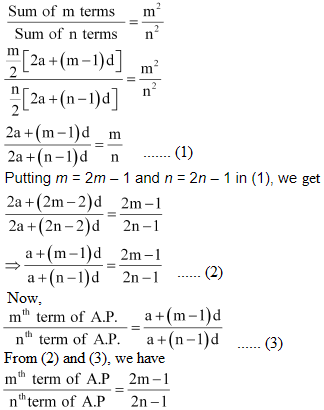
Then from the question, we have

NCERT Solutions Class 11 Mathematics Chapter 9 ex.9.2 - 15

Hence, the given result is proved.

Q13Written answer

If the sum of n terms of an A.P. is 3n2 + 5n and its mth term is 164, find the value of m.

Show solutionHide solution
Worked solution

Let’s consider a and b to be the first term and the common difference of the A.P., respectively.

am = a + (m – 1)d = 164 … (1)

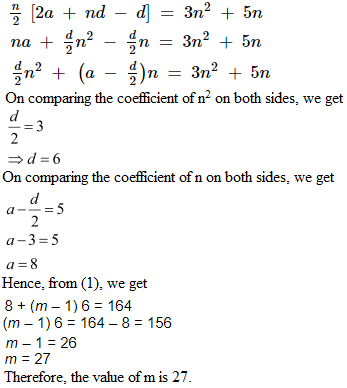
The sum of the terms is given by,

Sn = n/2 [2a + (n-1)d]

NCERT Solutions Class 11 Mathematics Chapter 9 ex.9.2 - 17

Q14Written answer

Insert five numbers between 8 and 26 such that the resulting sequence is an A.P.

Show solutionHide solution
Worked solution

Let’s assume A1, A2, A3, A4, and A5 to be five numbers between 8 and 26 such that 8, A1, A2, A3, A4, A5, and 26 are in an A.P.

Here we have,

a = 8, b = 26, n = 7

So,

26 = 8 + (7 – 1) d

6d = 26 – 8 = 18

d = 3

Now,

A1 = a + d = 8 + 3 = 11

A2 = a + 2d = 8 + 2 × 3 = 8 + 6 = 14

A3 = a + 3d = 8 + 3 × 3 = 8 + 9 = 17

A4 = a + 4d = 8 + 4 × 3 = 8 + 12 = 20

A5 = a + 5d = 8 + 5 × 3 = 8 + 15 = 23

Therefore, the required five numbers between 8 and 26 are 11, 14, 17, 20, and 23.

Q15Written answer

If NCERT Solutions Class 11 Mathematics Chapter 9 ex.9.2 - 18is the A.M. between a and b, then find the value of n.
Show solutionHide solution
Worked solution

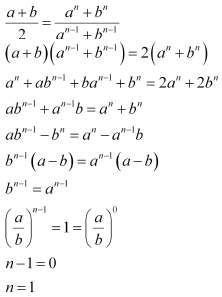
The A.M. between a and b is given by, (a + b)/2

Then according to the question,

NCERT Solutions Class 11 Mathematics Chapter 9 ex.9.2 - 19

Thus, the value of n is 1.

Q16Written answer

Between 1 and 31, m numbers have been inserted in such a way that the resulting sequence is an A.P. and the ratio of 7th and (m – 1)th numbers is 5:9. Find the value of m.

Show solutionHide solution
Worked solution

Let’s consider a1, a2, … am be m numbers such that 1, a1, a2, … am, 31 is an A.P.

And here,

a = 1, b = 31, n = m + 2

So, 31 = 1 + (m + 2 – 1) (d)

30 = (m + 1) d

d = 30/ (m + 1) ……. (1)

Now,

a1 = a + d

a2 = a + 2d

a3 = a + 3d …

Hence, a7 = a + 7d

am–1 = a + (m – 1) d

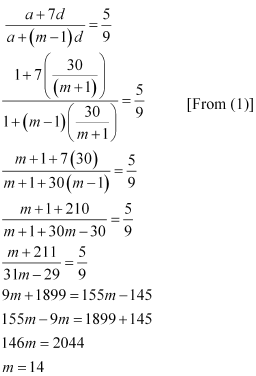
According to the question, we have

NCERT Solutions Class 11 Mathematics Chapter 9 ex.9.2 - 20

Therefore, the value of m is 14.

Q17Written answer

A man starts repaying a loan as the first instalment of Rs. 100. If he increases the instalment by Rs. 5 every month, what amount will he pay in the 30th instalment?

Show solutionHide solution
Worked solution

Given,

The first instalment of the loan is Rs. 100.

The second instalment of the loan is Rs. 105, and so on, as the instalment increases by Rs. 5 every month.

Thus, the amount that the man repays every month forms an A.P.

And the A.P. is 100, 105, 110, …

Where, the first term, a = 100

The common difference, d = 5

So, the 30th term in this A.P. will be

A30  = a + (30 – 1)d

= 100 + (29) (5)

= 100 + 145

= 245

Therefore, the amount to be paid in the 30th instalment will be Rs. 245.

Q18Written answer

The difference between any two consecutive interior angles of a polygon is 5°. If the smallest angle is 120°, find the number of the sides of the polygon.

Show solutionHide solution
Worked solution

It’s understood from the question that the angles of the polygon will form an A.P. with a common difference d = 5° and first term a = 120°.

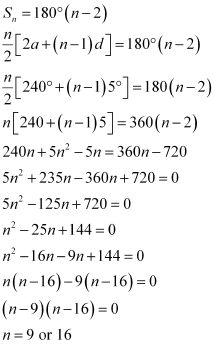
And, we know that the sum of all angles of a polygon with n sides is 180° (n – 2).

Thus, we can say

NCERT Solutions Class 11 Mathematics Chapter 9 ex.9.2 - 21

Thus, a polygon having 9 and 16 sides will satisfy the condition in the question.