My Cart
Your Cart 0

    Your cart is empty.

  • Total (Amount) ₹0.00
NCERT · Class 11 · Maths

Chapter 6: Linear Inequalities Exercise 6.3

Practice each question, then open the answer or worked solution.

Questions

15 questions
Q1Written answer

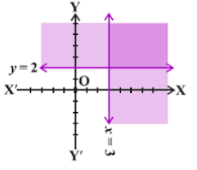
x ≥ 3, y ≥ 2


Show solutionHide solution
Worked solution

Given x ≥ 3……… (i)

y ≥ 2…………… (ii)

Since x ≥ 3 means for any value of y, the equation will be unaffected, so similarly, for y ≥ 2, for any value of x, the equation will be unaffected.

Now putting x = 0 in the (i)

0 ≥ 3, which is not true

Putting y = 0 in (ii)

0 ≥ 2, which is not true again

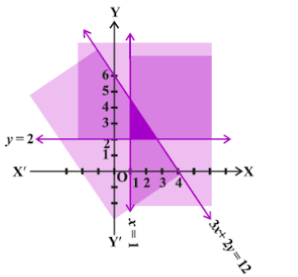
This implies the origin doesn’t satisfy the given inequalities. The region to be included will be on the right side of the two equalities drawn on the graphs.

The shaded region is the desired region.
ncert-sol-c11-maths-chapter-6-ex-3-img-1

Q2Written answer

3x + 2y ≤ 12, x ≥ 1, y ≥ 2


Show solutionHide solution
Worked solution

Given 3x+ 2y ≤ 12

Solving for the value of x and y by putting x = 0 and y = 0 one by one,

We get

y = 6 and x = 4

So the points are (0, 6) and (4, 0)

Now checking for (0, 0)

0 ≤ 12, which is also true

Hence the origin lies in the plane and the required area is toward the left of the equation.

Now checking for x ≥ 1,

The value of x would be unaffected by any value of y

The origin would not lie on the plane

⇒ 0 ≥ 1, which is not true

The required area to be included would be on the left of the graph x ≥1

Similarly, for y ≥ 2

The value of y will be unaffected by any value of x in the given equality. Also, the origin doesn’t satisfy the given inequality.

⇒ 0 ≥ 2, which is not true; hence origin is not included in the solution of the inequality.

The region to be included in the solution would be towards the left of the equality y≥ 2

The shaded region in the graph will give the answer to the required inequalities as it is the region which is covered by all the given three inequalities at the same time while satisfying all the given conditions.

ncert-sol-c11-maths-chapter-6-ex-3-img-2

Q3Written answer

2x + y ≥ 6, 3x + 4y ≤ 12


Show solutionHide solution
Worked solution

Given 2x + y ≥ 6…………… (i)

3x + 4y ≤ 12 ……………. (ii)

2x + y ≥ 6

Putting values of x = 0 and y = 0 in the equation one by one, we get values of

y = 6 and x = 3

So the point for the (0, 6) and (3, 0)

Now checking for (0, 0)

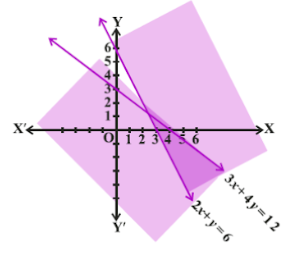
0 ≥ 6, which is not true; hence the origin does not lie in the solution of equality. The required region is on the right side of the graph.

Checking for 3x + 4y ≤ 12

Putting values of x= 0 and y = 0 one by one in the equation

We get y = 3, x = 4

The points are (0, 3), (4, 0)

Now checking for origin (0, 0)

0 ≤ 12, which is true,

So the origin lies in the solution of the equation.

The region on the right of the equation is the region required.

The solution is the region which is common to the graphs of both inequalities.

The shaded region is the required region.

ncert-sol-c11-maths-chapter-6-ex-3-img-3

Q4Written answer

x + y ≥ 4, 2x – y < 0


Show solutionHide solution
Worked solution

Given x + y ≥ 4

Putting values of x = 0 and y = 0 in the equation one by one, we get values of

y = 4 and x = 4

The points for the line are (0, 4) and (4, 0)

Checking for the origin (0, 0)

0 ≥ 4

This is not true,

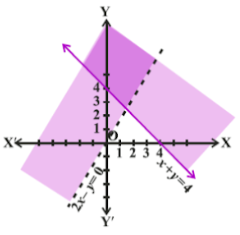
So the origin would not lie in the solution area. The required region would be on the right of the line graph.

2x – y < 0

Putting values of x = 0 and y = 0 in the equation one by one, we get values of

y= 0 and x = 0

Putting x = 1 we get y = 2

So the points for the given inequality are (0, 0) and (1, 2)

Now that the origin lies on the given equation, we will check for the (4, 0) point to check which side of the line graph will be included in the solution.

⇒ 8 < 0, which is not true, hence the required region would be on the left side of the line 2x-y < 0

The shaded region is the required solution to the inequalities.

ncert-sol-c11-maths-chapter-6-ex-3-img-4

Q5Written answer

2x – y >1, x – 2y < – 1


Show solutionHide solution
Worked solution

Given 2x – y >1……………… (i)

Putting values of x = 0 and y = 0 in the equation one by one, we get values of

y = -1 and x = 1/2 = 0.5

The points are (0,-1) and (0.5, 0)

Checking for the origin, putting (0, 0)

0 >1, which is false

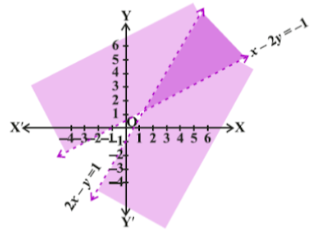
Hence the origin does not lie in the solution region. The required region would be on the right of the line graph.

x – 2y < – 1………… (ii)

Putting values of x = 0 and y = 0 in the equation one by one, we get values of

y = ½ = 0.5 and x = -1

The required points are (0, 0.5) and (-1, 0)

Now checking for the origin, (0, 0)

0 < -1, which is false

Hence, the origin does not lie in the solution area, the required area would be on the left side of the line graph.

∴ the shaded area is the required solution for the given inequalities.

ncert-sol-c11-maths-chapter-6-ex-3-img-5

Q6Written answer

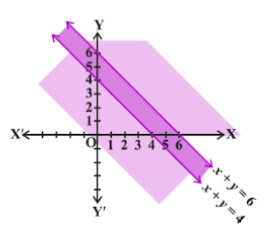
x + y ≤ 6, x + y ≥ 4


Show solutionHide solution
Worked solution

Given x + y ≤ 6,

Putting values of x = 0 and y = 0 in the equation one by one, we get values of

Y = 6 and x = 6

The required points are (0, 6) and (6, 0)

Checking further for origin (0, 0)

We get 0 ≤ 6; this is true.

Hence, the origin would be included in the area of the line graph. So the required solution of the equation would be on the left side of the line graph, which will be including the origin.

x + y ≥ 4

Putting values of x = 0 and y = 0 in the equation one by one, we get values of

y = 4 and x = 4

The required points are (0, 4) and (4, 0)

Checking for the origin (0, 0)

0 ≥ 4, which is false

So the origin would not be included in the required area. The solution area will be above the line graph or the area on the right of the line graph.

Hence the shaded area in the graph is the required graph area.

ncert-sol-c11-maths-chapter-6-ex-3-img-6

Q7Written answer

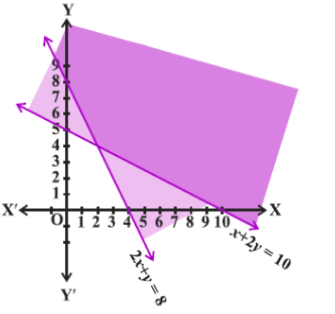
2x + y ≥ 8, x + 2y ≥ 10


Show solutionHide solution
Worked solution

Given 2x + y ≥ 8

Putting values of x = 0 and y = 0 in the equation one by one, we get values of

y = 8 and x = 4

The required points are (0, 8) and (4, 0)

Checking if the origin is included in the line graph (0, 0)

0 ≥ 8, which is false

Hence, the origin is not included in the solution area, and the required area would be the area to the right of the line graph.

x + 2y ≥ 10

Putting values of x = 0 and y = 0 in the equation one by one, we get values of

y = 5 and x = 10

The required points are (0, 5) and (10, 0)

Checking for the origin (0, 0)

0 ≥ 10, which is false,

Hence, the origin would not lie in the required solution area. The required area would be to the left of the line graph.

The shaded area in the graph is the required solution for the given inequalities.

ncert-sol-c11-maths-chapter-6-ex-3-img-7

Q8Written answer

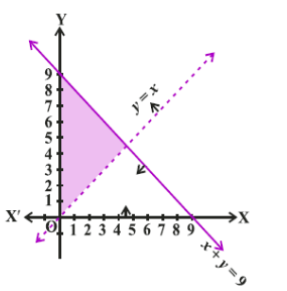
x + y ≤ 9, y > x, x ≥ 0


Show solutionHide solution
Worked solution

Given x + y ≤ 9,

Putting values of x = 0 and y = 0 in the equation one by one, we get values of

y = 9 and x = 9

The required points are (0, 9) and (9, 0)

Checking if the origin is included in the line graph (0, 0)

0 ≤ 9

This is true, so the required area would be including the origin and hence will lie on the left side of the line graph.

y > x,

Solving for y = x

We get x= 0, y = 0, so the origin lies on the line graph.

The other points would be (0, 0) and (2, 2)

Checking for (9, 0) in y > x,

We get 0 > 9, which is false since the area would not include the area below the line graph and hence would be on the left side of the line.

We have x ≥ 0

The area of the required line graph would be on the right side of the line graph.

Therefore the shaded area is the required solution for the given inequalities.

ncert-sol-c11-maths-chapter-6-ex-3-img-8

Q9Written answer

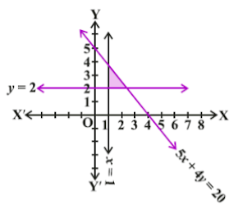
5x + 4y ≤ 20, x ≥ 1, y ≥ 2


Show solutionHide solution
Worked solution

Given 5x + 4y ≤ 20,

Putting values of x = 0 and y = 0 in the equation one by one, we get values of

y = 5 and x= 4

The required points are (0, 5) and (4, 0)

Checking if the origin lies in the solution area (0, 0)

0 ≤ 20

This is true; hence the origin would lie in the solution area. The required area of the line graph is on the left side of the graph.

We have x ≥ 1,

For all the values of y, x would be 1,

The required points would be (1, 0), (1, 2) and so on.

Checking for origin (0, 0)

0 ≥ 1, which is not true

So the origin would not lie in the required area. The required area on the graph will be on the right side of the line graph.

Consider y ≥ 2

Similarly, for all the values of x, y would be 2.

The required points would be (0, 2), (1, 2) and so on.

Checking for origin (0, 0)

0 ≥ 2, this is not true

Hence, the required area would be on the right side of the line graph.

The shaded area on the graph shows the required solution for the given inequalities.

ncert-sol-c11-maths-chapter-6-ex-3-img-9

Q10Written answer

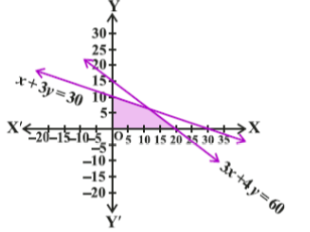
3x + 4y ≤ 60, x + 3y ≤ 30, x ≥ 0, y ≥ 0


Show solutionHide solution
Worked solution

Given 3x + 4y ≤ 60,

Putting values of x = 0 and y = 0 in the equation one by one, we get values of

y = 15 and x = 20

The required points are (0, 15) and (20, 0)

Checking if the origin lies in the required solution area (0, 0)

0 ≤ 60, this is true.

Hence, the origin would lie in the solution area of the line graph.

The required solution area would be on the left of the line graph.

We have x + 3y ≤ 30,

Putting values of x = 0 and y = 0 in the equation one by one, we get values of

y = 10 and x = 30

The required points are (0, 10) and (30, 0)

Checking for the origin (0, 0)

0 ≤ 30, this is true.

Hence, the origin lies in the solution area, which is given by the left side of the line graph.

Consider x ≥ 0,

y ≥ 0,

The given inequalities imply the solution lies in the first quadrant only.

Hence, the solution to the inequalities is given by the shaded region in the graph.

ncert-sol-c11-maths-chapter-6-ex-3-img-10