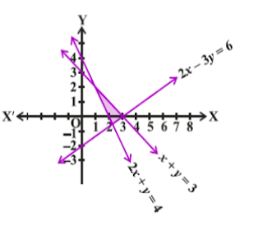
2x + y ≥ 4, x + y ≤ 3, 2x – 3y ≤ 6
Show solutionHide solution
Given 2x + y ≥ 4,
Putting values of x = 0 and y = 0 in the equation one by one, we get values of
y = 4 and x =2
The required points are (0, 4) and (2, 0)
Checking for origin (0, 0)
0 ≥ 4, this is not true
Hence, the origin doesn’t lie in the solution area of the line graph. The solution area would be given by the right side of the line graph.
x + y ≤ 3,
Putting values of x = 0 and y = 0 in the equation one by one, we get values of
y = 3 and x = 3
The required points are (0, 3) and (3, 0)
Checking for the origin (0, 0)
0 ≤ 3, this is true
Hence, the solution area would include the origin and hence would be on the left side of the line graph.
2x – 3y ≤ 6
Putting values of x = 0 and y = 0 in the equation one by one, we get values of
y = -2 and x = 3
The required points are (0, -2), (3, 0)
Checking for the origin (0, 0)
0 ≤ 6 this is true
So the origin lies in the solution area, and the area would be on the left of the line graph.
Hence, the shaded area in the graph is the required solution area for the given inequalities.