My Cart
Your Cart 0

    Your cart is empty.

  • Total (Amount) ₹0.00
NCERT · Class 11 · Economics

Chapter 8: Comparative Development Experiences of India and Its Neighbours

Practice each question, then open the answer or worked solution.

Source: NCERT Book Chapter 10,

Textbook page 185 · 9 questions
Q9Written answer

Compare and contrast India and China’s sectoral contribution towards GDP in 2003. What does it indicate?

Show solutionHide solution
Worked solution

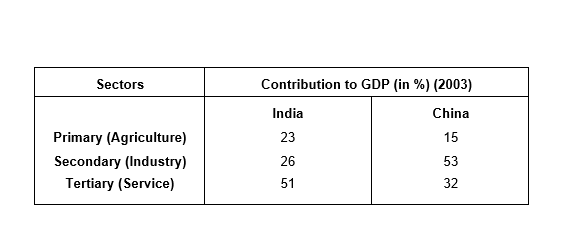
The tabular data shown below reflects India and China’s sectoral contribution towards their GDP:
Economics Solutions Class 11 Chapter 10-2

1. Primary Sectors’ contribution to GDP: Primary sector or agriculture contributes about 23% to the GDP of India, while it is 15% of the GDP of China. This shows that the Indian economy is still agrarian-based.

2. Secondary Sector contribution to GDP: This data shows that industries contribute around 26% of the GDP of India while it is 53% of the GDP of China. This shows that China has a robust industrial system which contributes most towards GDP.

3. Tertiary Sector contribution to GDP: Tertiary or service sector contributes 51% of the GDP of India while it is 32% of China’s GDP. This statistic shows the dominance of India on being a service powerhouse.

Therefore, the sectoral contribution studies show the following information:

1. India and China have moved from the primary sector and are looking to earn revenue from the other two sectors.

2. India is relying more on the tertiary sector, while China is going strong on the secondary sector to fuel its growth.
Q10Written answer

Mention the various indicators of human development.

Show solutionHide solution
Worked solution

The following are indicators of human development:

1. GDP per Capita

2. Life Expectancy

3. Infant Mortality Rate

4. Adult Literacy Rate

5. Percentage of the population below the poverty line

6. Percentage of the population having access to improved water resources

7. Percentage of the population having access to improved sanitation

Q11Written answer

Define liberty indicator. Give some examples of liberty indicators.

Show solutionHide solution
Worked solution

Liberty indicators are those indicators that represent the extent of civil and political freedom that is made available to individuals of a country. It is an index that measures people’s participation in decision-making. Some examples are given below:

1. The extent of constitutional protection of the independence of the Judiciary and the Rule of Law.

2. Extent of constitutional protection given to rights of a citizen

Q12Written answer

Evaluate the various factors that led to the rapid growth in economic development in China.

Show solutionHide solution
Worked solution

The following factors led to the rapid growth in the economic development of China:

1. Agriculture was given impetus, and under the commune system of farming, small lands were given to separate households for farming. The households can keep profit after paying taxes to the government.

2. Industrial sector was given emphasis in which private firms were encouraged to compete with government enterprises.

3. Setting up of SEZ to attract foreign investment and encourage exports.

4. Dual pricing was implemented, under which a fixed amount of purchases and sales need to be made, and the rest will be traded at market price.

Q13Written answer

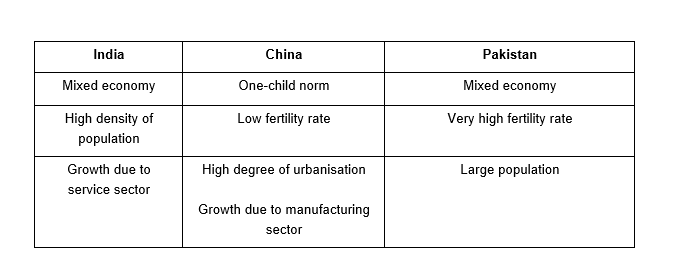
Group the following features pertaining to the economies of India, China and Pakistan under three heads.

Show solutionHide solution
Worked solution
  • One-child norm
  • Low fertility rate
  • High degree of urbanisation
  • Mixed economy
  • Very high fertility rate
  • Large population
  • High density of population
  • Growth due to the manufacturing sector
  • Growth due to the service sector

The features can be represented as:

Economics Solutions Class 11 Chapter 10- 3

Q14Written answer

Give reasons for the slow growth and re-emergence of poverty in Pakistan

Show solutionHide solution
Worked solution

The following are the reasons for the slow growth and re-emergence of poverty in Pakistan:

1. Pakistan was greatly dependent on public sector enterprises for economic growth. The operational inefficiencies of public sector enterprises and the allocation of scarce resources to such enterprises resulted in slow economic growth.

2. Agricultural practices that were in practice in Pakistan were traditional and outdated, which resulted in low crop production.

3. There was a lack of manufacturing sector in Pakistan hence they were experiencing slow growth.

4. Pakistan was in debt by taking foreign loans and was finding it difficult to repay the loans, which slowed down the growth of the nation.

5. Political stability was lacking in Pakistan, as a result of which there was huge public expenditure to maintain stability. The loan burden stunted the growth plans.

6. Pakistan failed to bring in adequate foreign investment, which was the result of political instability and lacking proper infrastructure.

Q15Written answer

Compare and contrast the development of India, China and Pakistan with respect to some salient human development indicators.

Show solutionHide solution
Worked solution

The following are indicators of human development:

1. GDP per Capita

2. Life Expectancy

3. Infant Mortality Rate

4. Adult Literacy Rate

5. Percentage of the population below the poverty line

6. Percentage of the population having access to improved water resources

7. Percentage of the population having access to improved sanitation

Human Development was constructed to calculate the development of humans in the form of food, shelter, education and health. A high HDI shows full spectrum growth of individuals and countries. China is ranked 81st, India 128th and Pakistan stands 136th. China has a better GDP due to its high GDP per capita. Also, population control has prevented the population from expanding. Due to all the above factors, GDP has increased.

Q16Written answer

Comment on the growth rate trends witnessed in China and India in the last two decades.

Show solutionHide solution
Worked solution

India, during the last two decades, performed average on the economic front. The majority of people still prefer agriculture, and the lack of infrastructure in many parts of the country is not helping the growth. The Standard of living hasn’t improved for about one-fourth of the population.

China, on the other hand, lacks political freedom, and this is a cause for concern. But, the country has been successful in raising the level of growth along with opportunities. Social security is ensured by the system of collective farming, which is famous as the Commune System. The intervention of the public in decisions of social infrastructure before economic reforms were introduced has helped register positive results for the economy.

Q17Written answer

Fill in the blanks

(a) First Five-Year Plan of ________________ commenced in the year 1956. (Pakistan/China)

(b) Maternal mortality rate is high in _____________. (China/Pakistan)

(c) Proportion of people below the poverty line is more in __________. (India/Pakistan)

(d) Reforms in ______________ were introduced in 1978. (China/Pakistan)

(a) Pakistan

(b) Pakistan

(c) India

(d) China

The concepts covered in this chapter are listed below:
  • Introduction
  • Developmental path – A snapshot view
  • Demographic indicators
  • Gross domestic product and sectors
  • Indicators of human development
  • Development strategies
  • conclusion
Conclusion
Show solutionHide solution
Worked solution

Solution coming soon.