My Cart
Your Cart 0

    Your cart is empty.

  • Total (Amount) ₹0.00
NCERT · Class 11 · Economics

Chapter 8: Comparative Development Experiences of India and Its Neighbours

Practice each question, then open the answer or worked solution.

Questions

8 questions
Q1Written answer

Why are regional and economic groupings formed?

Show solutionHide solution
Worked solution

Regional and economic groupings are formed by countries to understand the development strategies and growth measures that are used by the other member countries. This helped countries to analyse the strength and weaknesses they possessed and the corrective measures that needed to be taken to bring in growth and prosperity. Forming a regional group also makes countries maintain peace among themselves and having a common platform for trade as well as a representation on the World Forum.
Q2Written answer

What are the various means by which countries are trying to strengthen their own domestic economies?

Show solutionHide solution
Worked solution

The following are the means by which countries are trying to strengthen their own domestic economy:

1. By forming regional and economic groupings like European Union (EU), SAARC, ASEAN, OPEC, and G-8 etc.

2. By analysing the development model and strategies adopted by member countries in order to boost the economy of the country.

3. By liberalising the economies, which reduces government intervention in economic activities, the economy is governed by the demand and supply of the market.

4. By opening their economy to the world, which is known as globalisation. It is a move to provide the scope of business in the international market for domestic products.

Q3Written answer

What similar developmental strategies have India and Pakistan followed for their respective developmental paths?

Show solutionHide solution
Worked solution

The developmental strategies followed by India and Pakistan are as follows:

1. Developmental programmes adopted by both countries were based on economic planning.

2. For growth and development, the public sector was selected as the medium of choice.

3. A mixed economic structure was followed by both countries, which involved public and private sector participation.

4. Economic reforms were introduced at the same time to strengthen their respective economies.

Q4Written answer

Explain the Great Leap Forward campaign of China as initiated in 1958.

Show solutionHide solution
Worked solution

Great Leap Forward was a campaign started by communist leader Mao Zedong in 1958. It had the following objectives:

1. To initiate industrialisation of the economy in urban as well as rural areas.

2. Motivating people to set up industries in the backyard.

3. Engaging rural people in collective farming under the Commune System.

Q5Written answer

China’s rapid industrial growth can be traced back to its reforms in 1978. Do you agree? Elucidate.

Show solutionHide solution
Worked solution

The rapid industrial growth of China is attributed to the economic reforms that were introduced in phases in 1978. The first phase started with developments made in agriculture, investment and foreign trade. For agriculture commune system was introduced in which small plots were allocated to individual households. Income generated from the land can be kept by the households after paying the tax to the government. The next phase of reforms started with the industrial sector, where private firms were encouraged to compete with government-owned enterprises. A system of dual pricing was introduced in which farmers and industries need to buy and sell a fixed quantity of inputs and outputs at government-fixed price and trade remaining quantities at market price. Also introduced were special economic zones that were designed to attract foreign investment.

Q6Written answer

Describe the path of developmental initiatives taken by Pakistan for its economic development.

Show solutionHide solution
Worked solution

The following initiatives were taken by Pakistan for its economic development:

1. Adopted the mixed economy model where both public and private sectors exist.

2. Introduced regulatory frameworks during the 1950s-60s, where domestically produced goods were used as substitutes for imports, which helped develop domestic industries.

3. Mechanisation of agriculture to bring about the Green Revolution leading to the production of food grains.

4. Capital goods industries were nationalised in the 1970s.

5. The important thrust areas were denationalised, which encouraged private-sector participation.

Q7Written answer

What is the important implication of the ‘one child norm’ in China?

Show solutionHide solution
Worked solution

The important implication of one child norm led to low population growth and a decline in the sex ratio in China. It meant a lower proportion of females per thousand males.

Q8Written answer

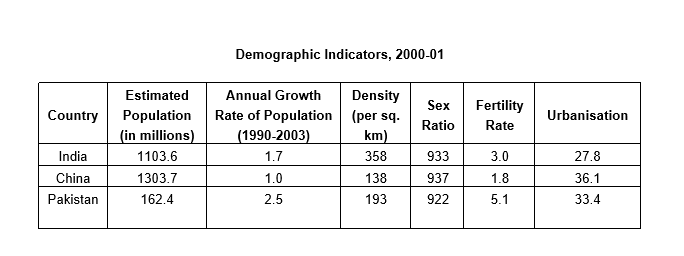
Mention the salient demographic indicators of China, Pakistan and India.

Show solutionHide solution
Worked solution

The important demographic indicators are shown below:

Economics Solutions Class 11 Chapter 10-1