Epithelial tissues are found lining the body surface forming a protective surface. These cells are densely packed with a very little intercellular matrix.
Various types of epithelial tissues are
i) Simple epithelium:
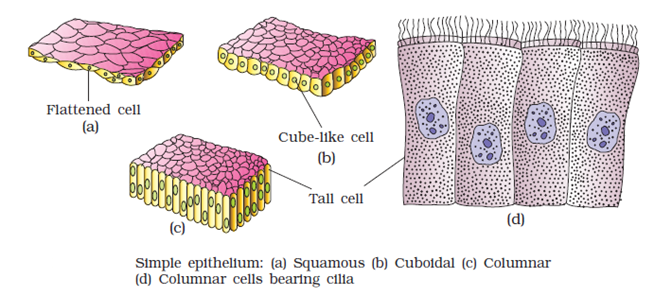
It is a single layer of cells which functions as a lining for body cavities, ducts, and tubes.
Based on the structural modifications of the cells, Simple epithelial cells are further divided into 4 types.
Simple epithelium is made of a single layer of a flattened cell having irregular boundaries. Since their cells represent tiles of a floor, they are also referred to as pavement epithelium. They are found in the walls of blood vessels and air sacs of the lungs. They are involved in excretion, protection, exchange of gases, secretion of coelomic fluid, etc.
Cuboidal epithelium is made up of a single layer of cube-like cells. They are commonly found in ducts of glands and tubular parts of nephrons in kidneys, and their primary functions are secretion and absorption of gamete formation.
The columnar epithelium is made of a single layer of tall and slender cells. They are found in the lining of the stomach and intestine and help in secretion and absorption. The nuclei of these cells are elongated and found at different positions. It aids in absorption and secretion.
If cuboidal or columnar epithelium has cilia, they are called ciliated epithelium. They are present in the inner surface of hollow organs like fallopian tubes and bronchioles. Their function is to move particles in a specific direction.
ii) Compound epithelium
The compound epithelium is a layer of two or more cells with a protective function, as it does in our skin. They are thick and strong compared to the simple epithelium, as they comprise two or more cell layers; they render protection. They cover the dry skin surface, the moist surface of the buccal cavity, and the inner lining of the ducts of pancreatic ducts and salivary ducts.