My Cart
Your Cart 0

    Your cart is empty.

  • Total (Amount) ₹0.00
NCERT · Class 10 · Science

Chapter 7: How Do Organisms Reproduce?

Practice each question, then open the answer or worked solution.

Exercises · Page 141

Textbook page 141 · 11 questions
Q1Written answer

Asexual reproduction takes place through budding in

(a) Amoeba

(b) Yeast

(c) Plasmodium

(d) Leishmania

Show solutionHide solution
Worked solution

(b) Yeast

Yeast is an example for asexual reproduction taking place through budding. A small protuberance is produced on the parent cell that grows in full size forming a bud. In the parent cell, the daughter nucleus splits and migrates to the daughter cell. By forming a constriction, the bud detaches from the mother’s body at the base. This process of budding continues to form a chain of bud cells. The mother cell is smaller than the daughter cell.
Q2Multiple choice

Which of the following is not a part of the female reproductive system in human beings?

Show answerHide answer
Correct option: C
Show solutionHide solution
Worked solution

(c) Vas deferens

Vas deferens is a part of the male reproductive system. It is a long, muscular tube travelling from the epididymis into the pelvic cavity. It is behind the bladder. Its function is to transport the mature sperm to the urethra. It also carries urine to the outside of the body.

Q3Written answer

The anther contains

(a) Sepals

(b) Ovules

(c) Pistil

(d) Pollen grains

Show solutionHide solution
Worked solution

(d) Pollen grains.

Pollen grains are the microscopic particles that occurs in the pollen giving rise to male gametophyte of a seed plant.

Q4Written answer

What are the advantages of sexual reproduction over asexual reproduction?

Show solutionHide solution
Worked solution

Following are the advantages of sexual reproduction:

  • The offspring has the characters of both the parents.
  • The survival of the species is ensured as there are more variations.
  • The offspring can easily adapt to environmental changes.
  • It also improves the health of humans.
Q5Written answer

What are the functions performed by the testis in human beings?

Show solutionHide solution
Worked solution

Following are the functions performed by the testis in human beings:

  • Apart from the production of sperms, it also produces the male hormone known as androgens.
  • They also produce hormone called testosterone, which is responsible for secondary sexual characters in boys.
Q6Written answer

Why does menstruation occur?

Show solutionHide solution
Worked solution

Menstruation is the normal bleeding of the vaginal line, which starts at puberty and lasts till menopause. During this period, the body prepares itself for pregnancy.

Every month an egg is released from one of the ovaries at the same time when the uterus prepares itself for the fertilized egg. The inner lining of the uterus gets thickened and is supplied with a sufficient amount of blood for the embryo. Since there is no interaction between the egg and the sperms, the fertilization of egg doesn’t takes place. So when the egg doesn’t get fertilized, the uterus lining breaks down slowly resulting in menstruation.

Q7Written answer

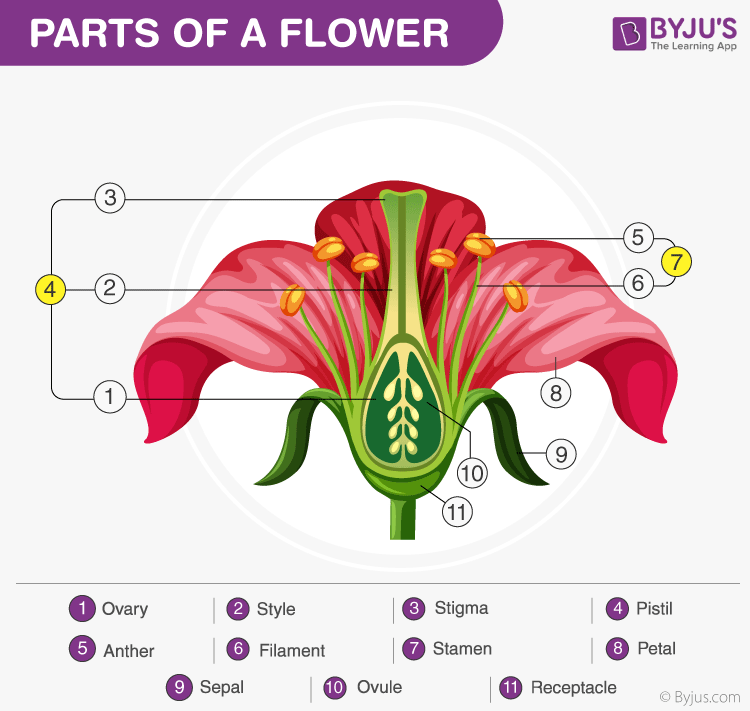
Draw a labelled diagram of the longitudinal section of a flower.

Show solutionHide solution
Worked solution

NCERT Solution for Class 10 Science Chapter 8 - image 1

Q8Written answer

What are the different methods of contraception?

Show solutionHide solution
Worked solution

Following are the different methods of contraception:

  • Natural method: In this method, the main focus is to avoid the meeting of sperms and ovum. This can be achieved by avoiding the mating from 10th to 17th day of the menstrual cycle. During this period, there are high chances of fertilization as ovulation is expected.
  • Barrier method: In this method, the meeting of sperms and ovum is avoided by using a barrier. These barriers are available for males as well as for females. Condoms for both male and female, diaphragms for female, cervical cap and contraceptive sponge for females.
  • Oral contraceptives: In this methods, pills are taken orally. These pills contain small portion of hormones that block the eggs so that fertilization doesn’t takes place.
  • Implants and surgical method: In this method, contraceptive devices like copper-T or a loop can be used to block the meeting of sperms and ovum. In surgical method, the fallopian tubes are blocked in females to stop the flow of eggs and vas deference is blocked in men to stop the flow of sperms.
Q9Written answer

How are the modes for reproduction different in unicellular and multicellular organisms?

Show solutionHide solution
Worked solution

The different modes of reproduction in unicellular organisms are fission, budding, etc. Here, the cell divides into two daughter cells and this process of cell division continues.

Whereas, in multicellular organisms there is a different organ system for reproduction. The different modes of reproduction in multicellular organisms are vegetative propagation, spore formation, etc.

In more complex organisms like humans and animals, reproduction is through sexual reproduction.

Q10Written answer

How does reproduction help in providing stability to populations of species?

Show solutionHide solution
Worked solution

Reproduction is the process of producing the same kind of species by the existing species. This is done so as to maintain the population of that species and also to take forward their species to the next generations. Stability is maintained by keeping a check of rate of births and rate of deaths.