Difficulty distribution
How the classified questions are distributed by difficulty.
24questions
Not classified
24
100%
Your cart is empty.
Practice Ray Optics - Optics - Physics previous year questions organised from real papers, with year-wise coverage and clear topic navigation.
Every graph below is calculated only from this selection.
Year-wise coverage for Ray Optics. Each bar uses a separate theme-derived color.
How the classified questions are distributed by difficulty.
MCQ, numerical, multiple-select and other formats found in these papers.
Top subjects by unique question coverage.
Top topics across the included previous year papers.
Top subtopics inside this exact selection.
Question coverage for the most populated papers. Every active PYP paper remains listed below.
Newest papers appear first. Sort by year, question coverage or name.
| Paper | Year / session | Questions in this view | Open |
|---|---|---|---|
| TS EAMCET 2023 (Online) 12th May Morning Shift | 2023 | 1 | View paper |
| TS EAMCET 2023 ONLINE 12TH MAY EVENING SHIFT | 2023 | 1 | View paper |
| TS EAMCET 2023 ONLINE 13TH MAY EVENING SHIFT | 2023 | 1 | View paper |
| TS EAMCET 2023 ONLINE 13TH MAY MORNING SHIFT | 2023 | 1 | View paper |
| TS EAMCET 2023 ONLINE 14TH MAY EVENING SHIFT | 2023 | 1 | View paper |
| TS EAMCET 2023 ONLINE 14TH MAY MORNING SHIFT | 2023 | 1 | View paper |
| TS EAMCET 2022 (Online) 19th July Evening Shift | 2022 | 1 | View paper |
| TS EAMCET 2022 (Online) 19th July Morning Shift | 2022 | 1 | View paper |
| TS EAMCET 2022 (Online) 20th July Evening Shift | 2022 | 1 | View paper |
| TS EAMCET 2022 (Online) 20th July Morning Shift | 2022 | 1 | View paper |
| TS EAMCET 2022 ONLINE 18TH JULY EVENING SHIFT | 2022 | 1 | View paper |
| TS EAMCET 2022 ONLINE 18TH JULY MORNING SHIFT | 2022 | 1 | View paper |
| TS EAMCET 2020 (Online) 10th September Evening Shift | 2020 | 2 | View paper |
| TS EAMCET 2020 (Online) 10th September Morning Shift | 2020 | 1 | View paper |
| TS EAMCET 2020 (Online) 11th September Evening Shift | 2020 | 2 | View paper |
| TS EAMCET 2020 (Online) 11th September Morning Shift | 2020 | 1 | View paper |
| TS EAMCET 2020 (Online) 14th September Evening Shift | 2020 | 2 | View paper |
| TS EAMCET 2020 (Online) 14th September Morning Shift | 2020 | 2 | View paper |
| TS EAMCET 2020 (Online) 14th September Morning Shift | 2020 | 2 | View paper |
Practice every matching question in batches of 20, with every available option.
A convex lens focusses an object 20 cm from it on a screen placed 5 cm away from it. A glass plate (refractive index $=7 / 5$ ) of thickness 1.4 cm is inserted between the lens and the screen. What is the distance of the object from the lens, so that its image is again focused on the screen?
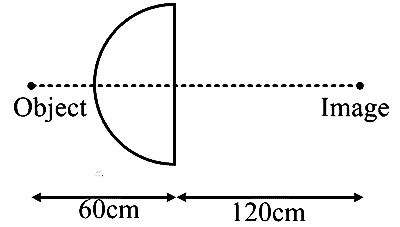
A lens is made of glass having an index of refraction 1.5 . One side of the lens is flat and the other side is convex with a radius $R$. If an object is placed 60 cm , towards the convex side of the lens, the image is formed at
120 cm on the other side of the lens. The value of $R$ isThe angles of incidence and emergence of a light ray passing through a prism of angle $A$ are $i$ and $e$ respectively. The total deviation produced by the prism is
A convex lens forms a real image of a point object placed on its principal axis. If the upper half of the lens is painted black, then
Refractive index of a medium is $\mu$. If the angle of incidence is twice that of the angle of refracation, then the angle of incidence is
The focal lengths of the objective and the eyepiece of a compound microscope are 2 cm and 3 cm respectively and the distance between them is 15 cm . The final image formed by the eyepiece is at infinity. The distances of the object and the image produced by the object from the objective lens are respectively.
Two convex lenses of focal lengths 20 cm and 30 cm are placed in contact with each other co-axially. The focal length of the combination is
A telescope has an objective of focal length 100 cm and an eye-piece of focal length 5 cm . The magnifying power of the telescope is
A convex lens and a concave lens, each with focal length of 4 cm are separated by a distance of 6 cm along their axis. An object is placed 8 cm before the convex lens. The distance between the object and its image is
If the image of an object is at the focal point $f$ to the right side of a convex lens, the position of the object on the left of the lens is at

A spherical glass is attached to a rigid wall as shown in the figure. An observer located at point $O$ is looking at a point $A$ on the wall. The refractive index of the glass is 1.5 and that of air is 1.0 . The distances are $O A=8 \mathrm{~cm}$, $X A=3 \mathrm{~cm}$. If the radius of curvature of spherical glass surface is $R=5 \mathrm{~cm}$, then the apparent distance of $A$ from observer $O$ is
A light ray travels from a medium with refractive index $n_1$ to another medium of refractive index $n_2$. If $n_1=2$ and $n_2=\sqrt{3}$, then find the critical angle.
A convex lens of focal length 25 cm and made of glass with refractive index 1.5 is immersed in water. the absolute change in focal length of the glass is [use refractive index of water $=4 / 3$ ]
What is the refractive index of the material of a double convex lens having radii of curvature of 5 cm and 10 cm and focal length of $\frac{20}{3} \mathrm{~cm}$
A prism is made of a glass having refractive index $\sqrt{2}$. If the angle of minimum deviation is equal to angle of the prism, then the angle of prism is
A thin glass prism of angle $9^{\circ}$ with refractive index 1.4 is combined with another glass prism of refractive index 1.6 as shown in the figure. The combination of the prism provides dispersion without deviation. Determine the angle $(A)$ of the second prism.

The magnifications produced by a convex lens for two position of an object are 4 and 3, respectively. If the distance of separation between the two positions of the object is 2 cm , then the focal length of the lens is
A small object is placed in the air, at a distance 45 cm from a convex refracting surface of radius of curvature 15 cm . If the surface separates air from glass of refractive index 1.5, then the position of image is
A thin prism of angle $6^{\circ}$ made of glass of refractive index 1.5 is combined with another prism made of refractive index 1.75 to produce dispersion without deviation. Then, the angle of the second prism is
Showing 20 of 22 questions