Exam Details
TS EAMCET 2020 (Online) 10th September Morning Shift
Review the key details, then start the test when you are ready. You can also open the full package to see related papers.
Questions
159
Duration
60 mins
Package
TS EAMCET- Previous Year Papers
Paper pattern & analysis
Filter this paper by subject, topic or subtopic. Every graph updates from the selected questions.
Topic distribution
Subtopic distribution
Difficulty distribution
159questions
Not classified
159
100%
Question type distribution
159questions
MCQ
159
100%
Practise paper questions
Choose your answer to check it. Log in to view the explanation. For a timed attempt and result, start the exam.
PYP
TS EAMCET 2020 (Online) 10th September Morning Shift
A car travelling at $15 \mathrm{~m} / \mathrm{s}$ overtake another car travelling at $10 \mathrm{~m} / \mathrm{s}$. Assuming, each car is 4 m long. What is the time taken during the overtake?
PYP
TS EAMCET 2020 (Online) 10th September Morning Shift
A projectile is launched from point $A$ of the given landscape with a water body as shown in the diagram. The launching angle is $15^{\circ}$. From the following, identify the right initial velocity of the projectile with which it will fall somewhere in between the points $C$ and $D$. [Assume, $g=10 \mathrm{~m} / \mathrm{s}^2$ ]

PYP
TS EAMCET 2020 (Online) 10th September Morning Shift
Due to an explosion underneath water, a bubble started oscillating. If this oscillation has time period $T$,which is proportional to $p^\alpha S^\beta E^\gamma$, where $p$ is static pressure, $S$ is density of water and $E$ is total energy of explosion. Determine $\alpha, \beta$ and $\gamma$.
PYP
TS EAMCET 2020 (Online) 10th September Morning Shift
When a bullet is fired from a rifle its momentum becomes $20 \mathrm{~kg}-\mathrm{ms}^{-1}$. If the velocity of the bullet is $1000 \mathrm{~ms}^{-1}$, then what is its mass?
PYP
TS EAMCET 2020 (Online) 10th September Morning Shift
A block is between two surfaces as shown in the figure. Find the normal reaction at both surfaces. [Assume, $g=10 \mathrm{~m} / \mathrm{s}^2$ ]

PYP
TS EAMCET 2020 (Online) 10th September Morning Shift
If $0.5 \hat{\mathbf{i}}+0.8 \hat{\mathbf{j}}+c \hat{\mathbf{k}}$ is a unit vector, then $c$ is
PYP
TS EAMCET 2020 (Online) 10th September Morning Shift
When a body is acted upon by a resultant force, then the work done by the resultant force is equal to
PYP
TS EAMCET 2020 (Online) 10th September Morning Shift
If a body moving in a circular path maintains constant speed of $10 \mathrm{~ms}^{-1}$, then which of the following correctly describes the relation between acceleration (a) and radius $(r)$ ?
PYP
TS EAMCET 2020 (Online) 10th September Morning Shift
A circular hole of radius 3 cm is cut out from a uniform circular disc of radius 6 cm . The centre of the hole is at 3 cm , from the centre of the original disc. The distance of centre of gravity of the resulting flat body from the centre of the original disc is
PYP
TS EAMCET 2020 (Online) 10th September Morning Shift
Choose the correct statement.
PYP
TS EAMCET 2020 (Online) 10th September Morning Shift
For a particle executing SHM, determine the ratio of average acceleration of the particle between extreme position and equilibrium position w.r.t. the maximum acceleration.
PYP
TS EAMCET 2020 (Online) 10th September Morning Shift
A bus moving with an uniform speed of $72 \mathrm{~km} / \mathrm{h}$ towards a building blows a horn of frequency 1.7 kHz . If speed of sound in air is $340 \mathrm{~m} / \mathrm{s}$, what will be the frequency of echo heard by bus driver?
PYP
TS EAMCET 2020 (Online) 10th September Morning Shift
A meniscus drop of radius 1 cm is sprayed into $10^6$ droplets of equal size. Calculate the energy expended if surface tension of mercury is $435 \times 10^{-3} \mathrm{~N} / \mathrm{m}$.
PYP
TS EAMCET 2020 (Online) 10th September Morning Shift
A bullet of mass 25 g moves horizontally at a speed of $250 \mathrm{~m} / \mathrm{s}$ is fired into a wooden block of mass 1 kg suspended by a long string. The bullet crosses the block and emerges on the other side. If the centre of the mass of the block rises through a height of 20 cm . The speed of the bullet as it emerges from the block is (take, $g=10 \mathrm{~m} / \mathrm{s}^2$ )
PYP
TS EAMCET 2020 (Online) 10th September Morning Shift
A slab of side 50 cm and thickness 10 cm is subjected to a shearing force of $10^5 \mathrm{~N}$ on its narrow edge. If the lower edge is riveted to the floor and upper edge is displaced by 0.2 mm , then shear modulus of the material of the slab is
PYP
TS EAMCET 2020 (Online) 10th September Morning Shift
If the image of an object is at the focal point $f$ to the right side of a convex lens, the position of the object on the left of the lens is at
PYP
TS EAMCET 2020 (Online) 10th September Morning Shift
Young's double slit experiment is carried out by using green, red and blue light, one colour at a time. The fringe width recorded are $\beta_{G^{\prime}} \beta_{R^{\prime}} \beta_B$ respectively, then
PYP
TS EAMCET 2020 (Online) 10th September Morning Shift
If a gas has $n$ degrees of freedom, then the ratio of $\frac{C_p}{C_V}$ is
PYP
TS EAMCET 2020 (Online) 10th September Morning Shift
The specific heat of helium at constant volume is 12.6 J $\mathrm{mol}^{-1} \mathrm{~K}^{-1}$. The specific heat of helium at constant pressure in $\mathrm{J} \mathrm{mol}^{-1} \mathrm{~K}^{-1}$ is approximately (assume, the universal gas constant, $R=8.314 \mathrm{~J} \mathrm{~mol}^{-1} \mathrm{~K}^{-1}$ )
PYP
TS EAMCET 2020 (Online) 10th September Morning Shift
Work done on heating one mole of monoatomic gas adiabatically through $20^{\circ} \mathrm{C}$ is $W$. Then, the work done on heating 6 moles of rigid diatomic gas through the same change in temperature
PYP
TS EAMCET 2020 (Online) 10th September Morning Shift
A composite slab is prepared with two different materials $A$ and $B$. The relation between their coefficient of thermal conductivity and thickness is given as $K_A=\frac{K_B}{2}$ and $X_A=2 X_B$, respectively. If the temperature of faces of $A$ and $B$ are $75^{\circ} \mathrm{C}$ and $50^{\circ} \mathrm{C}$ respectively, what will be the temperature of common surface?
PYP
TS EAMCET 2020 (Online) 10th September Morning Shift
Assume each oil drop consists of a capacitance of $C$. If combine $n$ drops to form a bigger drop, then the capacitance of bigger drop $C^{\prime}$ would be
PYP
TS EAMCET 2020 (Online) 10th September Morning Shift
If the Wheatstone's bridge with four resistors $R_1, R_2$ and $R_3, R_4$ is balanced, then the correct expression is

PYP
TS EAMCET 2020 (Online) 10th September Morning Shift
A conductor of length 100 cm and area of cross-section $1 \mathrm{~mm}^2$ carries a current of 5 A . If the resistivity of the material of the conductor is $3.0 \times 10^{-8} \Omega-\mathrm{m}$, then the electric field across the conductor is
PYP
TS EAMCET 2020 (Online) 10th September Morning Shift
If a proton is moved against the coulomb force of an electric field, then
PYP
TS EAMCET 2020 (Online) 10th September Morning Shift
A moving coil galvanometer of resistance $100 \Omega$ is used as an ammeter using a resistance $0.1 \Omega$. The maximum deflection current in the galvanometer is $100 \mu \mathrm{~A}$. Find the minimum current in the circuit, so that ammeter shows maximum deflection?
PYP
TS EAMCET 2020 (Online) 10th September Morning Shift
On using red light $(\lambda=6600 \mathop {\rm{A}}\limits^{\rm{o}})$ in Young's double slit experiment, 60 fringes are observed in the field of view. If violet light ( $\lambda=4400 \mathop {\rm{A}}\limits^{\rm{o}}$ ) is used, the number of fringes observed will be
PYP
TS EAMCET 2020 (Online) 10th September Morning Shift
A 50 cm long solenoid has winding of 400 turns. What current must pass through it to produce a magnetic field of induction $4 \pi \times 10^{-3} \mathrm{~T}$ at the centre?
PYP
TS EAMCET 2020 (Online) 10th September Morning Shift
What is the amplitude of the electric field in a parallel beam of light intensity $\left(\frac{15}{\pi}\right) \frac{\mathrm{W}}{\mathrm{m}^2}$ ?
$$ \left[\text { Assume }, \frac{1}{4 \pi \varepsilon_0}=9 \times 10^9 \frac{\mathrm{Nm}^2}{\mathrm{C}^2}\right] $$
PYP
TS EAMCET 2020 (Online) 10th September Morning Shift
A circular coil of 10 turns and radius 10 cm is placed in a uniform magnetic field of 0.1 T normal to the plane of the coil. If the current in the coil is 5 A , then the magnitude of the torque on the coil is
PYP
TS EAMCET 2020 (Online) 10th September Morning Shift
The ratio of maximum to minimum wavelength in Balmer series of an hydrogenic atom is
PYP
TS EAMCET 2020 (Online) 10th September Morning Shift
If relative permeability of iron is 5500 , then its susceptibility is
PYP
TS EAMCET 2020 (Online) 10th September Morning Shift
In $C R$-circuit the growth of charge on the capacitor is
PYP
TS EAMCET 2020 (Online) 10th September Morning Shift
Alpha rays emitted from a radioactive substance are
PYP
TS EAMCET 2020 (Online) 10th September Morning Shift
Which of the following depicts the output of the full wave rectifier with capacitor filter for the following AC input?

PYP
TS EAMCET 2020 (Online) 10th September Morning Shift
Photons of energy 2.4 eV and wavelength $\lambda$ fall on a metal plate and release photoelectrons with a maximum velocity $v$. By decreasing $\lambda$ by $50 \%$, the maximum velocity of photoelectrons becomes $3 v$. The work function of the material of the metal plate is
PYP
TS EAMCET 2020 (Online) 10th September Morning Shift
The Boolean expression of the circuit given in figure is

PYP
TS EAMCET 2020 (Online) 10th September Morning Shift
The nuclear forces are
PYP
TS EAMCET 2020 (Online) 10th September Morning Shift
A message signal of frequency 10 kHz and peak voltage of 15 V is used to modulate a carrier frequency of 1 MHz and peak voltage of 30 V . Determine the modulation index.
PYP
TS EAMCET 2020 (Online) 10th September Morning Shift
$\Delta H$ and $\Delta S$ for a reaction are $+30.0 \mathrm{~kJ} \mathrm{~mol}^{-1}$ and 0.06 $\mathrm{kJK}^{-1} \mathrm{~mol}^{-1}$ at 1 atm pressure. The temperature at which free energy change is equal to zero and nature of the reaction below this temperature are
PYP
TS EAMCET 2020 (Online) 10th September Morning Shift
The vapour density of $\mathrm{N}_2 \mathrm{O}_4$ in $\mathrm{N}_2 \mathrm{O}_4 \rightleftharpoons 2 \mathrm{NO}_2$ is 40 . The degree of dissociation is
PYP
TS EAMCET 2020 (Online) 10th September Morning Shift
The degeneracy of the level of hydrogen atoms that contain the energy of $\left(\frac{-R_{\mathrm{H}}}{16}\right)$ is
PYP
TS EAMCET 2020 (Online) 10th September Morning Shift
Root mean square ( rms ) speed of $\mathrm{O}_2$ is $500 \mathrm{~m} / \mathrm{s}$ at a constant temperature. Calculate the rms speed and the average kinetic energy of $\mathrm{H}_2$ at the same temperature. (Consider, $R=8.33 \mathrm{JK}^{-1} \mathrm{~mol}^{-1}$ )
PYP
TS EAMCET 2020 (Online) 10th September Morning Shift
Which of the following describes an ideal gas?
(i) The volume occupied by a gas molecule is negligible.
(ii) The collision between ideal gases are elastic.
(iii) Particles are very small compared to the distance between each other.
PYP
TS EAMCET 2020 (Online) 10th September Morning Shift
Wavelength of $\mathrm{H}^{+}$ion with kinetic energy 1.65 eV is (mass of proton $=1.6726 \times 10^{-27} \mathrm{~kg}$ )
PYP
TS EAMCET 2020 (Online) 10th September Morning Shift
$\mathrm{KMnO}_4$ oxidises $\mathrm{C}_2 \mathrm{H}_2 \mathrm{O}_4$ to form $\mathrm{CO}_2$. In which of the following, the reaction will be faster?
PYP
TS EAMCET 2020 (Online) 10th September Morning Shift
Copper crystallises in ccp arrangement and accepted value of metal ion radius was found to be $1.14 \mathop {\rm{A}}\limits^{\rm{o}}$. Calculate the density of copper in grams per cubic centimetre. (Atomic weight of copper is 64 , $N_A=6 \times 10^{23}$ )
PYP
TS EAMCET 2020 (Online) 10th September Morning Shift
The freezing point of equimolal aqueous solution will be highest for
PYP
TS EAMCET 2020 (Online) 10th September Morning Shift
The standard electrode potentials of $\mathrm{Ag}^{+} / \mathrm{Ag}$ is +0.80 V and $\mathrm{Cu}^{+} / \mathrm{Cu}$ is +0.34 V . If these electrodes are connected through a salt-bridge, which of the following statements is correct?
PYP
TS EAMCET 2020 (Online) 10th September Morning Shift
What is the equilibrium constant $\left(K_C\right)$ for the given reaction?
$$ \mathrm{N}_2+\mathrm{O}_2 \rightleftharpoons 2 \mathrm{NO} $$
Where the equilibrium concentration of $\mathrm{N}_2, \mathrm{O}_2$ and NO are found to be $4 \times 10^{-3}, 3 \times 10^{-3}$ and $3 \times 10^{-3} \mathrm{M}$ respectively.
PYP
TS EAMCET 2020 (Online) 10th September Morning Shift
The gold numbers of gelatin, haemoglobin and sodium acetate are $5 \times 10^{-3}, 5 \times 10^{-2}$ and $7 \times 10^{-1}$, respectively. The protective actions will be in the order
PYP
TS EAMCET 2020 (Online) 10th September Morning Shift
What is the $\%$ strength of 22.4 volume of $\mathrm{H}_2 \mathrm{O}_2$ solution?
PYP
TS EAMCET 2020 (Online) 10th September Morning Shift
For a zero order reaction, the plot of concentration of reactant vs time is (Hint: Consider the intercept on the concentration axis)
PYP
TS EAMCET 2020 (Online) 10th September Morning Shift
Hard water contains ion of
PYP
TS EAMCET 2020 (Online) 10th September Morning Shift
Which of the following molecules does not exist according to molecular orbital theory?
PYP
TS EAMCET 2020 (Online) 10th September Morning Shift
Assertion (A) $\mathrm{Mg}^{2+}$ and $\mathrm{Al}^{3+}$ are isoelectronic but the magnitude of ionic radius of $\mathrm{Al}^{3+}$ is less than that in $\mathrm{Mg}^{2+}$.
Reason (R) The effective nuclear charge on the outermost electrons in $\mathrm{Al}^{3+}$ is greater than that in $\mathrm{Mg}^{2+}$.The correct option among the following is
PYP
TS EAMCET 2020 (Online) 10th September Morning Shift
The successive ionisation energy values for an element ' $X$ ' are given below :
(i) 1st ionisation energy $=410 \mathrm{~kJ} \mathrm{~mol}^{-1}$
(ii) 2nd ionisation energy $=820 \mathrm{~kJ} \mathrm{~mol}^{-1}$
(iii) 3rd ionisation energy $=1100 \mathrm{~kJ} \mathrm{~mol}^{-1}$
(iv) 4th ionisation energy $=1500 \mathrm{~kJ} \mathrm{~mol}^{-1}$
(v) 5th ionisation energy $=3200 \mathrm{~kJ} \mathrm{~mol}^{-1}$
PYP
TS EAMCET 2020 (Online) 10th September Morning Shift
What is the nature of the bonding in anhydrous $\mathrm{AlCl}_3$ and hydrated $\mathrm{AlCl}_3$ respectively?
PYP
TS EAMCET 2020 (Online) 10th September Morning Shift
When copper metal is treated with cold and dilute nitric acid, it forms
PYP
TS EAMCET 2020 (Online) 10th September Morning Shift
Predict the feasibility of the given reactions in aqueous solution
(i) $\mathrm{Be}(\mathrm{OH})_2+2 \mathrm{OH}^{-} \longrightarrow\left[\mathrm{Be}(\mathrm{OH})_4\right]^{2-}$
(ii) $\mathrm{Be}(\mathrm{OH})_2+2 \mathrm{H}^{+} \longrightarrow\left[\mathrm{Be}(\mathrm{OH})_4\right]^{2+}$
PYP
TS EAMCET 2020 (Online) 10th September Morning Shift
Which of the following elements reacts with water?
PYP
TS EAMCET 2020 (Online) 10th September Morning Shift
Which one of the following is not a colourless compound?
PYP
TS EAMCET 2020 (Online) 10th September Morning Shift
Which of the following statement is not true about interstitial complexes?
PYP
TS EAMCET 2020 (Online) 10th September Morning Shift
Biochemical oxygen demand (BOD) is a measure of organic materials present in water, BOD value less than 5 ppm indicates a water sample to be
PYP
TS EAMCET 2020 (Online) 10th September Morning Shift
Which of the following molecules is colourless?
PYP
TS EAMCET 2020 (Online) 10th September Morning Shift
Which one of the following ores does not contain iron?
PYP
TS EAMCET 2020 (Online) 10th September Morning Shift
Which one of the following methods is suitable to generate aromatic compound(s) from linear aliphatic saturated hydrocarbons with at least six carbon atoms?
PYP
TS EAMCET 2020 (Online) 10th September Morning Shift
Ethyl phenyl acetylene (1-phenyl-1-butyne) on reduction with partially deactiveated palladised charcoal (Lindlar's catalyst) gives
PYP
TS EAMCET 2020 (Online) 10th September Morning Shift
$A^{2+}, B^{2+}$ and $C^{-}$form an ionic complex like $A_{x-2}\left[B(C)_x\right]_2$. If the complex is $75 \%$ dissociated in a solvent with $i=4$, the coordination number of $B$ is
PYP
TS EAMCET 2020 (Online) 10th September Morning Shift
$$ \text { Which of the following gives alcohol/phenol products? } $$

PYP
TS EAMCET 2020 (Online) 10th September Morning Shift
$$ \text { In the following reactions, } P, Q \text { and } R \text { are } $$
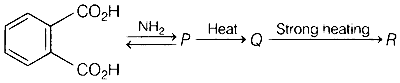
PYP
TS EAMCET 2020 (Online) 10th September Morning Shift
$$ \text { The major products } P \text { and } Q \text { in the following reactions are } $$

PYP
TS EAMCET 2020 (Online) 10th September Morning Shift
$$ \text { Following transformation can be accomplished by } $$
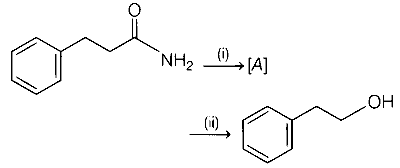
PYP
TS EAMCET 2020 (Online) 10th September Morning Shift
$$ \text { The major product in the following reaction sequence is } $$
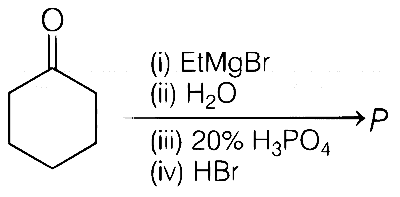
PYP
TS EAMCET 2020 (Online) 10th September Morning Shift
Which of the following vinyl derivatives is the most reactive towards anionic polymerisation?
PYP
TS EAMCET 2020 (Online) 10th September Morning Shift
Sodium fusion extract of aniline when heated with ferrous sulphate solution and then acidified with concentrated $\mathrm{H}_2 \mathrm{SO}_4$ from which of the following complexes?
PYP
TS EAMCET 2020 (Online) 10th September Morning Shift
Which among the following is an arsenic based antibiotic drug, for which Paul Ehrlich was awarded Noble prize in 1908.
PYP
TS EAMCET 2020 (Online) 10th September Morning Shift
The solutions of the equation $z^2\left(1-z^2\right)=16, z \in \mathbf{C}$, lie on the curve
PYP
TS EAMCET 2020 (Online) 10th September Morning Shift
If $z, \bar{z},-z,-\bar{z}$ forms a rectangle of area $2 \sqrt{3}$ square units, then one such $z$ is
PYP
TS EAMCET 2020 (Online) 10th September Morning Shift
Let $z=x+i y$ be a complex number, $A=\{z /|z| \leq 2\}$ and $B=\{z /(1-i) z+(1+i) \bar{z} \geq 4\}$ Then which one of the following options belongs to $A \cap B$ ?
PYP
TS EAMCET 2020 (Online) 10th September Morning Shift
Amino acids containing heterocyclic ring are
(i) Histidine
(ii) Valine
(iii) Arginine
(iv) Proline
PYP
TS EAMCET 2020 (Online) 10th September Morning Shift
$$ \left(\frac{\cos \theta+i \sin \theta}{\sin \theta+i \cos \theta}\right)^8+\left(\frac{1+\cos \theta-i \sin \theta}{1+\cos \theta+i \sin \theta}\right)^{16}= $$
PYP
TS EAMCET 2020 (Online) 10th September Morning Shift
Let $S$ be the set of all possible integral values of $\lambda$ in the interval $(-3,7)$ for which the roots of the quadratic equation $\lambda x^2+13 x+7=0$ are all rational numbers. Then the sum of the elements in $S$ is
PYP
TS EAMCET 2020 (Online) 10th September Morning Shift
For the equation $x^4+x^3-4 x^2+x-1=0$ the ratio of the sum of the squares of all the roots to the product of the distinct roots is
PYP
TS EAMCET 2020 (Online) 10th September Morning Shift
Let the greatest common divisor of $m, n$ be 1 . If $\frac{1}{1 \cdot 7}+\frac{1}{7 \cdot 13}+\frac{1}{13 \cdot 19}+\ldots \ldots$. upto 20 terms $=\frac{m}{n}$, then $5 m+2 n=$
PYP
TS EAMCET 2020 (Online) 10th September Morning Shift
$\alpha$ is the maximum value of $1-2 x-5 x^2$ and $\beta$ is the minimum value of $x^2-2 x+r$. If $5 \alpha x^2+\beta x+6>0$ for all real values $x$, then the interval in which $r$ lies is
PYP
TS EAMCET 2020 (Online) 10th September Morning Shift
If $\alpha_1, \beta_1, \gamma_1, \delta_1$ are the roots of the equation $a x^4+b x^3+c x^2+d x+e=0$ and $\alpha_2, \beta_2, \gamma_2, \delta_2$ are the roots of the equation $e x^4+d x^3+c x^2+b x+a=0$ such that $0<\alpha_1<\beta_1<\gamma_1<\delta_1, 0<\alpha_2<\beta_2<\gamma_2<\delta_2$, $\alpha_1-\delta_2=2=\beta_1-\gamma_2 ; \gamma_1-\beta_2=\delta_1-\alpha_2=4$, then $a+b+c+d+e=$
PYP
TS EAMCET 2020 (Online) 10th September Morning Shift
The total number of three digit and five digit integers which can be formed by using the digits $0,1,2,3,4,5$ but using each digit not more than once in each number is
PYP
TS EAMCET 2020 (Online) 10th September Morning Shift
If $A$ and $B$ are events of a sample space such that $P(A \cup B)=\frac{3}{4}, P(A \cap B)=\frac{1}{4}$ and $P(\bar{A})=\frac{2}{3}$, then $P(\bar{A} \cap B)$ is
PYP
TS EAMCET 2020 (Online) 10th September Morning Shift
Let $X$ and $Y$ be two events of a sample space such that $P(X)=\frac{1}{3}, P(X / Y)=\frac{1}{2}$ and $P(Y / X)=\frac{2}{5}$ then
PYP
TS EAMCET 2020 (Online) 10th September Morning Shift
Let $A$ and $B$ be not mutually exclusive events. If $P(A)=\frac{4}{9}, P(A \cap \bar{B})=\frac{3}{7}$ then $P\left(\frac{B}{A}\right)=$
PYP
TS EAMCET 2020 (Online) 10th September Morning Shift
If $20 \%$ of the bolts produced by a machine are defective then the probability that out of 4 bolts chosen at random, less than 2 bolts will be defective, is
PYP
TS EAMCET 2020 (Online) 10th September Morning Shift
At an election a voter may vote for any number of candidates not exceeding the number to be elected. If 4 candidates are to be elected out of the 12 contested in the election and voter votes for at least one candidate, then the number of ways in which a voter can vote is
PYP
TS EAMCET 2020 (Online) 10th September Morning Shift
In a book consisting of 600 pages, there are 60 typographical errors. The probability that a randomly chosen page will contain at most two errors, is
PYP
TS EAMCET 2020 (Online) 10th September Morning Shift
$\mathbf{p}=2 \hat{\mathbf{i}}-3 \hat{\mathbf{j}}+\hat{\mathbf{k}}, \mathbf{q}=\hat{\mathbf{i}}+\hat{\mathbf{j}}-\hat{\mathbf{k}}$. If the vectors $\mathbf{a}$ and $\mathbf{b}$ are the orthogonal projections of $\mathbf{p}$ on $\mathbf{q}$ and $\mathbf{q}$ on $\mathbf{p}$ respectively, then $\frac{\mathbf{a} \times \mathbf{b}}{\mathbf{a} \cdot \mathbf{b}}=$
PYP
TS EAMCET 2020 (Online) 10th September Morning Shift
For $0 < x < 1$, the expansion of $\left(1+\frac{1}{x}\right)^{\frac{1}{2}}$ is
PYP
TS EAMCET 2020 (Online) 10th September Morning Shift
Let $x \in \mathbf{R}$ be so small that the powers of $x$ beyond two are insignificant and negligibly small. For such $x$, if $(1-x)^3(2+x)^6$ is approximated by $a+b x+c x^2$, then $a+b+c=$
PYP
TS EAMCET 2020 (Online) 10th September Morning Shift
In a quadrilateral $A B C D$, the point $P$ divides $D C$ in the ratio $1: 3$ internally and $Q$ is the mid-point of $A C$. If $\mathbf{A B}+\mathbf{A D}+\mathbf{B C}-2 \mathbf{D C}=\lambda \mathbf{P Q}$, then the value of $\lambda$ is
PYP
TS EAMCET 2020 (Online) 10th September Morning Shift
Let $\mathbf{O A}=\mathbf{a}, \mathbf{O B}=\mathbf{b}$ be two non collinear vectors,
$\mathbf{O P}=x_1 \mathbf{a}+y_1 \mathbf{b}, \mathbf{O Q}=x_2 \mathbf{a}+y_2 \mathbf{b}$ and $\mathbf{A}^{\prime} \mathbf{O}=\mathbf{O A}$,
$\mathbf{B}^{\prime} \mathbf{O}=\mathbf{O B}$. If $x_1=\frac{-3}{4}, x_2=\frac{1}{3}, y_1=\frac{7}{4}, y_2=\frac{5}{3}$, then
PYP
TS EAMCET 2020 (Online) 10th September Morning Shift
Let $\mathbf{a}=2 \hat{\mathbf{i}}-3 \hat{\mathbf{j}}+4 \hat{\mathbf{k}}, \mathbf{b}=7 \hat{\mathbf{i}}+2 \hat{\mathbf{j}}-3 \hat{\mathbf{k}}, \mathbf{c}=\hat{\mathbf{i}}+\hat{\mathbf{j}}+\hat{\mathbf{k}}$. The vector $\mathbf{x}$ such that $\mathbf{x} \cdot \mathbf{c}=60$ and perpendicular to both $\mathbf{a}, \mathbf{b}$ is
PYP
TS EAMCET 2020 (Online) 10th September Morning Shift
If the points $A(-1,0,7), B(3,2, t), C(5, k,-2)$ are collinear, then the ratio in which the point $P(t, k-2 t, t+k)$ divides the line segment $B C$ is
PYP
TS EAMCET 2020 (Online) 10th September Morning Shift
A tetrahedron has vertices $O(0,0,0), A(1,2,1)$, $B(2,1,3), C(-1,1,2)$. If $\theta$ is the angle between the faces $O A B$ and $A B C$, then $\cos \theta=$
PYP
TS EAMCET 2020 (Online) 10th September Morning Shift
The position vector of a point $P$ is $2 \hat{\mathbf{i}}+\hat{\mathbf{j}}+3 \hat{\mathbf{k}}$ and $\mathbf{a}=-\hat{\mathbf{i}}-2 \hat{\mathbf{k}}, \mathbf{b}=\hat{\mathbf{i}}+\hat{\mathbf{j}}+2 \hat{\mathbf{k}}$ are two vectors which determine a plane $\pi$. The equation of a line through $P$ normal to $\mathbf{b}$ and lying on the plane $\pi$ is
PYP
TS EAMCET 2020 (Online) 10th September Morning Shift
The shortest distance between the line $\mathbf{r}=2 \hat{\mathbf{i}}-2 \hat{\mathbf{j}}+3 \hat{\mathbf{k}}+\lambda(\hat{\mathbf{i}}-\hat{\mathbf{j}}+4 \hat{\mathbf{k}})$ and the plane $\mathbf{r} \cdot(\hat{\mathbf{i}}+5 \hat{\mathbf{j}}+\hat{\mathbf{k}})=5$ is
PYP
TS EAMCET 2020 (Online) 10th September Morning Shift
The direction cosines $l, m, n$ of two lines are satisfying $3 l+m+5 n=0$ and $6 m n-2 n l+5 l m=0$. If $\theta$ is the angle between those lines then $|\cos \theta|=$
PYP
TS EAMCET 2020 (Online) 10th September Morning Shift
The solution set of the trigonometric equation $\tan \theta+5 \cot \theta=\sec \theta$ is
PYP
TS EAMCET 2020 (Online) 10th September Morning Shift
All the real values of $p, q$ so that the system of equations
$$ 2 x+p y+6 z=8, x+2 y+q z=5 $$
and $\quad x+y+3 z=4$
may have no solution are
PYP
TS EAMCET 2020 (Online) 10th September Morning Shift
If $A, B$ are two non singular matrices of order $3,|B|=k$, a positive integer, then match the items of list-I with the items of list-II.
| $$ \text { List-I } $$ |
$$ \text { List-II } $$ |
||
|---|---|---|---|
| A. | $\quad\left|k^{-1} A^{-1}\right|$ | I. | $$ B A^k+A^k B $$ |
| B. | $\left|\operatorname{Adj}\left(A^{-1}\right)\right|$ | II. | $$ \frac{B \operatorname{Adj}(B)}{|B|} $$ |
| C. | $B A B^{-1}=I, \Rightarrow B A^k B^{-1}=$ | III. | $$ \frac{1}{|B|^3|A|} $$ |
| D. | $\quad \operatorname{Adj}\left(\operatorname{Adj}\left(A^{-1}\right)\right)=$ | IV. | $$ \frac{1}{|A|}\left(A^{-1}\right) $$ |
| V. | $$ \frac{1}{|A|^2} $$ |
||
$$ \text { The correct match is } $$
PYP
TS EAMCET 2020 (Online) 10th September Morning Shift
For the following frequency distribution, the variance is approximately equal to
$$ \begin{array}{cccccc} \hline \begin{array}{c} \text { Class } \\ \text { Interval } \end{array} & 0-5 & 5-10 & 10-15 & 15-20 & 20-25 \\ \hline \text { Frequency } & 4 & 1 & 10 & 3 & 2 \\ \hline \end{array} $$
PYP
TS EAMCET 2020 (Online) 10th September Morning Shift
If the mean of the discrete distribution $8,9,6,5, x, 4$, 6, 5 is 6 , then its standard deviation (nearest to two decimal places) is
PYP
TS EAMCET 2020 (Online) 10th September Morning Shift
$$ \operatorname{cosec}^{-1}\left[\left(\frac{\tan ^2\left(\frac{\alpha-\pi}{4}\right)-1}{\tan ^2\left(\frac{\alpha-\pi}{4}\right)+1}+\cos \frac{\alpha}{2} \cdot \cot 5 \alpha\right) \sec \frac{11 \alpha}{2}\right] $$
PYP
TS EAMCET 2020 (Online) 10th September Morning Shift
If $p$ and $q$ are two distinct real values of $\lambda$ for which the system of equations
$$ \begin{array}{r} (\lambda-1) x+(3 \lambda+1) y+2 \lambda z=0 \\ (\lambda-1) x+(4 \lambda-2) y+(\lambda+3) z=0 \\ 2 x+(3 \lambda+1) y+3(\lambda-1) z=0 \end{array} $$
has non-zero solution, then $p^2+q^2-p q=$
PYP
TS EAMCET 2020 (Online) 10th September Morning Shift
If $\tan ^{-1} \frac{1}{5}+\frac{1}{2} \sec ^{-1} x+\tan ^{-1} \frac{1}{8}=\frac{\pi}{8}$, then $x^2=$
PYP
TS EAMCET 2020 (Online) 10th September Morning Shift
In $\triangle A B C, \frac{1+\cos C}{r_1+r_2}+\frac{1+\cos A}{r_2+r_3}+\frac{1+\cos B}{r_1+r_3}=$
PYP
TS EAMCET 2020 (Online) 10th September Morning Shift
$$ \begin{aligned} \sin ^4 \frac{\pi}{8}+\cos ^4 \frac{3 \pi}{8}-\sin ^4 \frac{3 \pi}{8} & +\sin ^4 \frac{5 \pi}{8} +\cos ^4 \frac{7 \pi}{8}-\sin ^4 \frac{7 \pi}{8}= \end{aligned} $$
PYP
TS EAMCET 2020 (Online) 10th September Morning Shift
In a triangle $A B C$, if $\cos A \cos B+\sin A \sin B \sin C=1$, then $a: b: c=$
PYP
TS EAMCET 2020 (Online) 10th September Morning Shift
In a $\triangle A B C$ if $\angle A=3 \angle B, C A=9$ and $B C=16$, then the length of $A B$ is
PYP
TS EAMCET 2020 (Online) 10th September Morning Shift
Assertion (A) If $A=15^{\circ}, B=17^{\circ}$ and $C=13^{\circ}$, then $\cot 2 A+\cot 2 B+\cot 2 C=\cot 2 A \cot 2 B \cot 2 C$
Reason (R) In a $\triangle P Q R$,
$$ \tan \frac{P}{2} \tan \frac{Q}{2}+\tan \frac{Q}{2} \tan \frac{R}{2}+\tan \frac{P}{2} \tan \frac{R}{2}=1 $$
The correct option among the following is
PYP
TS EAMCET 2020 (Online) 10th September Morning Shift
Assertion $(\mathrm{A}) \operatorname{cosech}^{-1}(3)=\log \left(\frac{1+\sqrt{10}}{3}\right)$
Reason (R) $e^{\operatorname{cosech}^{-1} x}$ is a root of the quadratic equation $x p^2-2 p-x=0$
The correct option among the following is
PYP
TS EAMCET 2020 (Online) 10th September Morning Shift
let $g(x) \neq 0, g^{\prime}(x) \neq 0, f(x) \neq 0, f^{\prime}(x) \neq 0$. If
$F(x)=f(x) g(x), G(x)=f^{\prime}(x) g^{\prime}(x)$ and
$F^{\prime}(x)=G(x) H(x)=F(x) K(x)$, then $H(x)+K(x)=$
PYP
TS EAMCET 2020 (Online) 10th September Morning Shift
If $\log (1+x)=x-\frac{x^2}{2}+\frac{x^3}{3}-\frac{x^4}{4}+\ldots \ldots \infty$ and $\mathop {\lim }\limits_{x \to 0} \frac{\log (1+x)^{1+x}}{x^2}-\frac{1}{x}=k$, then $12 k=$
PYP
TS EAMCET 2020 (Online) 10th September Morning Shift
Let $f(x)$ and $g(x)$ be twice differentiable functions such that $f(x)=x^2+g^{\prime}(1) x+g^{\prime \prime}(2)$ and $g(x)=f(1) x^2+x f^{\prime}(x)+f^{\prime \prime}(x)$. Then $f(x)-g(x)=$
PYP
TS EAMCET 2020 (Online) 10th September Morning Shift
If $f(x)=\left\{\begin{array}{ll}k, & \text { for } x=1 \\ \frac{(9 x-1)(\sqrt{x}-1)}{3 x^2+2 x-5}, & \text { for } x \neq 1\end{array}\right.$ is continuous on $[0, \infty)$, then $k=$
PYP
TS EAMCET 2020 (Online) 10th September Morning Shift
If $y=\frac{x \sin ^{-1} x}{\sqrt{1-x^2}}+\log \sqrt{1-x^2}$, then $\frac{d y}{d x}=$
PYP
TS EAMCET 2020 (Online) 10th September Morning Shift
$$ \int_{\pi / 4}^{\pi / 2} \frac{3 d x}{1+e^{\sqrt{8} \sin \left(x-\frac{3 \pi}{8}\right)}}= $$
PYP
TS EAMCET 2020 (Online) 10th September Morning Shift
If the area of the region bounded by $y=\cos x, y=\sin x$, $x=\pi / 4$ and $x=\pi$ is bisected by the line $x=a$, then $\sin \left(a+\frac{\pi}{4}\right)=$
PYP
TS EAMCET 2020 (Online) 10th September Morning Shift
$$ \mathop {\lim }\limits_{x \to \infty }\left[\left(1+\frac{1}{n^2}\right)\left(1+\frac{2^2}{n^2}\right) \ldots \ldots\left(1+\frac{n^2}{n^2}\right)\right]^{1 / n}= $$
PYP
TS EAMCET 2020 (Online) 10th September Morning Shift
If the family of curves $y=a e^{4 x}+b e^{-x}$, where $a, b$ are arbitrary constants represents the general solution of the differential equation
$$ f\left(x, y \frac{d y}{d x}, \frac{d^2 y}{d x^2}\right)=0, \text { then } \frac{d f}{d x}= $$
PYP
TS EAMCET 2020 (Online) 10th September Morning Shift
If the area of a circle increases at the rate of $\frac{1}{\sqrt{\pi}}$ sq. units/sec, then the rate (in units/sec) at which the perimeter of the circle changes, when perimeter is $\sqrt{\pi}$ units, is
PYP
TS EAMCET 2020 (Online) 10th September Morning Shift
If the general solution of the differential equation $(y-x+1) d y-(y+x+2) d x=0$ is $f(x, y, c)=0$, then the value of $c$ such that $f(1,1, c)=0$ is
PYP
TS EAMCET 2020 (Online) 10th September Morning Shift
If the length of the sub tangent at any point $p(x, y)$ on a curve $f(x, y)=0$ is $x+7 y^2$, then $f(x, y)=$
PYP
TS EAMCET 2020 (Online) 10th September Morning Shift
In each of the choices given below, a function and an interval are given. The correct choice having a function and the associated interval for which the Lagrange's mean value theorem is not valid is
PYP
TS EAMCET 2020 (Online) 10th September Morning Shift
Let $f:[0,10] \rightarrow[1,20]$ be a function defined as
$$ f(x)=\left\{\begin{array}{ll} \frac{60-5 x}{3}, & 0 \leq x \leq 6 \\ 10, & 6 \leq x \leq 7 \\ 31-3 x, & 7 \leq x \leq 10 \end{array} \text { then } f\right. \text { is } $$
PYP
TS EAMCET 2020 (Online) 10th September Morning Shift
Let $P(x)$ be a polynomial of degree 3 having extreme value at $x=1$. If $\mathop {\lim }\limits_{x \to 0}\left(\frac{P(x)+4}{x^2}+2\right)=6$, then $\left(\frac{d P}{d x}\right)_{x=\frac{1}{2}}=$
PYP
TS EAMCET 2020 (Online) 10th September Morning Shift
Let $a$ be a fixed positive real number and $n$ be an arbitrary constant. For the curve $y=\frac{x^n}{a^{n-1}}$, if the length of the subnormal at any point $(\alpha, \beta)$ is proportional to $a^2$, then $n=$
PYP
TS EAMCET 2020 (Online) 10th September Morning Shift
The domain of the function, $f(x)=\sqrt{\log _{10}\left(\frac{5 x-x^2}{4}\right)}$ is
PYP
TS EAMCET 2020 (Online) 10th September Morning Shift
If $\frac{4 x^2+5 x^4+7}{\left(x^2+1\right)\left(x^4+x^2+1\right)}=\frac{A x+B}{x^2+1} +\frac{C x^3+D x^2+E x+F}{x^4+x^2+1}$, then $B+2(D+F+E)-C \cdot A=$
PYP
TS EAMCET 2020 (Online) 10th September Morning Shift
$$ \int e^{-3 x}\left(x^2+\sin 4 x\right) d x= $$
PYP
TS EAMCET 2020 (Online) 10th September Morning Shift
Two points from the set of concyclic points of the circle passing through $(1,1),(2,-1),(3,2)$ is
PYP
TS EAMCET 2020 (Online) 10th September Morning Shift
The circle $S=0$ cuts the circles
$C_1=x^2+y^2-8 x-2 y+16=0$ and $C_2=x^2+y^2-4 x-4 y-1=0$ orthogonally. If the common chord of $S=0$ and $C_1=0$ is $2 x+13 y-15=0$, then the centre of $S=0$ is
PYP
TS EAMCET 2020 (Online) 10th September Morning Shift
If $\int \frac{2 x^{12}+5 x^9}{\left(1+x^3+x^5\right)^3} d x=\frac{x^m}{l\left(1+x^3+x^5\right)^r}+C$, then $\frac{m-l}{r}=$
PYP
TS EAMCET 2020 (Online) 10th September Morning Shift
If the polar of a point $P$ with respect to a circle of radius $r$ which touches the coordinate axes and lies in the first quadrant is $x+2 y=4 r$, then the point $P$ is
PYP
TS EAMCET 2020 (Online) 10th September Morning Shift
If the circles $x^2+y^2-2 x-2(3+\sqrt{7}) y+8+6 \sqrt{7}=0$ and $x^2+y^2-8 x-6 y+k^2=0, k \in \mathbf{Z}$, have exactly two common tangents, then the number of possible values of $k$ is
PYP
TS EAMCET 2020 (Online) 10th September Morning Shift
The normal at a point on the parabola $y^2=4 x$ passes through $(5,0)$. If there are two more normals to this parabola which pass through $(5,0)$, the centroid of the triangle formed by the feet of these three normals is
PYP
TS EAMCET 2020 (Online) 10th September Morning Shift
The equation of the hyperbola, whose eccentricity is $\sqrt{2}$ and whose foci are 16 units apart, is
PYP
TS EAMCET 2020 (Online) 10th September Morning Shift
If $M$ is the foot of the perpendicular drawn from the origin $O$ on to the variable line $L$, passing through a fixed point $(a, b)$, then the locus of the mid-point of $O M$ is
PYP
TS EAMCET 2020 (Online) 10th September Morning Shift
The equation of the circle passing through the points of intersection of the two orthogonal circles $S_1=x^2+y^2+k x-4 y-1=0$, $S_2=3 x^2+3 y^2-14 x+23 y-15=0$ and passing through the point $(-1,-1)$ is
PYP
TS EAMCET 2020 (Online) 10th September Morning Shift
Consider the parabola $y^2+2 x+2 y-3=0$ and match the items of List-I with those of the List-II.
$$ \begin{array}{llll} \hline & \text { List-I } & & \text { List-II } \\ \hline \text { A. } & 2 x-5=0 & \text { I. } & \text { Vertex } \\ \hline \text { B. } & \left(\frac{3}{2},-1\right) & \text { II. } & \text { Focus } \\ \hline \text { C. } & y+1=0 & \text { III. } & \text { Equation of directrix } \\ \hline \text { D. } & (2,-1) & \text { IV. } & \text { Equation of the axis } \\ \hline & & \text { V. } & \text { Equation of the Latus rectum } \\ \hline \end{array} $$
$$ \text { The correct match is } $$PYP
TS EAMCET 2020 (Online) 10th September Morning Shift
For $k \in(1, \infty), \int \frac{1}{1+k \cos x} d x=$
PYP
TS EAMCET 2020 (Online) 10th September Morning Shift
Angles made with the $X$-axis by the two lines passing through the point $P(1,2)$ and cutting the line $x+y=4$ at a distance $\frac{\sqrt{6}}{3}$ units from the point $P$ are
PYP
TS EAMCET 2020 (Online) 10th September Morning Shift
When the origin is shifted to the point $\left(\frac{3}{2}, \frac{3}{2}\right)$ by the translation of coordinate axes, then the transformed equation of $32 x^2+8 x y+32 y^2-108 x-108 y+99=0$ is
PYP
TS EAMCET 2020 (Online) 10th September Morning Shift
A line $L_1$ passing through $A(3,4)$ and having slope 1 cuts another line $L_2$ passing through $C$ at $B$, such that $A B=A C$. If the equation of line $B C$ is $2 x-y+4=0$, then the equation of $A C$ is
PYP
TS EAMCET 2020 (Online) 10th September Morning Shift
The straight lines $x+3 y-9=0,4 x+5 y-1=0$, $p x+q y+10=0$ are concurrent, if the line $5 x+6 y+10=0$ passes through the point
PYP
TS EAMCET 2020 (Online) 10th September Morning Shift
If the product of the lengths of the perpendiculars drawn from the foci to the tangent $y=\frac{-3}{4} x+3 \sqrt{2}$ of the ellipse $\frac{x^2}{a^2}+\frac{y^2}{b^2}=1$ is 9 , then the eccentricity of that ellipse is
PYP
TS EAMCET 2020 (Online) 10th September Morning Shift
The centroid of the triangle formed by the lines $x+y=1$ and $2 y^2-x y-6 x^2=0$ is
PYP
TS EAMCET 2020 (Online) 10th September Morning Shift
The eccentricity of an ellipse passing through $(3 \sqrt{2}, \sqrt{10})$ with foci at $(-4,0)$ and $(4,0)$ is
PYP
TS EAMCET 2020 (Online) 10th September Morning Shift
$$ \int \frac{y^2+\sqrt[3]{y^4}+\sqrt[6]{y^2}}{y\left(1+\sqrt[3]{y^2}\right)} d y= $$
PYP
TS EAMCET 2020 (Online) 10th September Morning Shift
A force acts on a body of mass 10 kg , resulting in its displacement given as $x=\left(\frac{t^3}{25}\right) \mathrm{m}$, where $t$ is the time in seconds. The work done by the force in 5 s is
PYP
TS EAMCET 2020 (Online) 10th September Morning Shift
$$ \text { Match the following : } $$
| List-I | List-II | ||
| A. | \(\mathrm{BF} 3_{}\)\(\mathrm{BF} 3_{}\)BF_(3) | I. | Tetrahedral |
| B. | \(\mathrm{ClF} 3_{}\)\(\mathrm{ClF} 3_{}\)ClF_(3) | II. | Trigonal planar |
| C. | \(\mathrm{NH} 3_{}\)\(\mathrm{NH} 3_{}\)NH_(3) | III. | T-shape |
| D. | \(\mathrm{NH} 4 +_{}^{}\)\(\mathrm{NH} 4 +_{}^{}\)NH_(4)^(+) | IV. | Trigonal pyramidal |
$$ \text { The correct match is } $$
Showing 5 of 159 questions