Difficulty distribution
How the classified questions are distributed by difficulty.
22questions
Not classified
22
100%
Your cart is empty.
Practice Waves - Mechanics - Physics previous year questions organised from real papers, with year-wise coverage and clear topic navigation.
Every graph below is calculated only from this selection.
Year-wise coverage for Waves. Each bar uses a separate theme-derived color.
How the classified questions are distributed by difficulty.
MCQ, numerical, multiple-select and other formats found in these papers.
Top subjects by unique question coverage.
Top topics across the included previous year papers.
Top subtopics inside this exact selection.
Question coverage for the most populated papers. Every active PYP paper remains listed below.
Newest papers appear first. Sort by year, question coverage or name.
| Paper | Year / session | Questions in this view | Open |
|---|---|---|---|
| TS EAMCET 2023 (Online) 12th May Morning Shift | 2023 | 2 | View paper |
| TS EAMCET 2023 ONLINE 12TH MAY EVENING SHIFT | 2023 | 2 | View paper |
| TS EAMCET 2023 ONLINE 13TH MAY EVENING SHIFT | 2023 | 2 | View paper |
| TS EAMCET 2023 ONLINE 13TH MAY MORNING SHIFT | 2023 | 2 | View paper |
| TS EAMCET 2023 ONLINE 14TH MAY EVENING SHIFT | 2023 | 2 | View paper |
| TS EAMCET 2023 ONLINE 14TH MAY MORNING SHIFT | 2023 | 2 | View paper |
| TS EAMCET 2022 (Online) 19th July Evening Shift | 2022 | 1 | View paper |
| TS EAMCET 2022 (Online) 19th July Morning Shift | 2022 | 1 | View paper |
| TS EAMCET 2022 (Online) 20th July Evening Shift | 2022 | 1 | View paper |
| TS EAMCET 2022 (Online) 20th July Morning Shift | 2022 | 1 | View paper |
| TS EAMCET 2022 ONLINE 18TH JULY EVENING SHIFT | 2022 | 1 | View paper |
| TS EAMCET 2022 ONLINE 18TH JULY MORNING SHIFT | 2022 | 1 | View paper |
| TS EAMCET 2020 (Online) 10th September Evening Shift | 2020 | 1 | View paper |
| TS EAMCET 2020 (Online) 10th September Morning Shift | 2020 | 1 | View paper |
| TS EAMCET 2020 (Online) 11th September Evening Shift | 2020 | 1 | View paper |
| TS EAMCET 2020 (Online) 11th September Morning Shift | 2020 | 1 | View paper |
Practice every matching question in batches of 20, with every available option.
The distance between two successive minima of a transverse wave is 2.7 m . Five crests of the wave pass a given point along the direction of travel every 15.0 s . The speed of the wave is
Two waves of amplitudes $A_1$ and $A_2$ respectively, are superimposed. The ratio between the maximum and minimum intensities of the resultant waves is $9: 4$.
The value of $\frac{A_2}{A_1}$ is (assume $A_1>A_2$ )
An observer moves towards a stationary source of sound with a speed $\frac{1}{5}$ th that of sound. The frequency of ${ }^{\text {th }}$ sound emitted by the source of $f$. The apparent frequency recorded by the observer is
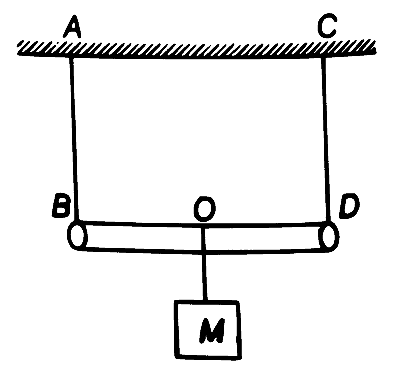
A rod of length $L$ and negligible mass is suspended by two identical strings $A B$ and $C D$ as shown in the figure A mass $M$ is suspended from point $O$ which is at a distance $x$ from $B$. If the frequency of the first harmonic of $A B$ is equal to the frequency of the second harmonic of $C D$, then the value of $x$ is
A tuning fork $A$ of frequency 250 Hz and another tuning fork $B$ of frequency $x$ produced 5 beats per second when vibrated together. If the fork $B$ is waxed and vibrated together with $A$, then 3 beats per second are produced. Then, $x=$
A wave is given by $y=5 \times 10^{-3} \sin \left(12.5 \pi x-\frac{\pi}{2} t\right)$. Then its wavelength and time period are respectively ( $y$ and $x$ are in metres and $t$ is in seconds)
An observer moves towards a stationary source of sound, with a speed of one fifth of the speed of sound. The apparent increase in the frequency heard by the observer is
If the seventh harmonic of a closed pipe is in unison with fourth harmonic of an open organ pipe, then the ratio of length of closed pipe to that of open pipe is
A source emitting sound is tied to one end of a string of length 50 cm and is rotated with an angular speed of $40 \mathrm{rad} \mathrm{s}^{-1}$ in the horizontal plane. The ratio of the maximum and minimum frequencies of the sound heard by an observer standing at a distance of 10 m from the fixed end of the string is
(speed of sound in air $=340 \mathrm{~ms}^{-1}$ )
One end of a string is tied to the ceiling of a lift and a load is attached at the bottom end of the string. When the lift is moving upwards with an acceleration of 2.1 $\mathrm{ms}^{-2}$, the speed of the transverse wave at the lower end of the string is $88 \mathrm{~ms}^{-1}$. If the lift moves downwards with an acceleration of $1.9 \mathrm{~ms}^{-2}$, the speed of the transverse wave at the lower end of the string is $\left(g=10 \mathrm{~ms}^{-2}\right)$
A source and an observer move away from each other with same velocity of $10 \mathrm{~ms}^{-1}$ with respect to ground. If the observer finds the frequency of sound coming from the source as 1980 Hz , then actual frequency of the source is (speed of sound in air $=340 \mathrm{~ms}^{-1}$ )
Among the following statements, the correct statement for a wave is
The transverse displacement $y(x, t)$ of a wave on a string is given by $y(x, t)=e^{-\left(a x^2+b t^2+2 \sqrt{a b x} t\right)}$. This represents a
A bus moving with an uniform speed of $72 \mathrm{~km} / \mathrm{h}$ towards a building blows a horn of frequency 1.7 kHz . If speed of sound in air is $340 \mathrm{~m} / \mathrm{s}$, what will be the frequency of echo heard by bus driver?
A wire of length 0.4 m stretched at both ends vibrates 250 times per second. If the length of the wire is increased by 0.1 m and the stretching force is reduced to $1 / 4$ th of its original value, then the new frequency is
Two strings $A$ and $B$ produce beat of frequency $\Delta f_1>0$. The tension in string $A$ is slightly increased and the beat frequency is found to be $\Delta f_2>0$. If the original frequency of $A$ is $f_0$ and $\Delta f_2<\Delta f_1$, then the frequency of $B$ is
A cylindrical tube open at both ends has a fundamental frequency $f$ in air. The tube is dipped vertically in water, so that half of it is in water. The new fundamental frequency is
Which of the following wave has the largest wave speed?

Showing 20 of 22 questions