Difficulty distribution
How the classified questions are distributed by difficulty.
26questions
Not classified
26
100%
Your cart is empty.
Practice Motion In A Straight Line - Mechanics - Physics previous year questions organised from real papers, with year-wise coverage and clear topic navigation.
Every graph below is calculated only from this selection.
Year-wise coverage for Motion In A Straight Line. Each bar uses a separate theme-derived color.
How the classified questions are distributed by difficulty.
MCQ, numerical, multiple-select and other formats found in these papers.
Top subjects by unique question coverage.
Top topics across the included previous year papers.
Top subtopics inside this exact selection.
Question coverage for the most populated papers. Every active PYP paper remains listed below.
Newest papers appear first. Sort by year, question coverage or name.
| Paper | Year / session | Questions in this view | Open |
|---|---|---|---|
| TS EAMCET 2023 (Online) 12th May Morning Shift | 2023 | 1 | View paper |
| TS EAMCET 2023 ONLINE 12TH MAY EVENING SHIFT | 2023 | 1 | View paper |
| TS EAMCET 2023 ONLINE 13TH MAY EVENING SHIFT | 2023 | 1 | View paper |
| TS EAMCET 2023 ONLINE 13TH MAY MORNING SHIFT | 2023 | 1 | View paper |
| TS EAMCET 2023 ONLINE 14TH MAY EVENING SHIFT | 2023 | 1 | View paper |
| TS EAMCET 2023 ONLINE 14TH MAY MORNING SHIFT | 2023 | 1 | View paper |
| TS EAMCET 2022 (Online) 19th July Evening Shift | 2022 | 1 | View paper |
| TS EAMCET 2022 (Online) 19th July Morning Shift | 2022 | 2 | View paper |
| TS EAMCET 2022 (Online) 20th July Evening Shift | 2022 | 1 | View paper |
| TS EAMCET 2022 (Online) 20th July Morning Shift | 2022 | 2 | View paper |
| TS EAMCET 2022 ONLINE 18TH JULY EVENING SHIFT | 2022 | 3 | View paper |
| TS EAMCET 2022 ONLINE 18TH JULY MORNING SHIFT | 2022 | 2 | View paper |
| TS EAMCET 2020 (Online) 10th September Evening Shift | 2020 | 1 | View paper |
| TS EAMCET 2020 (Online) 10th September Morning Shift | 2020 | 1 | View paper |
| TS EAMCET 2020 (Online) 11th September Evening Shift | 2020 | 2 | View paper |
| TS EAMCET 2020 (Online) 11th September Morning Shift | 2020 | 1 | View paper |
| TS EAMCET 2020 (Online) 14th September Evening Shift | 2020 | 2 | View paper |
| TS EAMCET 2020 (Online) 14th September Morning Shift | 2020 | 1 | View paper |
| TS EAMCET 2020 (Online) 14th September Morning Shift | 2020 | 1 | View paper |
Practice every matching question in batches of 20, with every available option.
Assertion (A) The zero velocity of a particle at any instant always implies zero acceleration at that instant.
Reason (R) A body is momentarily at rest when it reverses its direction of motion. The correct option among the following is
A river has a steady speed of $v$. A man swims upstream at a distance of $d$ and swims back to the starting point in total time $t$. The man can swim at a speed of $2 v$ in still water. If the time taken by the man in still water is $t_0$ to complete the same length of swim, then $\frac{t}{t_0}$ is
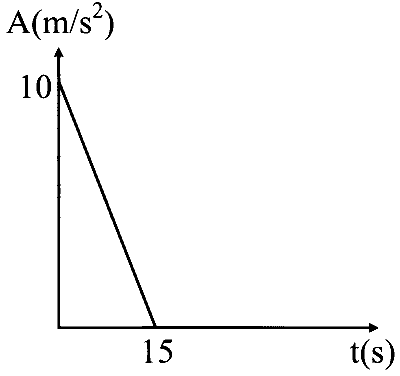
A particle starts from rest. Its acceleration (a) versus time $(t)$ graph is as shown in the figure. The maximum speed of the particle will be
A body starts from the rest and acquires a velocity of $10 \mathrm{~m} / \mathrm{s}$ in 2s. What is the acceleration of the body and the distance travelled?
A bullet fired into a target losses one-third of its velocity after travelling a distance $x$ metre into the target. If the bullet comes to rest by travelling a further distance $x^{\prime}$, then the ratio $\frac{x^{\prime}}{x}$ is
The ratio of the displacements of a freely falling body during first, second and third seconds of its motion is
A bird flies with a velocity $(t-2) \mathrm{ms}^{-1}$ along a straight line, where $t$ is the time in seconds. The distance covered by it in a time of 4 seconds is
A body starts rest with uniform acceleration. If its velocity after $n^{\text {th }}$ second (last second) is $v$ then its displacement in the last two seconds is
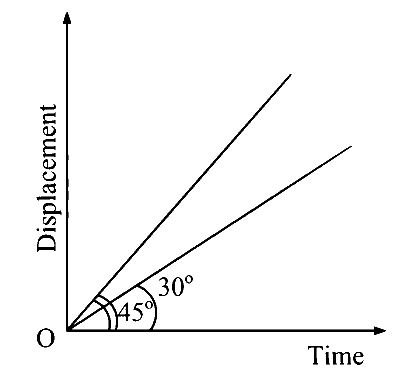
The displacement-time graphs of two moving particles make angles of $30^{\circ}$ and $45^{\circ}$ with the time axis. The ratio of their velocities is
The acceleration of a vertically projected body at its highest reaching position is
A particle is moving along the $Y$-axis. The position of the particle from the origin as a function of time $(t)$ is given as $y(t)=10 t e^{-2 t}$. How far is the particle from the origin when it stops momentarily? ( $y$ is given in units of metre and $t$ is in units of second)
A car travelling at $15 \mathrm{~m} / \mathrm{s}$ overtake another car travelling at $10 \mathrm{~m} / \mathrm{s}$. Assuming, each car is 4 m long. What is the time taken during the overtake?
A rocket moves straight upward with zero initial velocity and with an acceleration $20 \mathrm{~m} / \mathrm{s}^2$. It runs out of fuel and stops accelerating at the end of 5th second. It reaches a maximum height and falls back to the earth. The speed when it hits the ground is (take $g=10 \mathrm{~m} / \mathrm{s}^2$ )
A particle moves along a straight line, such that its displacement $x$ varies with time $t$ as $x=\alpha t^3+\beta t^2+\gamma$, where $\alpha, \beta$ and $\gamma$ are constants, $v_1$ is the average velocity of the particle during its journey between $t=1 \mathrm{~s}$ and $t=3 \mathrm{~s} . v_2$ is the instantaneous velocity of the particle at $t=3 \mathrm{~s}$. The ratio $\frac{v_1}{v_2}$ is
An aircraft is flying at a height of $h$ above the ground and at a speed of $v$. The maximum angle subtended at a ground observation point by the aircraft after time $t$ is
A car starts at time $t=0$ from an initial speed of $10 \mathrm{~m} / \mathrm{s}$ and accelerates uniformly with $2 \mathrm{~m} / \mathrm{s}^2$ on a straight road for time $0 \leq t \leq 10 \mathrm{~s}$. Let $s_1$ and $s_2$ be the distance covered by the car in time $3 \leq t \leq 4 \mathrm{~s}$ and $4 \leq t \leq 5 \mathrm{~s}$, respectively. The ratio $\frac{s_2}{s_1}$ is
A ball projected up passes the same height $H$ at 2 s and 10 s . The value of $H$ is (use, $g=9.8 \mathrm{~m} / \mathrm{s}^2$ )
Two towns $X$ and $Y$ are connected by a regular bus service. A bus leaves in either direction at every $t=T$ minutes. A man moving with same speed in the direction $X$ to $Y$ find that a bus goes past him every $t=t_1$ minutes in the direction of his motion, and every $t=t_2$ minutes in the opposite direction. Then, $T$ is given by
A ball is thrown vertically upwards with an initial velcoity $u$ reaches maximum height in 5 s . The ratio of distance travelled by the ball in the 2nd and 7th second is (assume, $g=10 \mathrm{~m} / \mathrm{s}^2$ )
Showing 20 of 25 questions