Difficulty distribution
How the classified questions are distributed by difficulty.
23questions
Not classified
23
100%
Your cart is empty.
Practice Laws Of Motion - Mechanics - Physics previous year questions organised from real papers, with year-wise coverage and clear topic navigation.
Every graph below is calculated only from this selection.
Year-wise coverage for Laws Of Motion. Each bar uses a separate theme-derived color.
How the classified questions are distributed by difficulty.
MCQ, numerical, multiple-select and other formats found in these papers.
Top subjects by unique question coverage.
Top topics across the included previous year papers.
Top subtopics inside this exact selection.
Question coverage for the most populated papers. Every active PYP paper remains listed below.
Newest papers appear first. Sort by year, question coverage or name.
| Paper | Year / session | Questions in this view | Open |
|---|---|---|---|
| TS EAMCET 2023 ONLINE 12TH MAY EVENING SHIFT | 2023 | 2 | View paper |
| TS EAMCET 2023 ONLINE 13TH MAY EVENING SHIFT | 2023 | 1 | View paper |
| TS EAMCET 2023 ONLINE 13TH MAY MORNING SHIFT | 2023 | 1 | View paper |
| TS EAMCET 2023 ONLINE 14TH MAY MORNING SHIFT | 2023 | 2 | View paper |
| TS EAMCET 2022 (Online) 19th July Evening Shift | 2022 | 1 | View paper |
| TS EAMCET 2022 (Online) 19th July Morning Shift | 2022 | 1 | View paper |
| TS EAMCET 2022 (Online) 20th July Morning Shift | 2022 | 1 | View paper |
| TS EAMCET 2022 ONLINE 18TH JULY EVENING SHIFT | 2022 | 1 | View paper |
| TS EAMCET 2022 ONLINE 18TH JULY MORNING SHIFT | 2022 | 2 | View paper |
| TS EAMCET 2020 (Online) 10th September Evening Shift | 2020 | 1 | View paper |
| TS EAMCET 2020 (Online) 10th September Morning Shift | 2020 | 2 | View paper |
| TS EAMCET 2020 (Online) 11th September Morning Shift | 2020 | 2 | View paper |
| TS EAMCET 2020 (Online) 14th September Evening Shift | 2020 | 2 | View paper |
| TS EAMCET 2020 (Online) 14th September Morning Shift | 2020 | 2 | View paper |
| TS EAMCET 2020 (Online) 14th September Morning Shift | 2020 | 2 | View paper |
Practice every matching question in batches of 20, with every available option.
A block is placed on a parabolic shape ramp given by equation, $y=\frac{x^2}{20}$. If the coefficient of static friction $\left(\mu_s\right)$ is 0.5 , then what is the maximum height above the ground at which the block can be placed without slipping?
Two blocks of masses 1 kg and 2 kg connected by a light rod and the system is slipping down a rough incline angle $45^{\circ}$ with the horizontal. The frictional coefficient at both the contacts is 0.4 . If the acceleration of the system is $\alpha \sqrt{2}$, the value of $\alpha$ is (use, $g=10 \mathrm{~m} / \mathrm{s}^2$ )
A time varying force acts on a ball of mass 100 g for 2 ms . The force versus time curve is shown below. If the initial speed of the ball is $10 \mathrm{~m} / \mathrm{s}$, then the speed of ball after 2 ms is
A body of mass 6 kg is moving with a uniform velocity $4 \mathrm{~ms}^{-1}$. Its velocity changes to $6 \mathrm{~ms}^{-1}$ when a force of 12 N acts on it. Then its displacement is
Two blocks of masses $w_1$ and $w_2$ are suspended from the ends of a light string passing over a smooth fixed pulley. If the pulley is pulled up with an acceleration $g$, then the tension in the string will be
A body of weight 50 N is placed on a horizontal surface as shown in the figure. The minimum force required to move the body is 28.28 N . The frictional force and the normal reaction are respectively
If a man of mass 50 kg is in a lift moving down with an acceleration equal to acceleration due to gravity, then the apparent weight of the man is
A block of mass 3 kg is pressed against a vertical wall by applying a force $F$ at an angle $30^{\circ}$ to the horizontal as shown in the figure. As a result, the block is prevented from falling down. If the coefficient of static friction between the block and wall is $\sqrt{3}$, then the value of $F$ is (use, $g=10 \mathrm{~m} / \mathrm{s}^2$ )

When a bullet is fired from a rifle its momentum becomes $20 \mathrm{~kg}-\mathrm{ms}^{-1}$. If the velocity of the bullet is $1000 \mathrm{~ms}^{-1}$, then what is its mass?
A block is between two surfaces as shown in the figure. Find the normal reaction at both surfaces. [Assume, $g=10 \mathrm{~m} / \mathrm{s}^2$ ]

A constant horizontal force $\mathbf{F}$ of magnitude 10 N is applied to a block $A$ and this produces an acceleration of magnitude $20 \mathrm{~m} / \mathrm{s}^2$. If this block $A$ is then kept against another block $B$ of mass 1.5 kg as shown in figure and a force $F^{\prime}$ of 20 N is applied, find the force on the block $B$. Neglect friction

A motor car moving with velocity $7 \mathrm{~m} / \mathrm{s}$ stops at 10 m distance when brakes are applied. What is the relation between the resistance force $R$ and the weight $w$ of the car? (take, value of $g=9.8 \mathrm{~m} / \mathrm{s}^2$ )
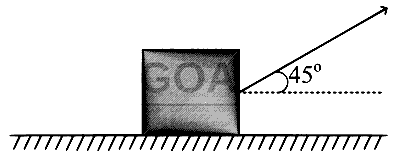
At time $t=0$, a force $F=\alpha t$, where $t$ is time in seconds, is applied to a body of mass 1 kg , resting on a smooth horizontal plane. If the direction of the force makes an angle of $45^{\circ}$ with the horizontal, then the velocity of the body at the moment of its breaking off the plane is
An infinite number of masses are placed on a frictionless table and they are connected via massless strings. Their masses follow the sequence, $m, \frac{m}{2}, \frac{m}{6}, \ldots \ldots \ldots . . \frac{m}{n!}, \ldots \ldots$. and they are further connected to a mass $m$ that hangs over a massless pulley. The acceleration of the hanging mass is

A block of mass $m=2 \mathrm{~kg}$ is initially at rest on a horizontal surface. A horizontal force $\mathbf{F}_1=(6 \mathrm{~N}) \hat{\mathbf{i}}$ and a vertical force $\mathbf{F}_2=(10 \mathrm{~N}) \hat{\mathbf{j}}$ are then applied to the block. The coefficients of static friction and kinetic friction for the block and the surfaces are 0.4 and 0.25 , respectively. The magnitude of the frictional force acting on the block is (assume, $g=10 \mathrm{~m} / \mathrm{s}^2$ )

A block rests on a fixed wedge inclined at an angle $\theta$. The coefficient of friction between the block and plane is $\mu$. The maximum value of $\theta$ for the block to remain motionless on the
wedge is

A block of mass 4 kg at rest on a rough inclined plane making an angle of $\theta$ with the horizontal. The coefficient of static friction between the block and plane is 0.5 and the frictional force on the block is 14.14 N , find the value of $\theta$ ?
The velocity of an object of mass 2 kg is given by $\mathbf{v}=\left(8 t \hat{\mathbf{i}}+3 t^2 \hat{\mathbf{j}}\right) \mathrm{m} / \mathrm{s}$, where $t$ is time in seconds. What will be the direction of net force on the object relative to the positive direction of $X$-axis, at the instant when its magnitude is 20 N ?
Showing 20 of 21 questions