Difficulty distribution
How the classified questions are distributed by difficulty.
83questions
Not classified
83
100%
Your cart is empty.
Practice Heat And Thermodynamics - Mechanics - Physics previous year questions organised from real papers, with year-wise coverage and clear topic navigation.
Every graph below is calculated only from this selection.
Year-wise coverage for Heat And Thermodynamics. Each bar uses a separate theme-derived color.
How the classified questions are distributed by difficulty.
MCQ, numerical, multiple-select and other formats found in these papers.
Top subjects by unique question coverage.
Top topics across the included previous year papers.
Top subtopics inside this exact selection.
Question coverage for the most populated papers. Every active PYP paper remains listed below.
Newest papers appear first. Sort by year, question coverage or name.
| Paper | Year / session | Questions in this view | Open |
|---|---|---|---|
| TS EAMCET 2023 (Online) 12th May Morning Shift | 2023 | 4 | View paper |
| TS EAMCET 2023 ONLINE 12TH MAY EVENING SHIFT | 2023 | 4 | View paper |
| TS EAMCET 2023 ONLINE 13TH MAY EVENING SHIFT | 2023 | 5 | View paper |
| TS EAMCET 2023 ONLINE 13TH MAY MORNING SHIFT | 2023 | 4 | View paper |
| TS EAMCET 2023 ONLINE 14TH MAY EVENING SHIFT | 2023 | 4 | View paper |
| TS EAMCET 2023 ONLINE 14TH MAY MORNING SHIFT | 2023 | 4 | View paper |
| TS EAMCET 2022 (Online) 19th July Evening Shift | 2022 | 5 | View paper |
| TS EAMCET 2022 (Online) 19th July Morning Shift | 2022 | 5 | View paper |
| TS EAMCET 2022 (Online) 20th July Evening Shift | 2022 | 5 | View paper |
| TS EAMCET 2022 (Online) 20th July Morning Shift | 2022 | 5 | View paper |
| TS EAMCET 2022 ONLINE 18TH JULY EVENING SHIFT | 2022 | 5 | View paper |
| TS EAMCET 2022 ONLINE 18TH JULY MORNING SHIFT | 2022 | 5 | View paper |
| TS EAMCET 2020 (Online) 10th September Evening Shift | 2020 | 4 | View paper |
| TS EAMCET 2020 (Online) 10th September Morning Shift | 2020 | 4 | View paper |
| TS EAMCET 2020 (Online) 11th September Evening Shift | 2020 | 4 | View paper |
| TS EAMCET 2020 (Online) 11th September Morning Shift | 2020 | 4 | View paper |
| TS EAMCET 2020 (Online) 14th September Evening Shift | 2020 | 4 | View paper |
| TS EAMCET 2020 (Online) 14th September Morning Shift | 2020 | 4 | View paper |
| TS EAMCET 2020 (Online) 14th September Morning Shift | 2020 | 4 | View paper |
Practice every matching question in batches of 20, with every available option.
Statement I Gas thermometers are less sensitive than liquid thermometers.
Statement II The ratio of universal gas constant and avogadro's number is called Boltzmann's constant.
Statement III The density of a given mass of a gas at constant pressure is inversely proportional to its absolute temperature.
The correct option among the following is
A hole of diameter 5 cm is drilled in a metal sheet at $30^{\circ} \mathrm{C}$. The linear expansion of metal is $2 \times 10^{-5} \mathrm{~K}^{-1}$. The diameter of the hole when the temperature is raised to $230^{\circ} \mathrm{C}$, is equal to
A metal cube absorbs 2100.0 J of heat when its temperature is raised by $2^{\circ} \mathrm{C}$. If the specific heat of the metal is $900 \mathrm{~J} \mathrm{~kg}^{-1} \mathrm{~K}^{-1}$, then the mass of the cube is
The net work done by an ideal gas going through the cycle as shown in the $p-V$ diagram below is
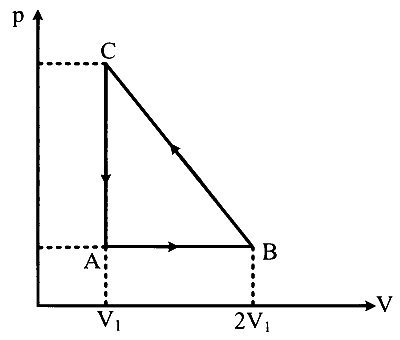
A diatomic gas $\left(C_p=\frac{7}{2} R\right)$ does 200 J of work when it is expanded isobarically. The heat given to the gas in the process is
An object cools from $100^{\circ} \mathrm{C}$ to $40^{\circ} \mathrm{C}$ in 10 min , when the surrounding temperature is $10^{\circ} \mathrm{C}$. Then the time taken by the object to cool from $70^{\circ} \mathrm{C}$ to $20^{\circ} \mathrm{C}$ is (take, $\ln 2=0.7, \ln 3=11, \ln 6=18$ )
1.00 kg of liquid water at $100^{\circ} \mathrm{C}$ undergoes a phase change into steam at $100^{\circ} \mathrm{C}$ at 1.0 atm (take it to be $1.00 \times 10^5 \mathrm{~Pa}$ ). The initial volume of the liquid water was $1.00 \times 10^{-3} \mathrm{~m}^3$ which is changed to $2.001 \mathrm{~m}^3$ of steam. Find the change in the internal energy of the system.
(Use heat of vaporisation $\simeq 2000 \mathrm{~kJ} / \mathrm{kg}$ )
A monoatomic gas does 100 J of work, when it is expanded isobarically. How much of heat is given to the gas in the process?
If the root mean square (rms) speed of nitrogen molecules at room temperature is $100 \mathrm{~m} / \mathrm{s}$, then the rms speed of helium molecule at the same temperature is
Find the ratio of the length of a steel rod and a copper rod, if the steel rod is 4 cm longer, then the copper rod at any temperature.
(The coefficient of linear expansion for steel and copper are $1.1 \times 10^{-5} /{ }^{\circ} \mathrm{C}$ and $1.7 \times 10^{-5} /{ }^{\circ} \mathrm{C}$, respectively)
Two rod of same area of cross-section have lengths $L$ and $2 L$ and coefficients of linear expansions $2 \alpha$ and $a$ respectively. If they are welded to form a composite rod of length $3 L$ then the coefficient of linear expansion of the composite rod is
An insulating cylinder contains 4 moles of an ideal diatomic gas. When a heat $Q$ is supplied to it, 2 moles of the gas molecules dissociate. If the temperature of the gas remains constant, then the value of $Q$ is ( $R=$ universal gas constant)
For a given mass of a gas at constant temperature, the volume and the pressure are $V$ and $p$ respectively. Then the slope of the graph drawn between $\log _e V$ on $X$-axis and $\log _e p$ on $Y$-axis is
An ideal gas at $127^{\circ} \mathrm{C}$ is compressed suddenly to $8 / 27 \mathrm{}$of its initial volume. If $\gamma=5 / 3$ for an ideal gas, then rise in its temperature is
The heat energy required to convert 10 kg of ice at $-10^{\circ} \mathrm{C}$ into water at $0^{\circ} \mathrm{C}$ is (specific heat capacity of ice $=0.5 \mathrm{calg}^{-1}$ and latent heat of fusion of ice $=80 \mathrm{calg}^{-1}$ )
When some amount of heat energy is supplied to a monatomic gas, the percentage of heat energy used for increasing the internal energy of the gas $(\gamma=5 / 3)$ is
The average energy possessed by an oscillator at a temperature 300 K is (Boltzmann constant $=1.38 \times 10^{-23} \mathrm{JK}^{-1}$ )
The length of a metal rod at $30^{\circ} \mathrm{C}$ is 30 cm . If its temperature is raised to $105^{\circ} \mathrm{C}$, its length is increased by 0.027 cm . Then, the coefficient of linear expansion of the metal is
If the reading in Fahrenheit scale is twice the reading in Celsius scale, then the reading in Fahrenheit scale is
Two identical containers $A$ and $B$ with frictionless pistons contain the same ideal gas at the same temperature and same volume $V$. The mass of the gas in $A$ is $m_A$ and that in $B$ is $m_B$. The gas in each cylinder is now allowed to expand isothermally to the same final volume $2 V$. The changes in the pressure of the gases in $A$ and $B$ are found to be $2 \Delta p$ and $3 \Delta p$ respectively. Then the relation between $m_A$ and $m_B$ is
Showing 20 of 79 questions