Difficulty distribution
How the classified questions are distributed by difficulty.
16questions
Not classified
16
100%
Your cart is empty.
Practice Center Of Mass - Mechanics - Physics previous year questions organised from real papers, with year-wise coverage and clear topic navigation.
Every graph below is calculated only from this selection.
Year-wise coverage for Center Of Mass. Each bar uses a separate theme-derived color.
How the classified questions are distributed by difficulty.
MCQ, numerical, multiple-select and other formats found in these papers.
Top subjects by unique question coverage.
Top topics across the included previous year papers.
Top subtopics inside this exact selection.
Question coverage for the most populated papers. Every active PYP paper remains listed below.
Newest papers appear first. Sort by year, question coverage or name.
| Paper | Year / session | Questions in this view | Open |
|---|---|---|---|
| TS EAMCET 2023 (Online) 12th May Morning Shift | 2023 | 1 | View paper |
| TS EAMCET 2023 ONLINE 13TH MAY EVENING SHIFT | 2023 | 1 | View paper |
| TS EAMCET 2023 ONLINE 13TH MAY MORNING SHIFT | 2023 | 3 | View paper |
| TS EAMCET 2023 ONLINE 14TH MAY EVENING SHIFT | 2023 | 1 | View paper |
| TS EAMCET 2023 ONLINE 14TH MAY MORNING SHIFT | 2023 | 1 | View paper |
| TS EAMCET 2022 (Online) 19th July Evening Shift | 2022 | 1 | View paper |
| TS EAMCET 2022 (Online) 19th July Morning Shift | 2022 | 1 | View paper |
| TS EAMCET 2022 ONLINE 18TH JULY EVENING SHIFT | 2022 | 1 | View paper |
| TS EAMCET 2022 ONLINE 18TH JULY MORNING SHIFT | 2022 | 1 | View paper |
| TS EAMCET 2020 (Online) 10th September Morning Shift | 2020 | 2 | View paper |
| TS EAMCET 2020 (Online) 14th September Evening Shift | 2020 | 1 | View paper |
| TS EAMCET 2020 (Online) 14th September Morning Shift | 2020 | 1 | View paper |
| TS EAMCET 2020 (Online) 14th September Morning Shift | 2020 | 1 | View paper |
Practice every matching question in batches of 20, with every available option.
A moving particle collides with a stationary particle of mass $\frac{1}{n}$ times the mass of moving particle, the fraction of its kinetic energy transferred to the stationary particle is
Four masses are arranged along a circle of radius 1 m as shown in the figure. The centre of mass of this system of masses is at

Two blocks of masses 2 kg and 1 kg are tied to the ends of a string which passes over a light frictionless pulley. The blocks are held at the same horizontal level and then released suddenly. The distance traversed by their centre of mass in 2 sec is
(acceleration due to gravity $=10 \mathrm{~ms}^{-2}$ )
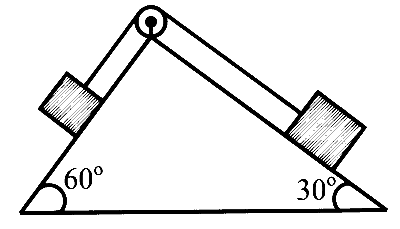
Two blocks of equal masses are tied to the ends of a light string. The string passes over a mass less pulley fixed on frictionless surface as shown in the figure. The acceleration of the centre of mass of the blocks is ( $g=$ acceleration due to gravity)
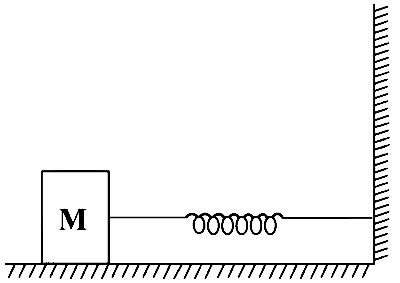
A block of mass $M$ moving on a frictionless horizontal surface collides with a spring of spring constant $K$, as shown in the figure. If the spring compresses by a length $L$, then the maximum momentum of the block after the collision is
A body falls freely from a height $h$ on a fixed horizontal plane and rebounds. If $e$ is the coefficient of restitution, the total distance travelled before it comes to rest is
A bomb of mass 16 kg explodes into two pieces of masses 4 kg and 12 kg . The velocity of the 12 kg mass is $4 \mathrm{~ms}^{-1}$. The kinetic energy of the second piece is
A ball falls freely from a height $h$ on a rigid horizontal plane. If the coefficient of restitution is $e$, then the total distance travelled by the ball before hitting the plane second time is
A circular hole of radius 3 cm is cut out from a uniform circular disc of radius 6 cm . The centre of the hole is at 3 cm , from the centre of the original disc. The distance of centre of gravity of the resulting flat body from the centre of the original disc is
A bullet of mass 25 g moves horizontally at a speed of $250 \mathrm{~m} / \mathrm{s}$ is fired into a wooden block of mass 1 kg suspended by a long string. The bullet crosses the block and emerges on the other side. If the centre of the mass of the block rises through a height of 20 cm . The speed of the bullet as it emerges from the block is (take, $g=10 \mathrm{~m} / \mathrm{s}^2$ )
Particle $A$ moving with a velocity $v=10 \mathrm{~m} / \mathrm{s}$ experienced a head on collision with a stationary particle $B$ of the same mass. As a result of collision, the kinetic energy of the system decreased by $1 \%$. The speed of particle $A$ after collision is
Assertion (A) In an elastic collision of two billiard balls, both kinetic energy and linear momentum remain conserved.
Reason (R) During the collision of the balls, as the collision is elastic there is no exchange of energy. Therefore, both energy and momentum are conserved. The correct option among the following is
Two blocks of equal masses are connected with a massless spring of spring constant $2500 \mathrm{~N} / \mathrm{m}^2$ and length 10 cm at rest on the frictionless horizontal plane. If a constant horizontal force 10 N is applied as shown in the figure, find the maximum distance between the blocks.

A moving body with a mass $m_1$ and velocity $u$ strikes a stationary body of mass $m_2$. The masses $m_1$ and $m_2$ should be in the ratio $\frac{m_1}{m_2}$, so as to decrease the velocity of the first body to $\frac{2 u}{3}$ and giving a velocity of $v$ to $m_2$ assuming a perfectly elastic impact. Then, the ratio $\frac{m_1}{m_2}$ is