Difficulty distribution
How the classified questions are distributed by difficulty.
32questions
Not classified
32
100%
Your cart is empty.
Practice Electrostatics - Electromagnetism - Physics previous year questions organised from real papers, with year-wise coverage and clear topic navigation.
Every graph below is calculated only from this selection.
Year-wise coverage for Electrostatics. Each bar uses a separate theme-derived color.
How the classified questions are distributed by difficulty.
MCQ, numerical, multiple-select and other formats found in these papers.
Top subjects by unique question coverage.
Top topics across the included previous year papers.
Top subtopics inside this exact selection.
Question coverage for the most populated papers. Every active PYP paper remains listed below.
Newest papers appear first. Sort by year, question coverage or name.
| Paper | Year / session | Questions in this view | Open |
|---|---|---|---|
| TS EAMCET 2023 (Online) 12th May Morning Shift | 2023 | 2 | View paper |
| TS EAMCET 2023 ONLINE 12TH MAY EVENING SHIFT | 2023 | 1 | View paper |
| TS EAMCET 2023 ONLINE 13TH MAY EVENING SHIFT | 2023 | 3 | View paper |
| TS EAMCET 2023 ONLINE 13TH MAY MORNING SHIFT | 2023 | 1 | View paper |
| TS EAMCET 2023 ONLINE 14TH MAY EVENING SHIFT | 2023 | 1 | View paper |
| TS EAMCET 2023 ONLINE 14TH MAY MORNING SHIFT | 2023 | 1 | View paper |
| TS EAMCET 2022 (Online) 19th July Evening Shift | 2022 | 2 | View paper |
| TS EAMCET 2022 (Online) 19th July Morning Shift | 2022 | 3 | View paper |
| TS EAMCET 2022 (Online) 20th July Evening Shift | 2022 | 2 | View paper |
| TS EAMCET 2022 (Online) 20th July Morning Shift | 2022 | 2 | View paper |
| TS EAMCET 2022 ONLINE 18TH JULY EVENING SHIFT | 2022 | 1 | View paper |
| TS EAMCET 2022 ONLINE 18TH JULY MORNING SHIFT | 2022 | 1 | View paper |
| TS EAMCET 2020 (Online) 10th September Evening Shift | 2020 | 2 | View paper |
| TS EAMCET 2020 (Online) 10th September Morning Shift | 2020 | 1 | View paper |
| TS EAMCET 2020 (Online) 11th September Evening Shift | 2020 | 2 | View paper |
| TS EAMCET 2020 (Online) 11th September Morning Shift | 2020 | 1 | View paper |
| TS EAMCET 2020 (Online) 14th September Evening Shift | 2020 | 2 | View paper |
| TS EAMCET 2020 (Online) 14th September Morning Shift | 2020 | 2 | View paper |
| TS EAMCET 2020 (Online) 14th September Morning Shift | 2020 | 2 | View paper |
Practice every matching question in batches of 20, with every available option.
A large metal plate has a surface charge density of $8.85 \times 10^{-6} \mathrm{C} / \mathrm{m}^2$. An electron having initial kinetic energy of $8 \times 10^{-17} \mathrm{~J}$ is moving towards the centre of the plate. If the electron stops just before reaching the plate, then the initial distance between the electron and the plate is
[take $\varepsilon_0=8.85 \times 10^{-12} \mathrm{C}^2 / \mathrm{N}-\mathrm{m}^2$ ]
An electron is released from a distance of 4 m from a stationary point charge 20 nC . What will be the speed of the electron, when it is
2 m away from the point charge?
(Charge of electron $=1.6 \times 10^{-19} \mathrm{C}$, mass of electron
$$=9 \times 10^{-31} \mathrm{~kg}, \frac{1}{4 \pi \varepsilon_0}=9 \times 10^9 \text { SI unit) }$$
Two electric charges $+2 \mu \mathrm{C}$ and $-4 \mu \mathrm{C}$ are separated by a distance 3 m in air. At a point $P$ located on the line joining the two charges and in between them, the electric potential is zero. Then the electric field at a point $P$ (in $\mathrm{NC}^{-1}$ ) is
Two conducting spheres of radii $r_1$ and $r_2$ are charged to the same surface charge density. The ratio of electric fields near their surfaces is
The ratio of relative strengths of the gravitational force and the electromagnetic force between two charged particles is
The flux of the electric field $\mathbf{E}=24 \hat{\mathbf{i}}+30 \hat{\mathbf{j}}+28 \hat{\mathbf{k}} \mathrm{NC}^{-1}$ through an area of $20 \mathrm{~m}^2$ on the $Y Z$-plane is
A hollow spherical shell of radius $r$ has a uniform charge density $\sigma$. It is kept in a cube of edge $3 r$ such that the centres of the cube and the shell coincide. Then the electric flux coming out of one face of a cube is ( $\varepsilon_0=$ permittivity of free space)
If the electric potential at a point on the surface of a hollow conducting sphere of radius $R$ is $V$, then the electric potential at a point which is at distance $R / 3$ from the centre of the sphere is
An infinite non-conducting sheet has a surface charge density $2 \times 10^{-7} \mathrm{C} / \mathrm{m}^2$ on one side. The distance between two equipotential surfaces whose potential differ by 90 V is (assume, $\frac{1}{4 \pi \varepsilon_0}=9 \times 10^9 \frac{\mathrm{Nm}^2}{\mathrm{C}^2}$ )
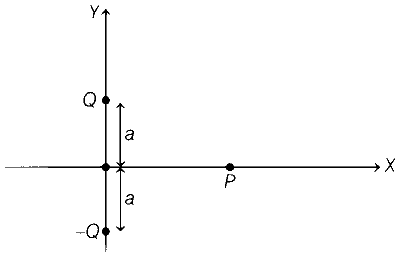
Two negative charges of equal magnitude are located in $x y$-plane as shown below in the figure. The direction of the electric field at point $P$ is
If a proton is moved against the coulomb force of an electric field, then
$6 \mu \mathrm{C}$ charge is placed at the centre of a cube. What will be the electric flux at each face of the cube?
$$\left[\text { Take, } \frac{1}{4 \pi \varepsilon_0}=9 \times 10^9 \mathrm{~N}-\mathrm{m}^2 \mathrm{C}^2\right]$$
There are two thin wire rings, each of radius $R$, whose axes coincide. The charges of the rings are $q$ and $-q$. The magnitude of potential difference between the centres of the rings separated by a distance $\sqrt{3} R$ is
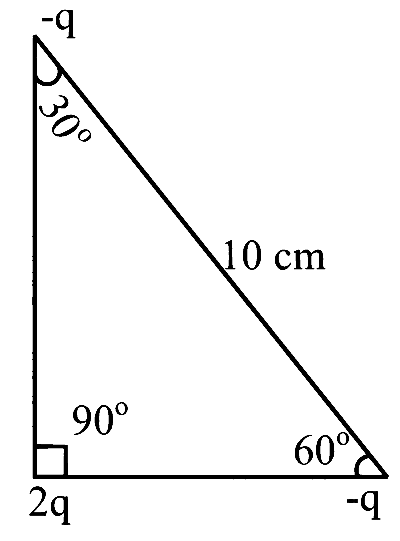
Three charges are arranged on the vertices of a right angle triangle as shown in the figure. The magnitude of dipole moment of the combination in the unit of $\mathrm{C}-\mathrm{cm}$ is
A particle of mass $m$ and charge $q$ travelling with a velocity $v$ along the $X$-axis enters a uniform electric field $\mathbf{E}$ directed along the $Y$-axis. What will be the trajectory of the particle?
Two charged particles of mass 1 g each are placed 1 m apart. If each of these possesses 1 femto coulomb of charge, then the dominant force of interaction between them is
Two metal spheres have their radii in the ratio of $4: 7$. They are put in contact and a charge $8.8 \times 10^{-7} \mathrm{C}$ is given to the system. Then they are separated, so that each can exert no influence on the other. The potential due to the smaller sphere at 60 m from it in V is
A small block of mass 5 g and charge $5 \mu \mathrm{C}$ is placed on insulated, frictionless, inclined plane of angle $60^{\circ}$. An electric field is applied parallel to the inclined plane. If the block remains at rest, then the magnitude of electric field is (take, $g=10 \mathrm{~m} / \mathrm{s}^2$ )
A sphere-1 with redius $R$ has charge $q$. Sphere-2 with radius $3 R$ is far from sphere-1 and is initially uncharged. If the two spheres are now connected with a thin conducting wire, then the ratio $\frac{\sigma_1}{\sigma_2}$ of the surface charge densities is
Showing 20 of 30 questions