Difficulty distribution
How the classified questions are distributed by difficulty.
17questions
Not classified
17
100%
Your cart is empty.
Practice Thermodynamics - Physical Chemistry - Chemistry previous year questions organised from real papers, with year-wise coverage and clear topic navigation.
Every graph below is calculated only from this selection.
Year-wise coverage for Thermodynamics. Each bar uses a separate theme-derived color.
How the classified questions are distributed by difficulty.
MCQ, numerical, multiple-select and other formats found in these papers.
Top subjects by unique question coverage.
Top topics across the included previous year papers.
Top subtopics inside this exact selection.
Question coverage for the most populated papers. Every active PYP paper remains listed below.
Newest papers appear first. Sort by year, question coverage or name.
| Paper | Year / session | Questions in this view | Open |
|---|---|---|---|
| TS EAMCET 2023 (Online) 12th May Morning Shift | 2023 | 1 | View paper |
| TS EAMCET 2023 ONLINE 12TH MAY EVENING SHIFT | 2023 | 1 | View paper |
| TS EAMCET 2023 ONLINE 13TH MAY EVENING SHIFT | 2023 | 1 | View paper |
| TS EAMCET 2023 ONLINE 13TH MAY MORNING SHIFT | 2023 | 1 | View paper |
| TS EAMCET 2023 ONLINE 14TH MAY EVENING SHIFT | 2023 | 1 | View paper |
| TS EAMCET 2023 ONLINE 14TH MAY MORNING SHIFT | 2023 | 1 | View paper |
| TS EAMCET 2022 (Online) 19th July Evening Shift | 2022 | 1 | View paper |
| TS EAMCET 2022 (Online) 19th July Morning Shift | 2022 | 1 | View paper |
| TS EAMCET 2022 (Online) 20th July Evening Shift | 2022 | 1 | View paper |
| TS EAMCET 2022 (Online) 20th July Morning Shift | 2022 | 2 | View paper |
| TS EAMCET 2022 ONLINE 18TH JULY EVENING SHIFT | 2022 | 3 | View paper |
| TS EAMCET 2022 ONLINE 18TH JULY MORNING SHIFT | 2022 | 1 | View paper |
| TS EAMCET 2020 (Online) 10th September Evening Shift | 2020 | 1 | View paper |
| TS EAMCET 2020 (Online) 10th September Morning Shift | 2020 | 1 | View paper |
Practice every matching question in batches of 20, with every available option.
Among the following given substances, the one with zero $\Delta_f H^{\circ}$ is
The change in enthalpy $[\Delta H]$ in $\mathrm{kJ} \mathrm{mol}^{-1}$ for the reaction, $\mathrm{Mg}+2 \mathrm{~F} \longrightarrow \mathrm{MgF}_2$ is
Given, electron affinity of $\mathrm{F}=328 \mathrm{~kJ} \mathrm{~mol}^{-1}$,
IE ${ }_1$ of $\mathrm{Mg}=737 \mathrm{kJmol}^{-1}, \mathrm{IE}_2$ of $\mathrm{Mg}=1451 \mathrm{kJmol}^{-1}$
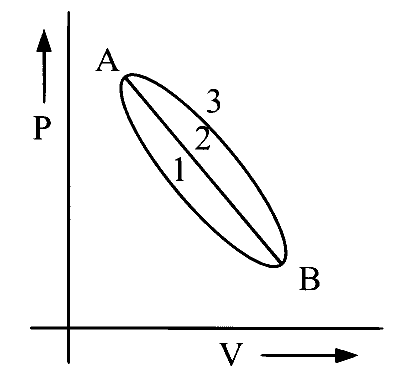
A certain mass of a gas was brought from state $A$ to $B$ by following three different paths, namely 1,2 and 3 , respectively. Which of the following relations is correct for the work done?
If 92 g Na reacts with water in open vessel at 300 K . What is the value of work done?
[Assume ideal nature of the gaseous product.]
The enthalpies of formation of gaseous $\mathrm{N}_2 \mathrm{O}$ and NO at 298 K are 82.0 and $90.0 \mathrm{~kJ} \mathrm{~mol}^{-1}$ respectively. The enthalpy change of the reaction
$\mathrm{N}_2 \mathrm{O}(g)+\frac{1}{2} \mathrm{O}_2(g) \longrightarrow 2 \mathrm{NO}(g)$ is
In. Observe the following properties.
II. Mass
III. Internal energy
IV. Volume
v. Enthalpy
VI. Temperature
VII. Density
The intensive properties in the above list are
Enthalpy of formation of $\mathrm{CO}(g), \mathrm{CO}_2(g)$ are -110 , $-393 \mathrm{~kJ} \mathrm{~mol}^{-1}$ respectively. The enthalpy of combustion of CO (in $\mathrm{kJ} \mathrm{mol}^{-1}$ ) is
At $T(\mathrm{~K}) 2$ mole of an ideal gas is allowed to expand reversibly and isothermally from a pressure of 10 atmospheres to 1 atmosphere. The work done (in kJ ) is $\left(R=8.3 \mathrm{JK}^{-1} \mathrm{~mol}^{-1}\right)$
For the reaction at $25^{\circ} \mathrm{C}, X_2 \mathrm{O}_4(l) \longrightarrow 2 \mathrm{XO}_2(g), \Delta U$ and $\Delta S$ are 2.1 k cal and $20 \mathrm{cal} / \mathrm{K}$ respectively. What is $\Delta \mathrm{G}$ for the reaction at the same temperature? ( $R=2 \mathrm{cal} \mathrm{K}^{-1} \mathrm{~mol}^{-1}$ )
What will be the $\Delta U$ value, when one mole of oxygen $\left(\mathrm{O}_2\right)$ is going from $-20^{\circ} \mathrm{C}$ to $40^{\circ} \mathrm{C}$ at constant volume? (Molar heat capacity for oxygen $\simeq 20.8 \mathrm{~J} \mathrm{~mol}^{-1} \mathrm{~K}^{-1}$ )
$\Delta H$ and $\Delta S$ for a reaction are $+30.0 \mathrm{~kJ} \mathrm{~mol}^{-1}$ and 0.06 $\mathrm{kJK}^{-1} \mathrm{~mol}^{-1}$ at 1 atm pressure. The temperature at which free energy change is equal to zero and nature of the reaction below this temperature are
An air bag on adiabatic expansion undergoes $5 \%$ increase in its volume. The percentage change in pressure is $\left[\gamma_{\text {air }}=1.4\right]$
Given,
$$\mathrm{H}_2(g)+\frac{1}{2} \mathrm{O}_2(g) \longrightarrow \mathrm{H}_2 \mathrm{O}(l) ; \Delta H=-285 \mathrm{~kJ}$$
$$\begin{aligned} & \mathrm{N}_2 \mathrm{O}_5(g)+\mathrm{H}_2 \mathrm{O}(l) \longrightarrow 2 \mathrm{HNO}_3(l) ; \Delta H=-76.6 \mathrm{~kJ} \\ & \mathrm{~N}_2(g)+3 \mathrm{O}_2(g)+\mathrm{H}_2(g) \longrightarrow 2 \mathrm{HNO}_3(l) ; \\ & \Delta H=-348.2 \mathrm{~kJ} \end{aligned}$$
Calculate the $\Delta \mathrm{H}$ of $2 \mathrm{~N}_2(\mathrm{~g})+5 \mathrm{O}_2(\mathrm{~g}) \longrightarrow 2 \mathrm{~N}_2 \mathrm{O}_5(\mathrm{~g})$.
The bond enthalpies of heavy hydrogen, $\mathrm{O}-\mathrm{O}$ and $\mathrm{D}-\mathrm{O}$ are $+400,+498$ and $+490 \mathrm{kJmol}^{-1}$, respectively. The $\Delta_r H^{\circ}$ of the reaction to produce $\mathrm{D}_2 \mathrm{O}$ is
In the reaction, $\mathrm{H}_2 \mathrm{O}(l) E \longrightarrow \mathrm{H}_2 \mathrm{O}(s)$ at $0^{\circ} \mathrm{C}$ and 1 atom, the internal energy change is $-41 \mathrm{~kJ} / \mathrm{mol}$. What will be the value of molar enthalpy change?
The correct order of " $\Delta H_f^{\circ}$ " values of diamond (I), graphite (II) and fullerene (III) is