Difficulty distribution
How the classified questions are distributed by difficulty.
15questions
Not classified
15
100%
Your cart is empty.
Practice Surface Chemistry - Physical Chemistry - Chemistry previous year questions organised from real papers, with year-wise coverage and clear topic navigation.
Every graph below is calculated only from this selection.
Year-wise coverage for Surface Chemistry. Each bar uses a separate theme-derived color.
How the classified questions are distributed by difficulty.
MCQ, numerical, multiple-select and other formats found in these papers.
Top subjects by unique question coverage.
Top topics across the included previous year papers.
Top subtopics inside this exact selection.
Question coverage for the most populated papers. Every active PYP paper remains listed below.
Newest papers appear first. Sort by year, question coverage or name.
| Paper | Year / session | Questions in this view | Open |
|---|---|---|---|
| TS EAMCET 2023 (Online) 12th May Morning Shift | 2023 | 1 | View paper |
| TS EAMCET 2023 ONLINE 12TH MAY EVENING SHIFT | 2023 | 1 | View paper |
| TS EAMCET 2023 ONLINE 13TH MAY EVENING SHIFT | 2023 | 1 | View paper |
| TS EAMCET 2023 ONLINE 13TH MAY MORNING SHIFT | 2023 | 1 | View paper |
| TS EAMCET 2023 ONLINE 14TH MAY EVENING SHIFT | 2023 | 1 | View paper |
| TS EAMCET 2023 ONLINE 14TH MAY MORNING SHIFT | 2023 | 1 | View paper |
| TS EAMCET 2022 (Online) 19th July Evening Shift | 2022 | 1 | View paper |
| TS EAMCET 2022 (Online) 19th July Morning Shift | 2022 | 1 | View paper |
| TS EAMCET 2022 (Online) 20th July Evening Shift | 2022 | 1 | View paper |
| TS EAMCET 2022 (Online) 20th July Morning Shift | 2022 | 1 | View paper |
| TS EAMCET 2022 ONLINE 18TH JULY EVENING SHIFT | 2022 | 2 | View paper |
| TS EAMCET 2022 ONLINE 18TH JULY MORNING SHIFT | 2022 | 1 | View paper |
| TS EAMCET 2020 (Online) 10th September Evening Shift | 2020 | 1 | View paper |
| TS EAMCET 2020 (Online) 10th September Morning Shift | 2020 | 1 | View paper |
Practice every matching question in batches of 20, with every available option.
Catalysts in the following reactions are
(I) $\mathrm{CH}_3 \mathrm{COOCH}_3(l)+\mathrm{H}_2 \mathrm{O}(l)\longrightarrow \mathrm{CH}_3 \mathrm{COOH}(a q)+\mathrm{CH}_3 \mathrm{OH}(l)$
(II) $2 \mathrm{SO}_2(\mathrm{~g}) \longrightarrow 2 \mathrm{SO}_3(\mathrm{~g})$
(III) $2 \mathrm{SO}_2(\mathrm{~g})+\mathrm{O}_2(\mathrm{~g}) \longrightarrow 2 \mathrm{SO}_3(\mathrm{~g})$
(IV) $\mathrm{N}_2(\mathrm{~g})+3 \mathrm{H}_2(\mathrm{~g}) \longrightarrow 2 \mathrm{NH}_3(\mathrm{~g})$
A cube of edge length 1 cm is divided into smaller cubes of uniform size of length 1 nm . Assuming that, no voids are present, the ratio of total surface area of all the cubes of 1 nm edge length to the surface area of the initial cube is
For $\mathrm{As}_2 \mathrm{~S}_3$ sol, the most effective coagulating agent is
Consider the following about the tyndall effect.
(I) It is used to distinguish between a true and colloidal solution.
(II) It is possible only when the dispersed medium and dispersed phase differ much in their refraction indices.
(III) It is observed only when the size of colloidal particles is much smaller than the wavelength of the light used.
The correct statements are
$$\text { Match the following. }$$
$$\begin{array}{llll} \hline & \text { List I } & & \text { List II } \\ \hline \text { A. } & \text { Negatively charged sol } & \text { I. } & \text { Emulsion } \\ \hline \text { B. } & \text { Milk } & \text { II. } & \text { Kala azar } \\ \hline \text { C. } & \text { Gold number } & \text { III. } & \begin{array}{l} \text { FeCl} \mathbf{C}_3 \text { solution is added to } \\ \text { excess NaOH solution } \end{array} \\ \hline \text { D. } & \text { Colloidal antimony } & \text { IV. } & \text { Protection of colloids } \\ \hline \end{array}$$
The correct answer is
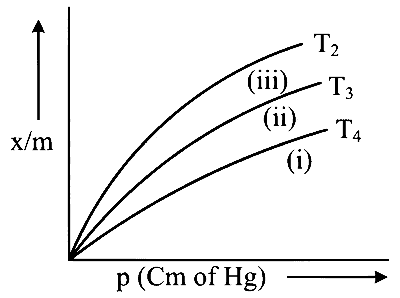
The graph given below is showing the relation between the extent of adsorption $(x / \mathrm{m})$ and pressure at different temperatures. The correct order of temperatures for curves i , ii and iii is
The sol prepared by Bredig's arc method is $X$ and the charge of sol particles of it is $q . X$ and $q$ are respectively
Which of the following can form ionic micelles in water?
Which of the following statements is correct for chemisorption?
The gold numbers of gelatin, haemoglobin and sodium acetate are $5 \times 10^{-3}, 5 \times 10^{-2}$ and $7 \times 10^{-1}$, respectively. The protective actions will be in the order
The coagulation of 200 mL of a positive colloid took place when 0.73 g of HCl was added to it without changing the volume much. The flocculation value of HCl for the colloid is
Which of the following does not show Tyndall effect?
The process in which colloids, when subjected to DC electric field move towards an electrode is
10 g of a gas is adsorbed on 500 g of solid at 10 bar. If the pressure is increased at 20 bar, 14 g of the gas is adsorbed by the same solid at the same temperature. What is the slope of Freundlich adsorption isotherm?
Identify the factors which favour the physical adsorption from the following
(I) High surface area
(II) Low temperatures
(III) High temperatures
(IV) Low pressures
(V) High pressures