Difficulty distribution
How the classified questions are distributed by difficulty.
21questions
Not classified
21
100%
Your cart is empty.
Practice States Of Matter - Physical Chemistry - Chemistry previous year questions organised from real papers, with year-wise coverage and clear topic navigation.
Every graph below is calculated only from this selection.
Year-wise coverage for States Of Matter. Each bar uses a separate theme-derived color.
How the classified questions are distributed by difficulty.
MCQ, numerical, multiple-select and other formats found in these papers.
Top subjects by unique question coverage.
Top topics across the included previous year papers.
Top subtopics inside this exact selection.
Question coverage for the most populated papers. Every active PYP paper remains listed below.
Newest papers appear first. Sort by year, question coverage or name.
| Paper | Year / session | Questions in this view | Open |
|---|---|---|---|
| TS EAMCET 2023 (Online) 12th May Morning Shift | 2023 | 1 | View paper |
| TS EAMCET 2023 ONLINE 12TH MAY EVENING SHIFT | 2023 | 1 | View paper |
| TS EAMCET 2023 ONLINE 13TH MAY EVENING SHIFT | 2023 | 1 | View paper |
| TS EAMCET 2023 ONLINE 13TH MAY MORNING SHIFT | 2023 | 1 | View paper |
| TS EAMCET 2023 ONLINE 14TH MAY EVENING SHIFT | 2023 | 1 | View paper |
| TS EAMCET 2023 ONLINE 14TH MAY MORNING SHIFT | 2023 | 1 | View paper |
| TS EAMCET 2022 (Online) 19th July Evening Shift | 2022 | 2 | View paper |
| TS EAMCET 2022 (Online) 19th July Morning Shift | 2022 | 1 | View paper |
| TS EAMCET 2022 (Online) 20th July Evening Shift | 2022 | 2 | View paper |
| TS EAMCET 2022 (Online) 20th July Morning Shift | 2022 | 2 | View paper |
| TS EAMCET 2022 ONLINE 18TH JULY EVENING SHIFT | 2022 | 2 | View paper |
| TS EAMCET 2022 ONLINE 18TH JULY MORNING SHIFT | 2022 | 2 | View paper |
| TS EAMCET 2020 (Online) 10th September Evening Shift | 2020 | 2 | View paper |
| TS EAMCET 2020 (Online) 10th September Morning Shift | 2020 | 2 | View paper |
Practice every matching question in batches of 20, with every available option.
A gaseous mixture of 2 moles of $A, 3$ moles of $B$, 5 moles of $C$ and 10 moles of $D$ is contained is contained in a vessel. Assuming that gases are ideal and partial pressure of $C$ is 1.5 atm , the total pressure is
Dipole-induced dipole interactions are present between which of the following pairs?
Gases deviate from ideal behaviour at high pressures because the gas molecules
According to kinetic molecular theory of gases, which of the following statements are correct?
(A) The actual volume of the molecules is negligible in comparison to the empty space between them.
(B) Collisions of gas molecules are inelastic.
(C) At any particular time, different particles in the gas have same speed and same kinetic energies.
(D) Pressure is exerted by the gas as a result of collision of the particles with the walls of the container.
Certain volume of oxygen gas diffuses through a porous pot in 20 seconds. Same volume of another gas, $X$ diffuses in $Y$ seconds as that of oxygen, then $X$ and $Y$ respectively are
4 g of an ideal gas $A$ (molar mass $=M_A$ ) present in a vessel of volume $V$ litre exerted a pressure of 5 atm at 300 K . When 16 g of another ideal gas $B$(molar mass $=M_B$ ) was introduced into this vessel at the same temperature, its pressure increased to 10 atm . What is the correct relationship between $M_A$ and $M_B$ ?
The ratio of rates of diffusion of gases $X$ and $Y$ of molecular weights 36 and 64 is
Two containers $A$ and $B$ contain $\mathrm{CO}_2$ gas. Pressure, volume and absolute temperature of the gas in $A$ are 4 times more compared to that in $B$. The mass of the gas in $B$ is $x \mathrm{~g}$, then the mass of the gas in $A$ will be
The rate of diffusion of a gas $A$ is $\sqrt{5}$ times more than that of gas $B$. If the molar mass of $A$ is $x \mathrm{~g} \mathrm{~mol}^{-1}$, the molar mass of $B$ (in $\mathrm{g} \mathrm{mol}^{-1}$ ) is
Identify the correct observation with respect to the given graphs.
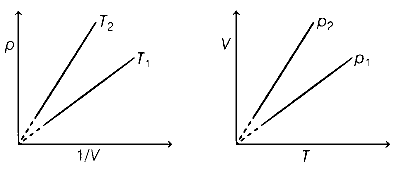
A gas is present at a pressure of 2 atm . What should be the increase in pressure, so that the volume of the gas can be decreased to $\frac{1}{4}$ th of the initial volume at constant temperature?
Root mean square ( rms ) speed of $\mathrm{O}_2$ is $500 \mathrm{~m} / \mathrm{s}$ at a constant temperature. Calculate the rms speed and the average kinetic energy of $\mathrm{H}_2$ at the same temperature. (Consider, $R=8.33 \mathrm{JK}^{-1} \mathrm{~mol}^{-1}$ )
Which of the following describes an ideal gas?
(i) The volume occupied by a gas molecule is negligible.
(ii) The collision between ideal gases are elastic.
(iii) Particles are very small compared to the distance between each other.
The compressibility factor $(\mathrm{Z})$ is lower for $\mathrm{NH}_3$ and $\mathrm{CO}_2$ gases than that of $\mathrm{N}_2$ gas because
The compressibility factor of a real gas at high pressure is
A plot of the compressibility factor $(z)$ vs $p$ is shown below for $\mathrm{H}_2, \mathrm{He}, \mathrm{N}_2, \mathrm{CO}_2$ and $\mathrm{SO}_2$. Identify the plot for $\mathrm{CO}_2$ gas.
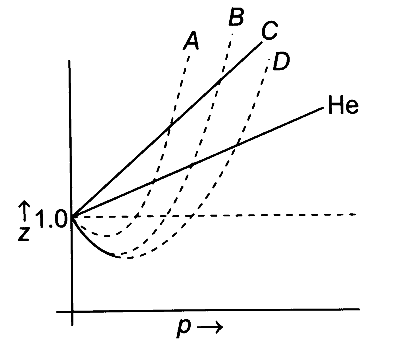
1 mole of a real gas is kept at high pressure of 100 bar at 300 K . If van der Waals' constant $b$ is $0.005 \mathrm{~L} / \mathrm{mol}$, what are the values of compressibility factor $Z$ of the gas and \% deviation of volume from ideality?
1 L closed flask contains a mixture of 4 g of methane and 4.4 g of carbon dioxide. The pressure inside the flask at $27^{\circ} \mathrm{C}$ is
[assume ideal behaviour of gases].
The rate of diffusion of methane at 1.0 atm pressure is twice than that of another gas ' $X$ ' kept at 1.45 atm . The molecular mass of the gas ' $X$ ' is
Which of the following gases has the maximum van der Waals' constant ' $a$ '?
Showing 20 of 21 questions