Difficulty distribution
How the classified questions are distributed by difficulty.
9questions
Not classified
9
100%
Your cart is empty.
Practice Polymers - Organic Chemistry - Chemistry previous year questions organised from real papers, with year-wise coverage and clear topic navigation.
Every graph below is calculated only from this selection.
Year-wise coverage for Polymers. Each bar uses a separate theme-derived color.
How the classified questions are distributed by difficulty.
MCQ, numerical, multiple-select and other formats found in these papers.
Top subjects by unique question coverage.
Top topics across the included previous year papers.
Top subtopics inside this exact selection.
Question coverage for the most populated papers. Every active PYP paper remains listed below.
Newest papers appear first. Sort by year, question coverage or name.
| Paper | Year / session | Questions in this view | Open |
|---|---|---|---|
| TS EAMCET 2023 (Online) 12th May Morning Shift | 2023 | 1 | View paper |
| TS EAMCET 2023 ONLINE 12TH MAY EVENING SHIFT | 2023 | 1 | View paper |
| TS EAMCET 2023 ONLINE 13TH MAY EVENING SHIFT | 2023 | 1 | View paper |
| TS EAMCET 2023 ONLINE 13TH MAY MORNING SHIFT | 2023 | 1 | View paper |
| TS EAMCET 2023 ONLINE 14TH MAY EVENING SHIFT | 2023 | 1 | View paper |
| TS EAMCET 2023 ONLINE 14TH MAY MORNING SHIFT | 2023 | 2 | View paper |
| TS EAMCET 2020 (Online) 10th September Evening Shift | 2020 | 1 | View paper |
| TS EAMCET 2020 (Online) 10th September Morning Shift | 2020 | 1 | View paper |
Practice every matching question in batches of 20, with every available option.
$$\text { Match the following }$$
| List-I (Polymer) |
List-II (Monomers) |
||
|---|---|---|---|
| (A) | Bakelite |
(I) | $$ \[\text { 2-methvl-1, 3-butadiene }\] $$ |
| (B) | Natural rubber | (II) | $$ \[\text { Glvcine + aminocaproic acid }\] $$ |
| (C) | Glyptal | (III) | $$ \[\text { Phenol + formaldehyde }\] $$ |
| (D) | Nylon 2-nylon 6 | (IV) | $$ \[\text { Phthalic acid + ethylene glycol }\] $$ |
Identify the correct statement from the following.
A. Glyptal is made from the monomers ethylene glycol and phthalic acid.
B. Bakelite is used in making electrical switches.
C. Nylon 2-nylon-6 is a biodegradable polymer.
A polymer sample contains 3 molecules of molar mass $10^3, 3$ molecules of molar mass 500 and 4 molecules of molar mass 200 . What is it's weight average molecular mass?
$$\text { Match the following. }$$
$$\begin{array}{llll} \hline & \text { List-I (Polymer type) } & & \text { List-II (Example) } \\ \hline \text { A. } & \text { Fibre } & \text { I. } & \text { Bakelite } \\ \hline \text { B. } & \text { Elastomer } & \text { II. } & \text { Polystyrene } \\ \hline \text { C. } & \text { Thermosetting polymer } & \text { III. } & \text { Neoprene } \\ \hline \text { D. } & \text { Thermosplastic polymer } & \text { IV. } & \text { Dacron } \\ \hline \end{array}$$
The correct answer is
Ziegler-Natta catalyst is used in the manufacture of
$R$ is one of the monomers for the formation of a polymer called
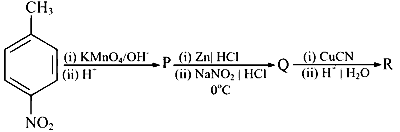
Which of the following are synthetic rubbers?
(i) Terylene
(ii) Buna-S
(iii) Buna-N
(iv) Neoprene
(v) Polyacrylonitrile
Which of the following vinyl derivatives is the most reactive towards anionic polymerisation?