Difficulty distribution
How the classified questions are distributed by difficulty.
26questions
Not classified
26
100%
Your cart is empty.
Practice Hydrocarbons - Organic Chemistry - Chemistry previous year questions organised from real papers, with year-wise coverage and clear topic navigation.
Every graph below is calculated only from this selection.
Year-wise coverage for Hydrocarbons. Each bar uses a separate theme-derived color.
How the classified questions are distributed by difficulty.
MCQ, numerical, multiple-select and other formats found in these papers.
Top subjects by unique question coverage.
Top topics across the included previous year papers.
Top subtopics inside this exact selection.
Question coverage for the most populated papers. Every active PYP paper remains listed below.
Newest papers appear first. Sort by year, question coverage or name.
| Paper | Year / session | Questions in this view | Open |
|---|---|---|---|
| TS EAMCET 2023 (Online) 12th May Morning Shift | 2023 | 2 | View paper |
| TS EAMCET 2023 ONLINE 12TH MAY EVENING SHIFT | 2023 | 1 | View paper |
| TS EAMCET 2023 ONLINE 13TH MAY EVENING SHIFT | 2023 | 2 | View paper |
| TS EAMCET 2023 ONLINE 13TH MAY MORNING SHIFT | 2023 | 2 | View paper |
| TS EAMCET 2023 ONLINE 14TH MAY EVENING SHIFT | 2023 | 4 | View paper |
| TS EAMCET 2023 ONLINE 14TH MAY MORNING SHIFT | 2023 | 3 | View paper |
| TS EAMCET 2022 (Online) 19th July Evening Shift | 2022 | 2 | View paper |
| TS EAMCET 2022 (Online) 19th July Morning Shift | 2022 | 2 | View paper |
| TS EAMCET 2022 (Online) 20th July Morning Shift | 2022 | 2 | View paper |
| TS EAMCET 2022 ONLINE 18TH JULY EVENING SHIFT | 2022 | 1 | View paper |
| TS EAMCET 2022 ONLINE 18TH JULY MORNING SHIFT | 2022 | 1 | View paper |
| TS EAMCET 2020 (Online) 10th September Evening Shift | 2020 | 2 | View paper |
| TS EAMCET 2020 (Online) 10th September Morning Shift | 2020 | 2 | View paper |
Practice every matching question in batches of 20, with every available option.
The most suitable solvent for Wurtz reaction is
The correct order of rate of addition of $\mathrm{Br}_2$ /water to the following alkenes is

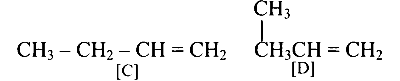
$$\text { Identify ' } Z \text { ' in the following reaction sequence }$$



An alkene $X\left(\mathrm{C}_6 \mathrm{H}_{12}\right)$ on ozonolysis gave acetaldehyde and ethyl methyl ketone. What is the product formed when $X$ reacts with HBr ?


An alkene $X$ with formula $\mathrm{C}_4 \mathrm{H}_8$ does not exhibit geometrical isomerism. In the conversion of $X$ to $Y$, the correct sequence of reagents $A$ and $B$ used are ( $Y$ gives iodoform test)
An alkene $(X)$ on ozonolysis gives propanal and ethanal. What is $X$ ?
Match the following.

The correct answer is
The rate of attack of an electrophile is least when $X$ in the given compound is

Arrange the following in the correct order of their acidic strength.
I. $\mathrm{H}_2 \mathrm{C}=\mathrm{CH}_2$
II. $\mathrm{CH} \equiv \mathrm{CH}$
III. $\mathrm{CH}_3-\mathrm{C} \equiv \mathrm{CH}$
IV. $\mathrm{CH}_3-\mathrm{CH}_3$
$$\mathrm{C}_3 \mathrm{H}_4+\mathrm{H}_2 \mathrm{O} \xrightarrow[333 \mathrm{~K}]{\mathrm{Hg}^{2+} / \mathrm{H}^{+}}[X] \stackrel{\text { Tautomerisation }}{\rightleftharpoons} Y$$
$X$ and $Y$ are respectively
Addition of HBr to propene in presence of a peroxide takes place contrary to Markownikoff rule. This can be explained by the mechanism involving
The aromatic compound/species with maximum number of $\pi$-electrons is
An alkene $X$ on ozonolysis gives a mixture of propan-2-one and methanal. What is $X$ ?
$$\text { In the conversion of } A \text { to } B \text {, the electrophile involved is }$$
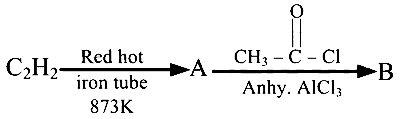
\({ }^{\oplus} \mathrm{CH}_3\)

\(\mathrm{Cl}^{\oplus}\)

Which of the following can be used as the test for unsaturation with regard to colour change of reaction?
A benzene derivative did not produce white precipitate with the ammonical silver nitrate solution but decolorised the cold dilute alkaline $\mathrm{KMnO}_4$ solution. The compound is
Which one of the following methods is suitable to generate aromatic compound(s) from linear aliphatic saturated hydrocarbons with at least six carbon atoms?
Ethyl phenyl acetylene (1-phenyl-1-butyne) on reduction with partially deactiveated palladised charcoal (Lindlar's catalyst) gives


The order of decreasing reactivity towards an electrophilic reagent, for the following compounds, is
(i) benzene
(iii) chlorobenzene
(ii) toluene
(iv) phenol
The major product of the following reaction is
$$\text { Glucose } \frac{\text { (i) } \mathrm{HI}, \Delta}{\text { (ii) } \mathrm{Mo}_2 \mathrm{O}_3, 773 \mathrm{~K}, 10 \cdot 20 \mathrm{am}}$$
Showing 20 of 26 questions