Difficulty distribution
How the classified questions are distributed by difficulty.
15questions
Not classified
15
100%
Your cart is empty.
Practice Coordination Compounds - Inorganic Chemistry - Chemistry previous year questions organised from real papers, with year-wise coverage and clear topic navigation.
Every graph below is calculated only from this selection.
Year-wise coverage for Coordination Compounds. Each bar uses a separate theme-derived color.
How the classified questions are distributed by difficulty.
MCQ, numerical, multiple-select and other formats found in these papers.
Top subjects by unique question coverage.
Top topics across the included previous year papers.
Top subtopics inside this exact selection.
Question coverage for the most populated papers. Every active PYP paper remains listed below.
Newest papers appear first. Sort by year, question coverage or name.
| Paper | Year / session | Questions in this view | Open |
|---|---|---|---|
| TS EAMCET 2023 (Online) 12th May Morning Shift | 2023 | 1 | View paper |
| TS EAMCET 2023 ONLINE 12TH MAY EVENING SHIFT | 2023 | 1 | View paper |
| TS EAMCET 2023 ONLINE 13TH MAY EVENING SHIFT | 2023 | 1 | View paper |
| TS EAMCET 2023 ONLINE 13TH MAY MORNING SHIFT | 2023 | 1 | View paper |
| TS EAMCET 2023 ONLINE 14TH MAY EVENING SHIFT | 2023 | 1 | View paper |
| TS EAMCET 2023 ONLINE 14TH MAY MORNING SHIFT | 2023 | 1 | View paper |
| TS EAMCET 2022 (Online) 19th July Evening Shift | 2022 | 1 | View paper |
| TS EAMCET 2022 (Online) 20th July Evening Shift | 2022 | 2 | View paper |
| TS EAMCET 2022 (Online) 20th July Morning Shift | 2022 | 1 | View paper |
| TS EAMCET 2022 ONLINE 18TH JULY EVENING SHIFT | 2022 | 1 | View paper |
| TS EAMCET 2022 ONLINE 18TH JULY MORNING SHIFT | 2022 | 1 | View paper |
| TS EAMCET 2020 (Online) 10th September Evening Shift | 2020 | 1 | View paper |
| TS EAMCET 2020 (Online) 10th September Morning Shift | 2020 | 2 | View paper |
Practice every matching question in batches of 20, with every available option.
Among the given complexes the possess " $\mathrm{CO}^{\prime \prime}$ as a bridged ligands are
I. $\left[\mathrm{Co}_2(\mathrm{CO})_8\right]$
II. $\left[\mathrm{Fe}_3(\mathrm{CO})_{12}\right]$
III. $\left[\mathrm{Mn}_2(\mathrm{CO})_{10}\right]$
IV. $\left[\mathrm{Fe}_2(\mathrm{CO})_9\right]$
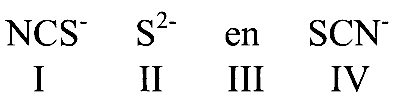
The correct order of decreasing field strength of the below given ligands is
Identify the incorrect match from the following.
Identify the correct set for $\left[\mathrm{Co}\left(\mathrm{NH}_3\right)_6\right]^{3+}$ ion.
(Hybridisation of $\mathrm{Co}^{3+}$, type of complex, number of unpaired electrons in the complex ion respectively.)
According to Werner's theory, the number of groups bonded to the central metal atom/ion in a coordination complex represent.
The sum of oxidation state and co-ordination number of central metal atom is maximum with respect to which of the following complex?
$$\text { Match the following. }$$
$$\begin{array}{llll} \hline & \begin{array}{l} \text { List-I } \\ (\text { Complex }) \end{array} & & \begin{array}{l} \text { List-II } \\ \text { (Spin only magnetic } \\ \text { moment) } \end{array} \\ \hline \text { A. } & {\left[\mathrm{CoF}_6\right]^{3-}} & \text { I. } & 0 \\ \hline \text { B. } & {\left[\mathrm{Co}\left(\mathrm{C}_2 \mathrm{O}_4\right)_3\right]^{3-}} & \text { II. } & \sqrt{24} \\ \hline \text { C. } & {\left[\mathrm{FeF}_6\right]^{3-}} & \text { III. } & \sqrt{8} \\ \hline \text { D. } & {\left[\mathrm{Mn}(\mathrm{CN})_6\right]^{3-}} & \text { IV. } & \sqrt{35} \\ \hline & & \text { V. } & \sqrt{15} \\ \hline \end{array}$$
The correct answer is
The correct match for complex with its magnetic behaviour in the following is
Which of the following molecules is colourless?
$A^{2+}, B^{2+}$ and $C^{-}$form an ionic complex like $A_{x-2}\left[B(C)_x\right]_2$. If the complex is $75 \%$ dissociated in a solvent with $i=4$, the coordination number of $B$ is
A metal complex absorbed orange light. The colour in which it appears is
Secondary valences of the following complexes based on their reactions with excess $\mathrm{AgNO}_3$ are
$$\begin{array}{llc} \[\hline & \begin{array}{l}\] \[\text { Formula of the } \\\] \[\text { complexes }\] \[\end{array} & \begin{array}{c}\] \[\text { Moles of } \mathrm{AgCl} \text { precipitated } \\\] \[\text { per mole of complex }\] \end{array} \\ \[\hline \text { (I) } & \mathrm{CoCl}_3 \cdot 6 \mathrm{H}_2 \mathrm{O} & 3 \\\] \[\hline \text { (II) } & \mathrm{NiCl}_3 \cdot 6 \mathrm{H}_2 \mathrm{O} & 2 \\\] \[\hline \text { (III) } & \mathrm{Co}\left(\mathrm{SO}_4\right) \mathrm{Br} \cdot 5 \mathrm{NH}_3 & 1 \\\] \hline \end{array}$$$$\text { Match the following }$$
| Column -I (Reaction) |
Column - II (Colour of the product or nature) | ||
|---|---|---|---|
| (A) | $\mathrm{FeCl}_3(\mathrm{aq})+\mathrm{NH}_3(\mathrm{aq}) \longrightarrow$ | (l) | Green ppt. |
| (B) | $\mathrm{AgCl}(\mathrm{aq})+\mathrm{NH}_3(\mathrm{aq}) \longrightarrow$ | (II) | Deep blue |
| (C) | $\mathrm{Cu}^{2+}(\mathrm{aq})+\mathrm{NH}_3(\mathrm{aq}) \longrightarrow$ | (III) | Brown ppt. |
| (IV) | Colourless | ||
$$\text { The correct match }$$
The pair in which both the species have same magnetic moment (spin only) is
 The correct answer is Table