My Cart
Your Cart 0

    Your cart is empty.

  • Total (Amount) ₹0.00
Previous year question hub

Reservoir Flow and Drive Mechanisms - Reservoir Engineering - Petroleum Engineering Previous Year Questions

Practice Reservoir Flow and Drive Mechanisms - Reservoir Engineering - Petroleum Engineering previous year questions organised from real papers, with year-wise coverage and clear topic navigation.

10Papers
10Years
56Questions
1Topics

Reservoir Flow and Drive Mechanisms question pattern

Every graph below is calculated only from this selection.

Questions by year

Year-wise coverage for Reservoir Flow and Drive Mechanisms. Each bar uses a separate theme-derived color.

Difficulty distribution

How the classified questions are distributed by difficulty.

Medium 34 60.7%
Easy 20 35.7%
Hard 2 3.6%
Question type distribution

MCQ, numerical, multiple-select and other formats found in these papers.

Numerical Answer Type (NAT) 32 57.1%
MCQ 20 35.7%
MSQ 4 7.1%

Subject weightage

Top subjects by unique question coverage.

Petroleum Engineering
56 Qs

Most asked topics

Top topics across the included previous year papers.

Reservoir Engineering
56 Qs

Subtopic coverage

Top subtopics inside this exact selection.

Reservoir Flow and Drive Mechanisms
56 Qs

Paper coverage

Question coverage for the most populated papers. Every active PYP paper remains listed below.

Petroleum Engineering (PE) 2026
8 Qs
Petroleum Engineering (PE) 2025
6 Qs
Petroleum Engineering (PE) 2024
7 Qs
Petroleum Engineering (PE) 2023
2 Qs
Petroleum Engineering (PE) 2022
7 Qs
Petroleum Engineering (PE) 2021
5 Qs
Petroleum Engineering (PE) 2020
5 Qs
Petroleum Engineering (PE) 2018
8 Qs
Petroleum Engineering (PE) 2017
4 Qs
Petroleum Engineering (PE) 2016
4 Qs

Included previous year papers

Newest papers appear first. Sort by year, question coverage or name.

PaperYear / sessionQuestions in this viewOpen
Petroleum Engineering (PE) 202620268View paper
Petroleum Engineering (PE) 202520256View paper
Petroleum Engineering (PE) 202420247View paper
Petroleum Engineering (PE) 202320232View paper
Petroleum Engineering (PE) 202220227View paper
Petroleum Engineering (PE) 202120215View paper
Petroleum Engineering (PE) 202020205View paper
Petroleum Engineering (PE) 201820188View paper
Petroleum Engineering (PE) 201720174View paper
Petroleum Engineering (PE) 201620164View paper

All Reservoir Flow and Drive Mechanisms previous year questions

Practice every matching question in batches of 20, with every available option.

1
2016 · Petroleum Engineering · Reservoir Engineering · Reservoir Flow and Drive Mechanisms
Petroleum Engineering (PE) 2016
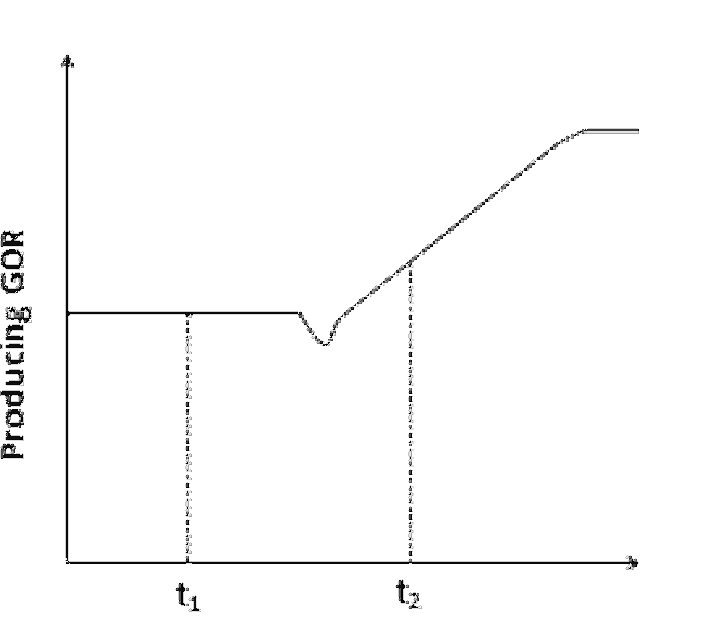
The figure shows the producing gas oil ratio (GOR) behaviour with time for an oil reservoir under primary production. At initial reservoir condition, P_b is the bubble point pressure of the crude oil. P_R(t) represents the reservoir pressure at time ‘t’. Which of the following statements is TRUE?
Open complete paper
2
2016 · Petroleum Engineering · Reservoir Engineering · Reservoir Flow and Drive Mechanisms
Petroleum Engineering (PE) 2016
An oil well is drilled to cover a circular drainage area of radius 700 ft. The well is completed with a 7 inch production casing. Assume reservoir pressure of 1000 psig, permeability of 50 md, pay zone thickness of 20 ft, oil viscosity of 3 cp and oil formation volume factor of 1.25 reservoir-bbl/STB.
For a flowing bottom-hole pressure of 500 psig, the primary production rate is _____ STB/day.
Open complete paper
3
2016 · Petroleum Engineering · Reservoir Engineering · Reservoir Flow and Drive Mechanisms
Petroleum Engineering (PE) 2016
An oil well of wellbore radius 0.5 ft is shown to develop a skin due to formation damage. The damaged zone radius is 2.25 ft around the well. The formation permeability is 300 md and the permeability of the damaged zone is 100 md.
The effective well bore radius for this well is__________ ft.
Open complete paper
4
2016 · Petroleum Engineering · Reservoir Engineering · Reservoir Flow and Drive Mechanisms
Petroleum Engineering (PE) 2016
For a water-flood operation in a one-dimensional reservoir, the following data are given. Porosity, φ = 0.25; Cross-sectional area, A = 25,000 ft²; Horizontal distance between the vertical production and injection well = 600 ft; Water injection rate, iw = 900 bbl/day; Slope of fractional flow curve at shock front water saturation = 1.97; Water formation volume factor = 1.0 bbl/STB.
[ 1 bbl = 5.615 ft³ ]
The cumulative water volume injected at breakthrough is__________ × 10⁵ bbl.
Open complete paper
5
2017 · Petroleum Engineering · Reservoir Engineering · Reservoir Flow and Drive Mechanisms
Petroleum Engineering (PE) 2017
Which one of the following curves shows a typical behavior of the producing gas oil ratio (GOR) with time for a reservoir under solution gas drive?
Open complete paper
6
2017 · Petroleum Engineering · Reservoir Engineering · Reservoir Flow and Drive Mechanisms
Petroleum Engineering (PE) 2017
Which one of the following statements is correct for pseudo-steady state condition in a confined reservoir?
Open complete paper
7
2017 · Petroleum Engineering · Reservoir Engineering · Reservoir Flow and Drive Mechanisms
Petroleum Engineering (PE) 2017
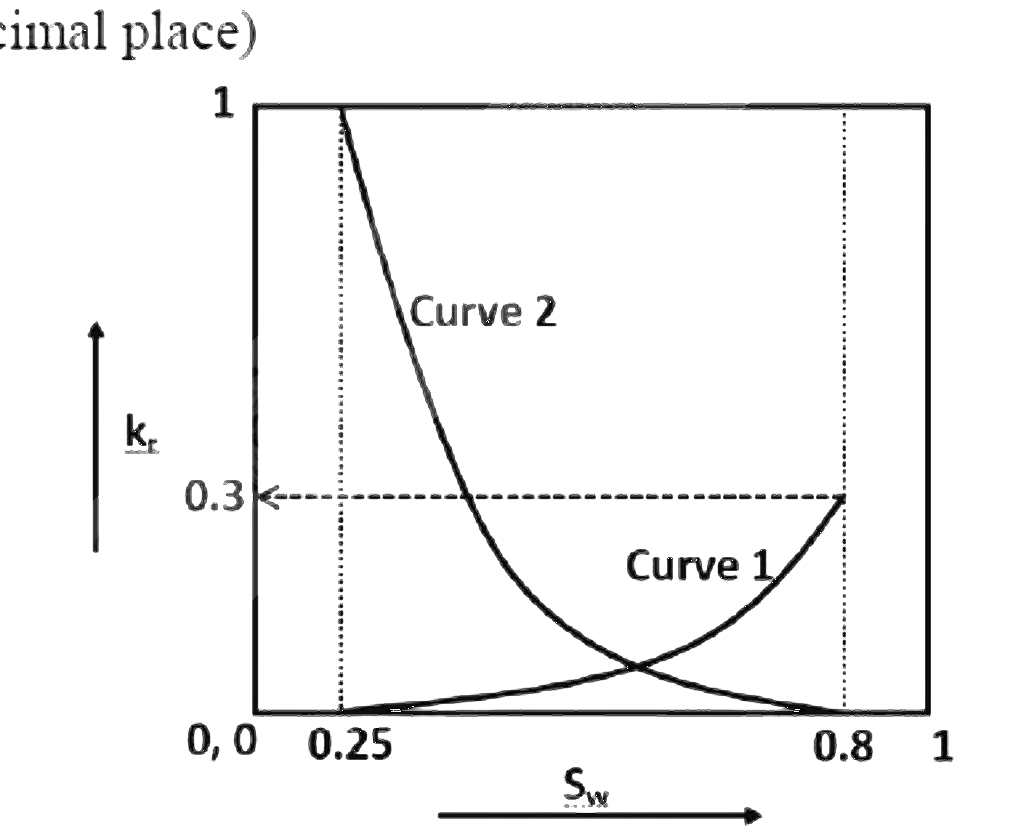
Relative permeability curves are shown in the following figure for a water-oil system in a porous medium. \(S_w\) is water saturation and \(k_r\) is relative permeability. Curve 1 is relative permeability of water and Curve 2 is relative permeability of oil. Assuming the porous medium is at irreducible water saturation initially, the maximum possible recovery of oil by water flooding is _____%. (write answer with one decimal place)
Open complete paper
8
2017 · Petroleum Engineering · Reservoir Engineering · Reservoir Flow and Drive Mechanisms
Petroleum Engineering (PE) 2017
A well of radius 0.25 m is drilled. Mud invasion in the formation caused a skin radius of 2 m and reduced the permeability of the damaged zone to 30 mD. Well test revealed that the skin factor of the damaged zone is 2.3. The permeability of the unaffected formation will be ______ mD. (write answer with one decimal place)
Open complete paper
9
2018 · Petroleum Engineering · Reservoir Engineering · Reservoir Flow and Drive Mechanisms
Petroleum Engineering (PE) 2018

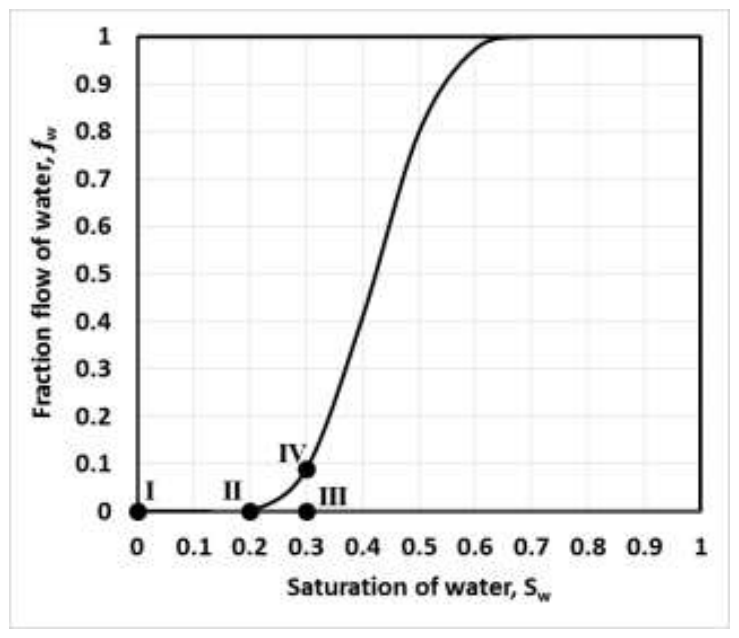
A fractional flow curve is given for a core for which the irreducible water saturation is 0.2 and the residual oil saturation is 0.3. The initial water saturation in the core is 0.3. If Welge’s method is applied to find the breakthrough saturation and fraction flow of water at breakthrough, which point should be used in the figure to draw a tangent line to the fractional flow curve.

Source question diagram

Open complete paper
10
2018 · Petroleum Engineering · Reservoir Engineering · Reservoir Flow and Drive Mechanisms
Petroleum Engineering (PE) 2018

Assume that viscous, gravity, and capillary are the only dominant forces for fluid flow in a given reservoir, a cone formed around the perforation zone will break into the well, when

Open complete paper
11
2018 · Petroleum Engineering · Reservoir Engineering · Reservoir Flow and Drive Mechanisms
Petroleum Engineering (PE) 2018
In an oil reservoir the current average pressure is below bubble point pressure of the oil. The current oil production rate is 10³ m³/day and total gas production rate is 10⁵ m³/day at STP conditions (25°C and 1 atm). The formation volume factor of the oil is 1.2 m³ at reservoir pressure / m³ at STP and that of gas is 0.01 m³ at reservoir pressure / m³ at STP. The dissolved gas oil ratio is 10 m³ of gas at STP / m³ of oil at STP of oil. The gas flow rate at bottom-hole conditions is __________× 10⁵ m³ per day. (rounded-off to two decimal places)
Open complete paper
12
2018 · Petroleum Engineering · Reservoir Engineering · Reservoir Flow and Drive Mechanisms
Petroleum Engineering (PE) 2018
Match the following:
Open complete paper
13
2018 · Petroleum Engineering · Reservoir Engineering · Reservoir Flow and Drive Mechanisms
Petroleum Engineering (PE) 2018
Which one of the following options presents the correct combinations?
(P) Borisov’s    (I) Critical rate correlation in vertical wells with coning
(Q) Schols’    (II) Horizontal well performance relation
(R) Efros’    (III) Vertical well performance relation
(S) Wiggins’    (IV) Critical rate correlation in horizontal wells with coning
Open complete paper
14
2018 · Petroleum Engineering · Reservoir Engineering · Reservoir Flow and Drive Mechanisms
Petroleum Engineering (PE) 2018
An oil well is tested at a flow rate (Q) of 50 BOPD. The bottom hole flowing pressure (Pwf) is 500 psia. The shut-in pressure is 1000 psia. If Pwf is lowered to 300 psia and assuming the Vogel’s correlation holds, the estimated flow rate in the oil well is ______BOPD (rounded-off to two decimal places). The Vogel’s correlation is:
\( \frac{Q}{Q_{max}} = 1 - 0.2 \left( \frac{P_{wf}}{\bar{P}} \right) - 0.8 \left( \frac{P_{wf}}{\bar{P}} \right)^2 \)
Open complete paper
15
2018 · Petroleum Engineering · Reservoir Engineering · Reservoir Flow and Drive Mechanisms
Petroleum Engineering (PE) 2018
Oil is being transported between two reservoirs with the help of three parallel pipes at steady state. The diameters of these pipes are 2 cm, 3 cm and 4 cm, respectively. The pipes are equal in length and the flow is laminar. The discharge through the 4 cm diameter pipe is 50 litres/s. The discharge through the 2 cm diameter pipe is _____ litres/s. (rounded-off to two decimal places)
Open complete paper
16
2018 · Petroleum Engineering · Reservoir Engineering · Reservoir Flow and Drive Mechanisms
Petroleum Engineering (PE) 2018
The viscosity, \(\mu\) (in Pa.s) of a power law fluid as a function of shear rate, \(\dot{\gamma}\) (in s⁻¹) is given by the following relation: \[ \mu = \frac{1}{2} |\dot{\gamma}| \] This power law fluid lies between two infinitely large horizontal parallel plates separated by a distance (\(h\)) of \(10^{-3}\) m. The top plate is moving horizontally at a velocity (\(v\)) of \(10^{-3}\) m/s and the bottom plate is held stationary. Assuming laminar flow and neglecting gravity, the absolute value of steady-state shear stress acting on the bottom plate is _____ Pa. (rounded-off to two decimal places)
Open complete paper
17
2020 · Petroleum Engineering · Reservoir Engineering · Reservoir Flow and Drive Mechanisms
Petroleum Engineering (PE) 2020
Consider unidirectional, laminar flow of water through a homogeneous porous media as shown in the Figure. Here, H = 100 m, W = 500 m, L = 500 m, permeability of the porous media is 10-12 m2, and the driving pressure drop (across length L) is 106 Pa. Use the viscosity of water as 10-3 Pa.s.

At steady state, the volumetric flow rate of water (rounded off to two decimal places) is given by _____________ m3/s.
Open complete paper
18
2020 · Petroleum Engineering · Reservoir Engineering · Reservoir Flow and Drive Mechanisms
Petroleum Engineering (PE) 2020
The initial oil production from an offshore well is 1000 STB/day, which decreased to 960 STB/day in 30 days. Using the ‘exponential decline model’, the daily production rate after 360 days from the start (rounded off to one decimal place) will be ______________ STB/day.
Open complete paper
19
2020 · Petroleum Engineering · Reservoir Engineering · Reservoir Flow and Drive Mechanisms
Petroleum Engineering (PE) 2020
An incompressible fluid is flowing through a tube of radius, R and length, L. The shear rate dependence of the fluid viscosity is given by the power law, $\mu = k|\dot{\gamma}|^{n-1}$ where, $\dot{\gamma}$ is the scalar shear rate, $k$ is a constant, and $n$ is the flow behavior index. Assuming the flow to be steady, laminar, and fully developed, the velocity profile inside the tube for a pressure drop of $\Delta p$ applied across the tube is
Open complete paper
20
2020 · Petroleum Engineering · Reservoir Engineering · Reservoir Flow and Drive Mechanisms
Petroleum Engineering (PE) 2020
A unidirectional, immiscible displacement of an oil is carried out with water in a cylindrical reservoir core sample (Buckley-Leverett theory is applicable). The connate water saturation is 0.25. A fractional flow of water (fw) vs. water saturation (Sw) curve is drawn for the process. A line drawn from a point (Sw = 0.25, fw = 0) on the fractional flow curve is tangent at the point (Sw = 0.8, fw = 0.8) on the curve. The average water saturation (S̅w) in the core at the time of breakthrough (rounded off to two decimal places) is ______ (in fraction).
Open complete paper

Showing 20 of 56 questions