My Cart
Your Cart 0

    Your cart is empty.

  • Total (Amount) ₹0.00
Previous year question hub

Formation Evaluation and Log Interpretation - Petroleum Formation Evaluation - Petroleum Engineering Previous Year Questions

Practice Formation Evaluation and Log Interpretation - Petroleum Formation Evaluation - Petroleum Engineering previous year questions organised from real papers, with year-wise coverage and clear topic navigation.

10Papers
10Years
26Questions
1Topics

Formation Evaluation and Log Interpretation question pattern

Every graph below is calculated only from this selection.

Questions by year

Year-wise coverage for Formation Evaluation and Log Interpretation. Each bar uses a separate theme-derived color.

Difficulty distribution

How the classified questions are distributed by difficulty.

Medium 15 57.7%
Easy 10 38.5%
Hard 1 3.8%
Question type distribution

MCQ, numerical, multiple-select and other formats found in these papers.

Numerical Answer Type (NAT) 15 57.7%
MCQ 7 26.9%
MSQ 4 15.4%

Subject weightage

Top subjects by unique question coverage.

Petroleum Engineering
26 Qs

Most asked topics

Top topics across the included previous year papers.

Petroleum Formation Evaluation
26 Qs

Subtopic coverage

Top subtopics inside this exact selection.

Formation Evaluation and Log Interpretation
26 Qs

Paper coverage

Question coverage for the most populated papers. Every active PYP paper remains listed below.

Petroleum Engineering (PE) 2026
3 Qs
Petroleum Engineering (PE) 2025
3 Qs
Petroleum Engineering (PE) 2024
1 Qs
Petroleum Engineering (PE) 2023
3 Qs
Petroleum Engineering (PE) 2022
5 Qs
Petroleum Engineering (PE) 2021
1 Qs
Petroleum Engineering (PE) 2020
3 Qs
Petroleum Engineering (PE) 2018
4 Qs
Petroleum Engineering (PE) 2017
1 Qs
Petroleum Engineering (PE) 2016
2 Qs

Included previous year papers

Newest papers appear first. Sort by year, question coverage or name.

PaperYear / sessionQuestions in this viewOpen
Petroleum Engineering (PE) 202620263View paper
Petroleum Engineering (PE) 202520253View paper
Petroleum Engineering (PE) 202420241View paper
Petroleum Engineering (PE) 202320233View paper
Petroleum Engineering (PE) 202220225View paper
Petroleum Engineering (PE) 202120211View paper
Petroleum Engineering (PE) 202020203View paper
Petroleum Engineering (PE) 201820184View paper
Petroleum Engineering (PE) 201720171View paper
Petroleum Engineering (PE) 201620162View paper

All Formation Evaluation and Log Interpretation previous year questions

Practice every matching question in batches of 20, with every available option.

1
2016 · Petroleum Engineering · Petroleum Formation Evaluation · Formation Evaluation and Log Interpretation
Petroleum Engineering (PE) 2016
Using the gamma ray log given in the figure, the shalliness index for point S is ______%.
Open complete paper
2
2016 · Petroleum Engineering · Petroleum Formation Evaluation · Formation Evaluation and Log Interpretation
Petroleum Engineering (PE) 2016
A section of a clean sandstone reservoir was logged and found to have a porosity of 10%. The cementation (m) and saturation (n) exponents are equal to 2. The constant 'a' in Archie's saturation equation is 1. The formation water resistivity is 0.036 ohm-meter and the formation resistivity is 10 ohm-meter.
The water saturation in the reservoir is_____%.
Open complete paper
3
2017 · Petroleum Engineering · Petroleum Formation Evaluation · Formation Evaluation and Log Interpretation
Petroleum Engineering (PE) 2017
The sonic log travel time in a loosely consolidated formation is 260 μs/m. The matrix and fluid travel times are 130 μs/m and 618 μs/m, respectively. A correction factor of 1.0 may be used in a Wyllie time average equation for simplification. The calculated formation porosity using the Wyllie time average equation is ______%. (write answer with two decimal places)
Open complete paper
4
2018 · Petroleum Engineering · Petroleum Formation Evaluation · Formation Evaluation and Log Interpretation
Petroleum Engineering (PE) 2018
A cylindrical sandstone core, 7.5 cm long and 3.5 cm diameter has grain density of 3 g/cm³. If the mass of the dry core is 200 g, the porosity of the core is __________%. (rounded-off to two decimal places)
Open complete paper
5
2018 · Petroleum Engineering · Petroleum Formation Evaluation · Formation Evaluation and Log Interpretation
Petroleum Engineering (PE) 2018

Which one of the following options represents the typical sequence of applying cut-offs for pay zone identification in a conventional reservoir?

Open complete paper
6
2018 · Petroleum Engineering · Petroleum Formation Evaluation · Formation Evaluation and Log Interpretation
Petroleum Engineering (PE) 2018
A dry core was subjected to the mercury injection test in the laboratory. Following are the related details:
Average formation porosity = 0.2
Formation volume factor, Bo = 1.2 reservoir-bbl/STB
Oil API° = 32, Specific gravity of water = 1.1
Hydrostatic gradient = 0.433 psi/ft
OW cos θ)res = 26 dyne/cm, where σOW is the oil-water interfacial tension and θ is the contact angle
AM cos θ)lab = 367 dyne/cm, where σAM is air- mercury interfacial tension and θ is the contact angle
Average drainage area = 80 acres
(1 acre-ft = 7758 bbl)
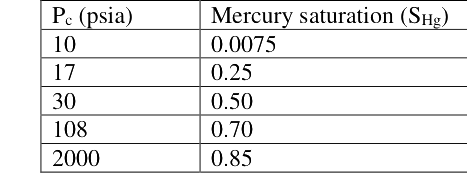
The Table shows the laboratory data for capillary pressure at different mercury saturations.
Pc (psia)Mercury saturation (SHg)
100.0075
170.25
300.50
1080.70
20000.85

\( P_c = \frac{2\sigma \cos \theta}{r} \) and the average water saturation (Sw) for the productive column is 0.25. The Original Oil in Place (OOIP) in the productive column where Sw ≤ 0.5 is _________ MMSTB. (rounded-off to one decimal place)

Question diagram

Open complete paper
7
2018 · Petroleum Engineering · Petroleum Formation Evaluation · Formation Evaluation and Log Interpretation
Petroleum Engineering (PE) 2018
A well is drilled with water based mud. The water saturation in the completely flushed zone (no formation fluid residual) is given by,
\( S_{xo} = \left( \frac{a}{\phi^2} \times \frac{R_{mf}}{R_{xo}} \right)^{1/2} \),
where, Rmf and Rxo are the mud filtrate resistivity and flushed zone resistivity, respectively. Use, a = 1.0 and Rxo = 25 Rmf.
The calculated porosity (φ) of the formation is ______. (in fraction rounded-off to two decimal places)
Open complete paper
8
2020 · Petroleum Engineering · Petroleum Formation Evaluation · Formation Evaluation and Log Interpretation
Petroleum Engineering (PE) 2020

Which one of the following options best represents the correct order of increasing thermal conductivity of the subsurface formations?

Open complete paper
9
2020 · Petroleum Engineering · Petroleum Formation Evaluation · Formation Evaluation and Log Interpretation
Petroleum Engineering (PE) 2020
The following primary and secondary porosity types are prevalent in the subsurface formations:
1. Interparticle
2. Intraparticle
3. Fracture
4. Solution
5. Bedding plane voids
6. Channel
Which one of the following options represents the correct combination?

Question diagram

Open complete paper
10
2020 · Petroleum Engineering · Petroleum Formation Evaluation · Formation Evaluation and Log Interpretation
Petroleum Engineering (PE) 2020
Given the following data of a shale gas formation:

WTOC (weight fraction of total organic carbon (TOC)) = 0.10
SwT (total water saturation) = 0.25
ρTOC (density of TOC) = 1.10 g/cm³
ρm (density of matrix) = 2.65 g/cm³
ρg (density of gas) = 0.35 g/cm³
ρw (density of water) = 1.00 g/cm³
ρB (formation bulk density) = 2.00 g/cm³

Consider that only water and gas are present in the formation and the following equations apply,

ρB = (ρm×(1-φT)+ρf×φT) / (1-WTOC×(1-ρmTOC)) , ρB = (ρTOC×VTOC/WTOC) + φT × ρf

Where, ρf is the fluid density, φT is the total porosity, and VTOC is the volume fraction of TOC.

The volume fraction of TOC (rounded off to two decimal places) is ______.
Open complete paper
11
2021 · Petroleum Engineering · Petroleum Formation Evaluation · Formation Evaluation and Log Interpretation
Petroleum Engineering (PE) 2021

Match the following rock types (GROUP I) with their respective chemical compositions (GROUP II) from the given options.

GROUP IGROUP II
(P) Sandstone(I) A non-clastic carbonate rock consisting mainly of the mineral calcite.
(Q) Limestone(II) A non-clastic chemical rock composed of mineral halite.
(R) Shale(III) A siliciclastic rock formed mainly of sand.
(S) Rock salt(IV) A fissile rock with a laminated structure, formed by consolidation of clay or mud.
Open complete paper
12
2022 · Petroleum Engineering · Petroleum Formation Evaluation · Formation Evaluation and Log Interpretation
Petroleum Engineering (PE) 2022

The Timur chart for estimating the permeability is the plot between

Open complete paper
13
2022 · Petroleum Engineering · Petroleum Formation Evaluation · Formation Evaluation and Log Interpretation
Petroleum Engineering (PE) 2022

Which of the following Logging tool combinations are required to estimate the Hydrocarbon Initial in Place (HCIP)?

Open complete paper
14
2022 · Petroleum Engineering · Petroleum Formation Evaluation · Formation Evaluation and Log Interpretation
Petroleum Engineering (PE) 2022

The log data obtained for a particular well section are shown in the following figures. Identify the CORRECT interpretations for different zones.

Open complete paper
15
2022 · Petroleum Engineering · Petroleum Formation Evaluation · Formation Evaluation and Log Interpretation
Petroleum Engineering (PE) 2022
In a sandstone reservoir, the density log reads 2.11 g/cc and sonic log reads 90 μs/ft. The other parameters are given below:
Matrix density (ρma) = 2.68 g/cc
Fluid density (ρfl) = 1.0 g/cc
Compressional wave travel time in matrix (Δtma) = 54 μs/ft
Compressional wave travel time in fluid (Δtfl) = 189 μs/ft
The calculated secondary porosity of the reservoir is ______ % (rounded off to the nearest integer).
Open complete paper
16
2022 · Petroleum Engineering · Petroleum Formation Evaluation · Formation Evaluation and Log Interpretation
Petroleum Engineering (PE) 2022
The hydrogen index (HI) of a potential source rock is 500. If 400 g of the same rock produces 6000 mg of hydrocarbons during a thermal pyrolysis at the maximum temperature, the calculated total organic content (TOC) of the rock is __________ weight % (rounded off to one decimal place).
Open complete paper
17
2024 · Petroleum Engineering · Petroleum Formation Evaluation · Formation Evaluation and Log Interpretation
Petroleum Engineering (PE) 2024
A core sample from a well-consolidated sand has a length of 10 cm, diameter of 4 cm, and a resistance (r) of 100 Ω at \(T_2 = 200 \ ^\circ F\) when completely saturated with brine. The resistivity \(R_w(T_1)\) of brine is 0.5 Ω·m at \(T_1 = 75 \ ^\circ F\). The cementation factor, m = 2 and the tortuosity factor, a = 1.
Use \(R_w(T_2) = R_w(T_1) \frac{(T_1+6.77)}{(T_2+6.77)}\), where \(T_1\) and \(T_2\) are in °F.
The porosity (in fraction) of the core sample using generalized Humble’s formula at 200 °F is ______ (round off to two decimal places).
Open complete paper
18
2025 · Petroleum Engineering · Petroleum Formation Evaluation · Formation Evaluation and Log Interpretation
Petroleum Engineering (PE) 2025

Which of the following logging tool(s) underestimate(s) porosity in a gas-bearing formation?

Open complete paper
19
2025 · Petroleum Engineering · Petroleum Formation Evaluation · Formation Evaluation and Log Interpretation
Petroleum Engineering (PE) 2025
The formation resistivity factor (\( F \)) is related to the formation porosity (\( \phi \)) in a water-bearing carbonate formation by the following correlation
\[ F = 0.9\phi^{-2} \]
where \( \phi \) is in fraction. The resistivity of the invaded zone of the formation obtained by the Microspherically Focused Log (MSFL) is 4.5 \( \Omega\cdot m \), and the resistivity of the mud-filtrate is 0.05 \( \Omega\cdot m \).
The formation porosity is ______% (rounded off to one decimal place).
Open complete paper
20
2025 · Petroleum Engineering · Petroleum Formation Evaluation · Formation Evaluation and Log Interpretation
Petroleum Engineering (PE) 2025
The laboratory analysis data obtained from the core is as follows:
Weight of clean dry core in air = 30 g
Weight of core completely saturated with oil = 32 g
Weight of saturated core completely immersed in oil = 24 g
If the density of oil used for saturation of core during the experiment is 0.88 g/cc, then the effective porosity of the core is ______ % (rounded off to two decimal places).
Open complete paper

Showing 20 of 26 questions