My Cart
Your Cart 0

    Your cart is empty.

  • Total (Amount) ₹0.00
Previous year question hub

Numerical Methods - Engineering Mathematics - Petroleum Engineering Previous Year Questions

Practice Numerical Methods - Engineering Mathematics - Petroleum Engineering previous year questions organised from real papers, with year-wise coverage and clear topic navigation.

11Papers
11Years
20Questions
1Topics

Numerical Methods question pattern

Every graph below is calculated only from this selection.

Questions by year

Year-wise coverage for Numerical Methods. Each bar uses a separate theme-derived color.

Difficulty distribution

How the classified questions are distributed by difficulty.

Easy 18 90%
Medium 2 10%

Question type distribution

MCQ, numerical, multiple-select and other formats found in these papers.

Numerical Answer Type (NAT) 11 55%
MCQ 8 40%
MSQ 1 5%

Subject weightage

Top subjects by unique question coverage.

Petroleum Engineering
20 Qs

Most asked topics

Top topics across the included previous year papers.

Engineering Mathematics
20 Qs

Subtopic coverage

Top subtopics inside this exact selection.

Numerical Methods
20 Qs

Paper coverage

Question coverage for the most populated papers. Every active PYP paper remains listed below.

Petroleum Engineering (PE) 2026
1 Qs
Petroleum Engineering (PE) 2025
1 Qs
Petroleum Engineering (PE) 2024
1 Qs
Petroleum Engineering (PE) 2023
2 Qs
Petroleum Engineering (PE) 2022
2 Qs
Petroleum Engineering (PE) 2021
1 Qs
Petroleum Engineering (PE) 2020
2 Qs
Petroleum Engineering (PE) 2019
4 Qs
Petroleum Engineering (PE) 2018
1 Qs
Petroleum Engineering (PE) 2017
4 Qs
Petroleum Engineering (PE) 2016
1 Qs

Included previous year papers

Newest papers appear first. Sort by year, question coverage or name.

PaperYear / sessionQuestions in this viewOpen
Petroleum Engineering (PE) 202620261View paper
Petroleum Engineering (PE) 202520251View paper
Petroleum Engineering (PE) 202420241View paper
Petroleum Engineering (PE) 202320232View paper
Petroleum Engineering (PE) 202220222View paper
Petroleum Engineering (PE) 202120211View paper
Petroleum Engineering (PE) 202020202View paper
Petroleum Engineering (PE) 201920194View paper
Petroleum Engineering (PE) 201820181View paper
Petroleum Engineering (PE) 201720174View paper
Petroleum Engineering (PE) 201620161View paper

All Numerical Methods previous year questions

Practice every matching question in batches of 20, with every available option.

1
2016 · Petroleum Engineering · Engineering Mathematics · Numerical Methods
Petroleum Engineering (PE) 2016
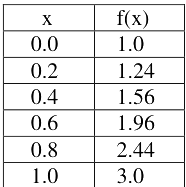
For a function f(x), the values of the function in the interval [0, 1] are given in the table below.
xf(x)
0.01.0
0.21.24
0.41.56
0.61.96
0.82.44
1.03.0
The value of the integral \(\int_{0}^{1} f(x) dx\) according to the trapezoidal rule is __________.

Question diagram

Open complete paper
2
2017 · Petroleum Engineering · Engineering Mathematics · Numerical Methods
Petroleum Engineering (PE) 2017
If \(\frac{d^2 y}{dx^2} + f(x, y) = 0\) is to be solved using the conditions \(y(0) = a\) and \(y(1) = b\), which of the following numerical method(s) can be used?
Open complete paper
3
2017 · Petroleum Engineering · Engineering Mathematics · Numerical Methods
Petroleum Engineering (PE) 2017
The numerical method used to find the root of a non-linear algebraic equation, that converges quadratically, is:
Open complete paper
4
2017 · Petroleum Engineering · Engineering Mathematics · Numerical Methods
Petroleum Engineering (PE) 2017
Single step integration (step size = 0.5) of \(I = \int_0^1 x^2 e^x dx\), evaluated numerically using the Simpson's 1/3 rule, is __________. (write answer with three decimal places)
Open complete paper
5
2017 · Petroleum Engineering · Engineering Mathematics · Numerical Methods
Petroleum Engineering (PE) 2017
Solve \(\frac{dy}{dx} = -y\) numerically from \(x = 0\) to 1 using explicit, forward, first order Euler method with initial condition of \(y(0) = 1\) and step size (\(h\)) of 0.2. The absolute value of error in \(y(1)\) calculated using analytical and numerical solution is ____% (calculate the error using analytical solution as the basis and use three decimal places).
Open complete paper
6
2018 · Petroleum Engineering · Engineering Mathematics · Numerical Methods
Petroleum Engineering (PE) 2018
Solve the given differential equation using the 2nd order Runge-Kutta (RK2) method:
\[ \frac{dy}{dt} = t - \sqrt{y} \,; \, \text{Initial condition:} \, y(t=0) = 4 \]
Use the following form of RK2 method with an integration step-size, \( h = 0.5 \):
\[ k_1 = f(t_i, y_i) \, ; \, k_2 = f(t_i + 0.5h, y_i + 0.5k_1 h) \]
\[ y_{i+1} = y_i + k_2 h \]
The value of \( y(t = 0.5) \) = _____________. (rounded-off to two decimal places)
Open complete paper
7
2019 · Petroleum Engineering · Engineering Mathematics · Numerical Methods
Petroleum Engineering (PE) 2019

A company has purchased an asset by investing Rs.30,000. The useful life of the asset is 5 years and it has no salvage value at the end of its useful life. The depreciation cost (in Rs.) for the 2nd year using sum-of-years-digit (SYD) method is

Open complete paper
8
2019 · Petroleum Engineering · Engineering Mathematics · Numerical Methods
Petroleum Engineering (PE) 2019
The man-hours required (\(T_n\)) to manufacture the \(n^{th}\) unit in a plant is given by \(T_n = T_1 n^b\), where \(b = -0.322\) at the 80% learning rate. If the manufacturing time for the first unit (\(T_1\)) is 80 man-hours, the total time (in man-hours) required to manufacture the first 4 units, at 80% learning rate, is
Open complete paper
9
2019 · Petroleum Engineering · Engineering Mathematics · Numerical Methods
Petroleum Engineering (PE) 2019
The numerical value of the definite integral \(\int_{0}^{1} e^{-x} dx\) using trapezoidal rule with function evaluations at points \(x = 0, 0.5\) and \(1\) is _____ (round off to 3 decimal places)
Open complete paper
10
2019 · Petroleum Engineering · Engineering Mathematics · Numerical Methods
Petroleum Engineering (PE) 2019
The sales data of a product for 5 years are
Year20142015201620172018
Sales (units)280268259270287

Assume the forecast for the year 2014 as 260 units. Using an exponential smoothing method with smoothing constant \( \alpha = 0.5 \), the sales forecast (units) for the year 2019, is ______
Open complete paper
11
2020 · Petroleum Engineering · Engineering Mathematics · Numerical Methods
Petroleum Engineering (PE) 2020
Match the following P. Gauss-Seidel method I. Interpolation Q. Forward Newton-Gauss method II. Non-linear differential equation R. Runge-Kutta method III. Linear algebraic equation
Open complete paper
12
2020 · Petroleum Engineering · Engineering Mathematics · Numerical Methods
Petroleum Engineering (PE) 2020
The equation \( x^3 - 3x - 5 = 0 \) is to be solved using the Newton-Raphson method. Starting with an initial guess of 2, the value of \( x \) after three iterations (rounded off to three decimal places) is ________.
Open complete paper
13
2021 · Petroleum Engineering · Engineering Mathematics · Numerical Methods
Petroleum Engineering (PE) 2021
The estimate for the root of the function \( f(x) = e^{2x} + 2x \) after one iteration with an initial guess of \( x_0 = 0 \), using the Newton-Raphson method is __________ (correct up to two decimal places).
Open complete paper
14
2022 · Petroleum Engineering · Engineering Mathematics · Numerical Methods
Petroleum Engineering (PE) 2022
Simpson’s one-third rule will give the exact value of the integral, \( I = \int_{a}^{b} [b_{0} + b_{1}x + b_{2}x^{2} + \cdots + b_{n}x^{n}] dx \) (where \( a, b, b_{0}, b_{1}, b_{2}, \cdots, b_{n} \) are numeric constants), if the values of \( n \) are
Open complete paper
15
2022 · Petroleum Engineering · Engineering Mathematics · Numerical Methods
Petroleum Engineering (PE) 2022
Consider the following ordinary differential equation
\[ \frac{dy}{dx} = x^2 y \]
The initial value is \(y(0) = 1\) and the step-size is 0.1. Solving this differential equation by Euler’s first-order method, the value of \(y(0.2)\) is _____ (rounded off to three decimal places).
Open complete paper
16
2024 · Petroleum Engineering · Engineering Mathematics · Numerical Methods
Petroleum Engineering (PE) 2024
Given \(f(x) = 2 + 20x + 30x^5\).
The value of \(\int_0^2 f(x)dx\) using Simpson's 1/3rd rule with only one interior point is __________.
Open complete paper
17
2025 · Petroleum Engineering · Engineering Mathematics · Numerical Methods
Petroleum Engineering (PE) 2025
Let \( f(x) = \ln x \). The first derivative \( f'(x) \) is to be calculated at \( x = 1 \) using numerical differentiation. \( f'(1) \) is calculated using first order forward difference (\( f'_{FD} \)), first order backward difference (\( f'_{BD} \)), and second order central difference (\( f'_{CD} \)), using interval width \( h = 0.1 \).
The CORRECT order of the values of \( f'_{FD} \), \( f'_{BD} \), and \( f'_{CD} \) is
Open complete paper
18
2023 · Petroleum Engineering · Engineering Mathematics · Numerical Methods
Petroleum Engineering (PE) 2023
In the \( 4^{th} \) order Runge-Kutta method for solving ordinary differential equations with step size \( h < 1 \), the ratio of the order of local error to the order of global error is
Open complete paper
19
2023 · Petroleum Engineering · Engineering Mathematics · Numerical Methods
Petroleum Engineering (PE) 2023
Using Simpson's one-third rule (with step size h = 0.25), the area under the curve y = e^{-x^2}, from x = 0 to x = 1 is ______ (rounded to two decimal places).
Open complete paper
20
2026 · Petroleum Engineering · Engineering Mathematics · Numerical Methods
Petroleum Engineering (PE) 2026
The values of a function f(X) at three different X are given as:
f(0.90) = 7.75
f(1.00) = 9.00
f(1.10) = 10.35
Using the central difference approximation method, which of the following is the CORRECT estimate of first differential, f'(1.00) and second differential, f''(1.00), respectively?
Open complete paper