My Cart
Your Cart 0

    Your cart is empty.

  • Total (Amount) ₹0.00
Previous year question hub

Ship Geometry and Hydrostatic Calculations - Naval Architecture and Ocean Engineering - Naval Architecture & Marine Engineering Previous Year Questions

Practice Ship Geometry and Hydrostatic Calculations - Naval Architecture and Ocean Engineering - Naval Architecture & Marine Engineering previous year questions organised from real papers, with year-wise coverage and clear topic navigation.

6Papers
5Years
17Questions
1Topics

Ship Geometry and Hydrostatic Calculations question pattern

Every graph below is calculated only from this selection.

Questions by year

Year-wise coverage for Ship Geometry and Hydrostatic Calculations. Each bar uses a separate theme-derived color.

Difficulty distribution

How the classified questions are distributed by difficulty.

Easy 10 58.8%
Medium 6 35.3%
Hard 1 5.9%
Question type distribution

MCQ, numerical, multiple-select and other formats found in these papers.

MCQ 8 47.1%
Numerical Answer Type (NAT) 8 47.1%
MSQ 1 5.9%

Subject weightage

Top subjects by unique question coverage.

Naval Architecture & Marine Engineering
17 Qs

Most asked topics

Top topics across the included previous year papers.

Naval Architecture and Ocean Engineering
17 Qs

Subtopic coverage

Top subtopics inside this exact selection.

Ship Geometry and Hydrostatic Calculations
17 Qs

Paper coverage

Question coverage for the most populated papers. Every active PYP paper remains listed below.

Mining Engineering (MN) 2026
5 Qs
Naval Architecture and Marine Engineering (NM) 2026
3 Qs
Naval Architecture & Marine Engineering (NM) 2025
2 Qs
Naval Architecture & Marine Engineering (NM) 2024
4 Qs
Naval Architecture & Marine Engineering (NM) 2023
1 Qs
Naval Architecture & Marine Engineering (NM) 2022
2 Qs

Included previous year papers

Newest papers appear first. Sort by year, question coverage or name.

PaperYear / sessionQuestions in this viewOpen
Mining Engineering (MN) 202620265View paper
Naval Architecture and Marine Engineering (NM) 202620263View paper
Naval Architecture & Marine Engineering (NM) 202520252View paper
Naval Architecture & Marine Engineering (NM) 202420244View paper
Naval Architecture & Marine Engineering (NM) 202320231View paper
Naval Architecture & Marine Engineering (NM) 202220222View paper

All Ship Geometry and Hydrostatic Calculations previous year questions

Practice every matching question in batches of 20, with every available option.

1
2022 · Naval Architecture & Marine Engineering · Naval Architecture and Ocean Engineering · Ship Geometry and Hydrostatic Calculations
Naval Architecture & Marine Engineering (NM) 2022

The margin line used for the floodable length calculation of a ship is

Open complete paper
2
2022 · Naval Architecture & Marine Engineering · Naval Architecture and Ocean Engineering · Ship Geometry and Hydrostatic Calculations
Naval Architecture & Marine Engineering (NM) 2022
Consider a rectangular box barge of length 80 m, breadth 20 m and depth 15 m floating at an even draught of 10 m. Assume that the heave added mass of the vessel is equal to its mass displacement and the acceleration due to gravity is 9.81 m/s². The heave natural period of the vessel lies in between ________ s.
Open complete paper
3
2023 · Naval Architecture & Marine Engineering · Naval Architecture and Ocean Engineering · Ship Geometry and Hydrostatic Calculations
Naval Architecture & Marine Engineering (NM) 2023
Two 30 m long bilge keels of mass 40 tonnes each, are fitted at the turn of the bilge on port and starboard sides of a ship. The cross section of the bilge keel is shown in the following figure. Assume density of water = 1000 kg/m³. If the TPC (tonnes per centimeter) immersion of the ship is 50, then the change in the mean draft is _____ cm
Open complete paper
4
2024 · Naval Architecture & Marine Engineering · Naval Architecture and Ocean Engineering · Ship Geometry and Hydrostatic Calculations
Naval Architecture & Marine Engineering (NM) 2024
An 80 m long barge with rectangular cross-section of 12 m beam and 4 m draft floats at even keel. The transverse metacenter (KM) above the keel is _____ m.
Open complete paper
5
2024 · Naval Architecture & Marine Engineering · Naval Architecture and Ocean Engineering · Ship Geometry and Hydrostatic Calculations
Naval Architecture & Marine Engineering (NM) 2024
A cube-shaped pontoon with 200 tonnes of mass placed on it, floats with a freeboard of 1 m in fresh water. When the mass is removed, the pontoon floats with a freeboard of 3 m. The length of the pontoon is _____ m (rounded off to two decimal places).
Open complete paper
6
2024 · Naval Architecture & Marine Engineering · Naval Architecture and Ocean Engineering · Ship Geometry and Hydrostatic Calculations
Naval Architecture & Marine Engineering (NM) 2024

A ship with a displacement of 10000 tonnes has the center of gravity at 4 m above the keel and 1.5 m forward of midship. If 2000 tonnes of cargo is placed at 10 m above the keel and 1.5 m aft of midship, then the new position of the center of gravity is

Open complete paper
7
2024 · Naval Architecture & Marine Engineering · Naval Architecture and Ocean Engineering · Ship Geometry and Hydrostatic Calculations
Naval Architecture & Marine Engineering (NM) 2024
The waterplane area of a ship floating in sea water is 2000 m². The density of seawater is 1025 kg/m³. If a mass of 246 tonnes is added to the ship, then the TPC (Tonnes Per Centimetre immersion) and increase in draft (in cm) respectively are
Open complete paper
8
2025 · Naval Architecture & Marine Engineering · Naval Architecture and Ocean Engineering · Ship Geometry and Hydrostatic Calculations
Naval Architecture & Marine Engineering (NM) 2025
A ship of length 200 m has a beam of 25 m. She floats in seawater with an even keel draught of 5 m. The prismatic coefficient of the ship is 0.9; the mass displacement is 20500 tonne and the density of seawater is 1025 kg/m³.
The midship section coefficient is _____ (rounded off to two decimal places).
Open complete paper
9
2025 · Naval Architecture & Marine Engineering · Naval Architecture and Ocean Engineering · Ship Geometry and Hydrostatic Calculations
Naval Architecture & Marine Engineering (NM) 2025
A ship of length 100 m and displacement 5000 tonne floats even-keel at 6.5 m in fresh water of density 1000 kg/m³. The ship's hydrostatic properties are:
MCT per cm is 10 tonne-m,
TPC in seawater is 6.25,
LCB is 2 m forward of amidship,
LCF is 2 m forward of amidship.
The ship has moved to seawater of density 1025 kg/m³ without change in the displacement. The new forward and aft draughts are _____ respectively.
Open complete paper
10
2026 · Naval Architecture & Marine Engineering · Naval Architecture and Ocean Engineering · Ship Geometry and Hydrostatic Calculations
Mining Engineering (MN) 2026
The igneous intrusion along the bedding plane of the coal seam, as indicated by P, is known as
Open complete paper
11
2026 · Naval Architecture & Marine Engineering · Naval Architecture and Ocean Engineering · Ship Geometry and Hydrostatic Calculations
Mining Engineering (MN) 2026
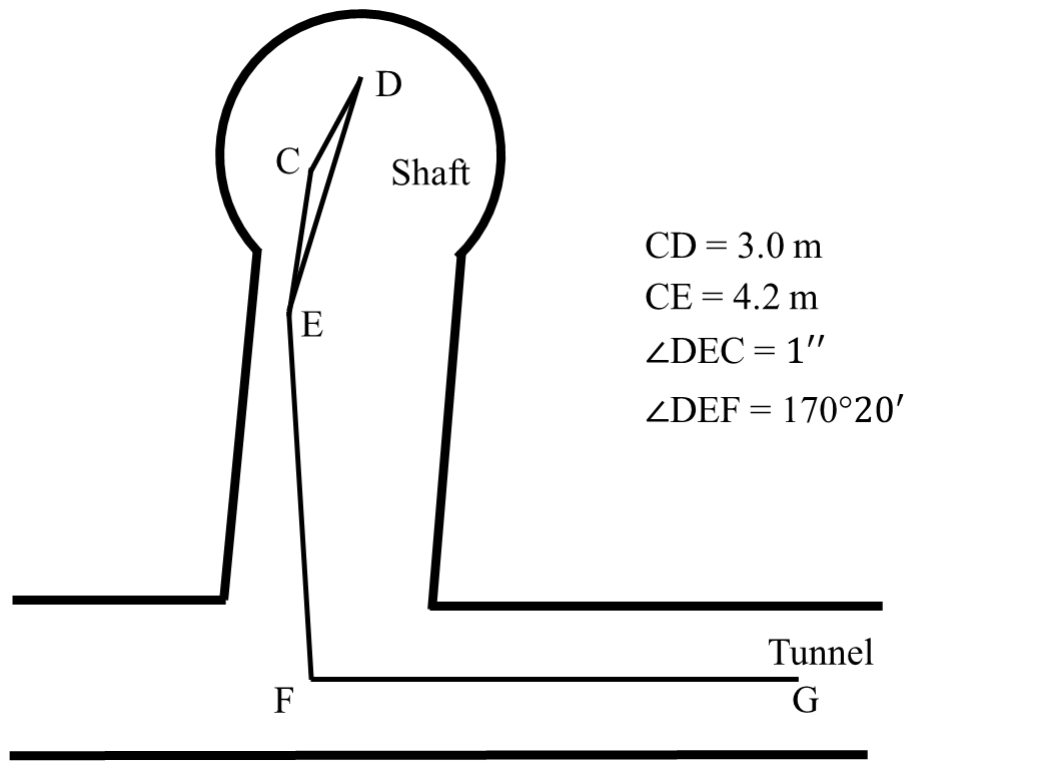
The observations from a correlation survey are shown. If the coordinates of points C and D are (East: 375 m, North: 1120 m) and (East: 376 m, North: 1121 m), respectively, the whole circle bearing of the line EF is

Question source image

Open complete paper
12
2026 · Naval Architecture & Marine Engineering · Naval Architecture and Ocean Engineering · Ship Geometry and Hydrostatic Calculations
Mining Engineering (MN) 2026
A rake of wagons, with inter-wagon gap of 100 cm, is moving at a speed of 0.4 km per hour under a silo loading system. The dimensions of the wagon are 8 m (L) × 3 m (W) × 3 m (H). The silo stops discharging the material between the wagons. Considering the fill factor of the wagon as 0.95 and the bulk density of coal as 1.2 tonne per cubic meter, the loading rate of the silo, in tonne per hour, is __________. (rounded off to nearest integer)
Open complete paper
13
2026 · Naval Architecture & Marine Engineering · Naval Architecture and Ocean Engineering · Ship Geometry and Hydrostatic Calculations
Mining Engineering (MN) 2026
A bord and pillar panel has 24 developed pillars of size 40 m × 40 m (centre to centre) under extraction. The following information is given:
Gallery width = 4 m
Extraction height = 3 m
Extraction ratio during depillaring = 80%
Specific gravity of coal = 1.4
Incubation period = 6 months
Average working days per month = 25

In order to extract the panel within the incubation period, the minimum rate of production, in tonne per day, is ______. (rounded off to one decimal place)
Open complete paper
14
2026 · Naval Architecture & Marine Engineering · Naval Architecture and Ocean Engineering · Ship Geometry and Hydrostatic Calculations
Mining Engineering (MN) 2026
Following observations were taken using a Tacheometer with staff held vertical. The additive and multiplying constants of the instrument are 0 and 100, respectively. The reduced level (RL) of the staff station R, in m, is __________. (rounded off to two decimal places)

Question source image

Open complete paper
15
2026 · Naval Architecture & Marine Engineering · Naval Architecture and Ocean Engineering · Ship Geometry and Hydrostatic Calculations
Naval Architecture and Marine Engineering (NM) 2026
A ship floating in seawater has a TPC (Tonne Per Centimeter immersion) of 20. If bilge keel of total mass 65.1 tonne and volume 44 m³ is added to the ship, then the change in the mean draft is_____ cm. Assume that after bilge keel fitment, the TPC remains constant, and the ship undergoes parallel sinkage. Density of seawater is 1025 kg/m³.
Open complete paper
16
2026 · Naval Architecture & Marine Engineering · Naval Architecture and Ocean Engineering · Ship Geometry and Hydrostatic Calculations
Naval Architecture and Marine Engineering (NM) 2026
A ship of 4000 m³ displacement has a block coefficient of 0.8.
If the beam is 0.1 times the length and twice the draught, then the length of the ship is ______ m (answer in integer).
Open complete paper
17
2026 · Naval Architecture & Marine Engineering · Naval Architecture and Ocean Engineering · Ship Geometry and Hydrostatic Calculations
Naval Architecture and Marine Engineering (NM) 2026
A ship consumes 250 tonne of fuel when moving from sea to a river. On arrival, draught and trim (measured at rest) are the same as the corresponding values at sea.
The displacement of the ship in seawater is ______ tonne (answer in integer).
The density of seawater and river water are 1025 kg/m³ and 1000 kg/m³ respectively.
Open complete paper
