Difficulty distribution
How the classified questions are distributed by difficulty.
127questions
Not classified
127
100%
Your cart is empty.
Practice Dual Nature Of Radiation - Modern Physics - Physics previous year questions organised from real papers, with year-wise coverage and clear topic navigation.
Every graph below is calculated only from this selection.
Year-wise coverage for Dual Nature Of Radiation. Each bar uses a separate theme-derived color.
How the classified questions are distributed by difficulty.
MCQ, numerical, multiple-select and other formats found in these papers.
Top subjects by unique question coverage.
Top topics across the included previous year papers.
Top subtopics inside this exact selection.
Question coverage for the most populated papers. Every active PYP paper remains listed below.
Newest papers appear first. Sort by year, question coverage or name.
| Paper | Year / session | Questions in this view | Open |
|---|---|---|---|
| MHT CET (PCB) 2025 9th April Evening Shift | 2025 | 2 | View paper |
| MHT CET (PCB) 2025 9th April Morning Shift | 2025 | 2 | View paper |
| MHT CET 2025 19TH APRIL EVENING SHIFT | 2025 | 2 | View paper |
| MHT CET 2025 19TH APRIL MORNING SHIFT | 2025 | 2 | View paper |
| MHT CET 2025 20TH APRIL EVENING SHIFT | 2025 | 2 | View paper |
| MHT CET 2025 20TH APRIL MORNING SHIFT | 2025 | 2 | View paper |
| MHT CET 2025 21ST APRIL EVENING SHIFT | 2025 | 2 | View paper |
| MHT CET 2025 21ST APRIL MORNING SHIFT | 2025 | 2 | View paper |
| MHT CET 2025 22ND APRIL EVENING SHIFT | 2025 | 3 | View paper |
| MHT CET 2025 22ND APRIL MORNING SHIFT | 2025 | 2 | View paper |
| MHT CET 2025 23RD APRIL EVENING SHIFT | 2025 | 2 | View paper |
| MHT CET 2025 23RD APRIL MORNING SHIFT | 2025 | 2 | View paper |
| MHT CET 2025 25TH APRIL EVENING SHIFT | 2025 | 2 | View paper |
| MHT CET 2025 25TH APRIL MORNING SHIFT | 2025 | 3 | View paper |
| MHT CET 2025 26TH APRIL EVENING SHIFT | 2025 | 2 | View paper |
| MHT CET 2025 26TH APRIL MORNING SHIFT | 2025 | 2 | View paper |
| MHT CET 2025 5TH MAY EVENING SHIFT | 2025 | 2 | View paper |
| MHT CET (PCB) 2024 22th April Evening Shift | 2024 | 2 | View paper |
| MHT CET (PCB) 2024 22th April Morning Shift | 2024 | 2 | View paper |
| MHT CET 2024 10TH MAY EVENING SHIFT | 2024 | 2 | View paper |
| MHT CET 2024 10TH MAY MORNING SHIFT | 2024 | 2 | View paper |
| MHT CET 2024 11TH MAY EVENING SHIFT | 2024 | 2 | View paper |
| MHT CET 2024 11TH MAY MORNING SHIFT | 2024 | 2 | View paper |
| MHT CET 2024 15TH MAY EVENING SHIFT | 2024 | 2 | View paper |
| MHT CET 2024 15TH MAY MORNING SHIFT | 2024 | 2 | View paper |
| MHT CET 2024 16TH MAY EVENING SHIFT | 2024 | 2 | View paper |
| MHT CET 2024 16TH MAY MORNING SHIFT | 2024 | 1 | View paper |
| MHT CET 2024 2ND MAY EVENING SHIFT | 2024 | 2 | View paper |
| MHT CET 2024 2ND MAY MORNING SHIFT | 2024 | 2 | View paper |
| MHT CET 2024 3RD MAY EVENING SHIFT | 2024 | 3 | View paper |
| MHT CET 2024 3RD MAY MORNING SHIFT | 2024 | 2 | View paper |
| MHT CET 2024 4TH MAY EVENING SHIFT | 2024 | 2 | View paper |
| MHT CET 2024 4TH MAY MORNING SHIFT | 2024 | 2 | View paper |
| MHT CET 2024 9TH MAY EVENING SHIFT | 2024 | 2 | View paper |
| MHT CET 2024 9TH MAY MORNING SHIFT | 2024 | 2 | View paper |
| MHT CET 2023 10TH MAY EVENING SHIFT | 2023 | 2 | View paper |
| MHT CET 2023 10TH MAY MORNING SHIFT | 2023 | 2 | View paper |
| MHT CET 2023 11TH MAY EVENING SHIFT | 2023 | 2 | View paper |
| MHT CET 2023 11TH MAY MORNING SHIFT | 2023 | 1 | View paper |
| MHT CET 2023 12TH MAY EVENING SHIFT | 2023 | 2 | View paper |
| MHT CET 2023 12TH MAY MORNING SHIFT | 2023 | 2 | View paper |
| MHT CET 2023 13TH MAY EVENING SHIFT | 2023 | 2 | View paper |
| MHT CET 2023 13TH MAY MORNING SHIFT | 2023 | 2 | View paper |
| MHT CET 2023 14TH MAY EVENING SHIFT | 2023 | 1 | View paper |
| MHT CET 2023 14TH MAY MORNING SHIFT | 2023 | 1 | View paper |
| MHT CET 2023 9TH MAY EVENING SHIFT | 2023 | 2 | View paper |
| MHT CET 2023 9TH MAY MORNING SHIFT | 2023 | 1 | View paper |
| MHT CET 2022 11TH AUGUST EVENING SHIFT | 2022 | 1 | View paper |
| MHT CET 2021 20TH SEPTEMBER EVENING SHIFT | 2021 | 2 | View paper |
| MHT CET 2021 20TH SEPTEMBER MORNING SHIFT | 2021 | 2 | View paper |
| MHT CET 2021 21TH SEPTEMBER EVENING SHIFT | 2021 | 3 | View paper |
| MHT CET 2021 21TH SEPTEMBER MORNING SHIFT | 2021 | 2 | View paper |
| MHT CET 2021 22TH SEPTEMBER EVENING SHIFT | 2021 | 3 | View paper |
| MHT CET 2021 22TH SEPTEMBER MORNING SHIFT | 2021 | 2 | View paper |
| MHT CET 2021 23RD SEPTEMBER EVENING SHIFT | 2021 | 3 | View paper |
| MHT CET 2021 23th September Morning Shift | 2021 | 2 | View paper |
| MHT CET 2021 24TH SEPTEMBER EVENING SHIFT | 2021 | 2 | View paper |
| MHT CET 2021 24TH SEPTEMBER MORNING SHIFT | 2021 | 2 | View paper |
| MHT CET 2020 16TH OCTOBER EVENING SHIFT | 2020 | 2 | View paper |
| MHT CET 2020 16TH OCTOBER MORNING SHIFT | 2020 | 2 | View paper |
| MHT CET 2020 19TH OCTOBER EVENING SHIFT | 2020 | 2 | View paper |
| MHT CET 2019 2ND MAY EVENING SHIFT | 2019 | 1 | View paper |
| MHT CET 2019 2ND MAY MORNING SHIFT | 2019 | 2 | View paper |
| MHT CET 2019 3RD MAY MORNING SHIFT | 2019 | 2 | View paper |
Practice every matching question in batches of 20, with every available option.
A metal surface is illuminated by light of given intensity and frequency to cause photoemission. If the intensity of illumination is reduced to one fourth of its original value then the maximum KE of the emitted photoelectrons would be
When photons of energy $h v$ fall on a metal plate of work function ' $W_0$ ', photoelectrons of maximum kinetic energy ' $K$ ' are ejected. If the frequency of the radiation is doubled, the maximum kinetic energy of the ejected photoelectrons will be
The maximum velocity of the photoelectron emitted by the metal surface is ' $v$ '. Charge and mass of the photoelectron is denoted by ' $e$ ' and ' $m$ ' respectively. The stopping potential in volt is
The stopping potential of the photoelectrons, from a photo cell is
When certain metal surface is illuminated with a light of wavelength $\lambda$, the stopping potential is $V$, When the same surface is illuminated by light of wavelength $2 \lambda$, the stopping potential is $\left(\frac{V}{3}\right)$. The threshold wavelength for the surface is
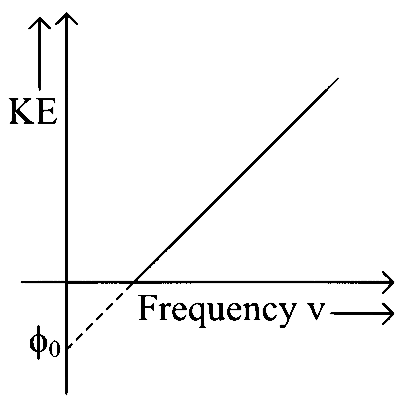
The graph of kinetic energy against the frequency \(v\) of incident light is as shown in the figure. The slope of the graph and intercept on \(X\)-axis respectively are
The light of wavelength \(\lambda\) incident on the surface of metal having work function \(\phi\) emits the electrons. The maximum velocity of electrons emitted is [ \(c=\) velocity of light, \(h=\) Planck's constant, \(m=\) mass of electron]
Energy of the incident photon on the metal surface is \(3 W\) and then \(5 W\), where \(W\) is the work function for that metal. The ratio of velocities of emitted photoelectrons is
The maximum velocity of the photoelectron emitted by the metal surface is \(v\). Charge and mass of the photoelectron is denoted by \(e\) and \(m\), respectively. The stopping potential in volt is
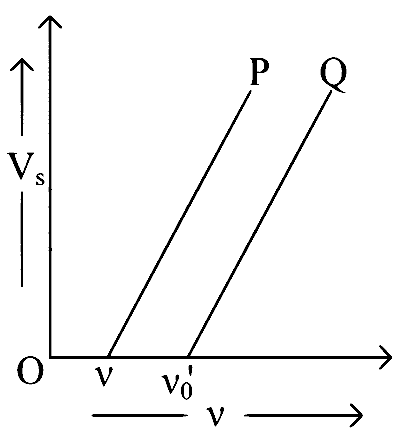
The graph of stopping potential $V_s$ against frequency $v$ of incident radiation is plotted for two different metals $P$ and $Q$ as shown in the graph. $\phi_p$ and $\phi_Q$ are work-functions of $P$ and $Q$ respectively, then
If the maximum kinetic energy of emitted electrons in photoelectric effect is $3.2 \times 10^{-19} \mathrm{~J}$ and the work-function for metal is $6.63 \times 10^{-19} \mathrm{~J}$, then stopping potential and threshold wavelength respectively are
[Planck's constant, $h=6.63 \times 10^{34} \mathrm{~J}$-s]
[Velocity of light, $c=3 \times 10^8 \frac{\mathrm{~m}}{\mathrm{~s}}$ ]
[Charge on electron $=1.6 \times 10^{-19} \mathrm{C}$ ]
What is the additional energy that should be supplied to a moving electron to reduce its de Broglie wavelength from \(1 \mathrm{~nm}\) to \(0.5 \mathrm{~nm}\) ?
Photoelectrons are emitted when photons of energy \(4.2 ~\mathrm{eV}\) are incident on a photosensitive metallic sphere of radius \(10 \mathrm{~cm}\) and work function \(2.4 ~\mathrm{eV}\). The number of photoelectrons emitted before the emission is stopped is
\(\left[\frac{1}{4 \pi \epsilon_0}=9 \times 10^9\right.\) SI unit; \(\left.\mathrm{e}=1.6 \times 10^{-19} \mathrm{C}\right]\)
When a photosensitive surface is irradiated by light of wavelengths '\(\lambda_1\)' and '\(\lambda_2\)', kinetic energies of emitted photoelectrons are 'E\(_1\)' and 'E\(_2\)' respectively. The work function of photosensitive surface is
When light of wavelength '\(\lambda\)' is incident on a photosensitive surface, photons of power 'P' are emitted. The number of photon 'n' emitted in time 't' is [h = Planck's constant, c = velocity of light in vacuum]
Photoemission from metal surface takes place for frequencies '\(v_1\)' and '\(v_2\)' of incident rays \(\left(v_1>v_2\right)\). Maximum kinetic energy of photoelectrons emitted is in the ratio \(1: \mathrm{K}\). The threshold frequency of metallic surface is
The wave number of the last line of the Balmer series in the hydrogen spectrum will be \(\left(\right.\) Rydberg's cons \(\left.\tan t, R=\frac{10^7}{\mathrm{~m}}\right)\)
A proton and alpha particle are accelerated through the same potential difference. The ratio of the de-Broglie wavelength of proton to that of alpha particle will be (mass of alpha particle is four times mass of proton.)
Light of frequency two times the threshold frequency is incident on photosensitive material. If the incident frequency is made \(\left(\frac{1}{3}\right)^{\text {rd }}\) and intensity is doubled, then the photoelectric current will
On a photosensitive surface, if the intensity of incident radiation is increased, the stopping potential
Showing 20 of 127 questions