My Cart
Your Cart 0

    Your cart is empty.

  • Total (Amount) ₹0.00
Previous year question hub

Geometry - General Aptitude (GA) Previous Year Questions

Practice Geometry - General Aptitude (GA) previous year questions organised from real papers, with year-wise coverage and clear topic navigation.

12Papers
9Years
27Questions
1Topics

Geometry question pattern

Every graph below is calculated only from this selection.

Questions by year

Year-wise coverage for Geometry. Each bar uses a separate theme-derived color.

Difficulty distribution

How the classified questions are distributed by difficulty.

Medium 15 55.6%
Easy 11 40.7%
Hard 1 3.7%
Question type distribution

MCQ, numerical, multiple-select and other formats found in these papers.

MCQ 18 66.7%
Numerical Answer Type (NAT) 9 33.3%

Subject weightage

Top subjects by unique question coverage.

General Aptitude (GA)
27 Qs

Most asked topics

Top topics across the included previous year papers.

Geometry
27 Qs

Subtopic coverage

Top subtopics inside this exact selection.

Circles
7 Qs
Triangles
4 Qs
Lines
4 Qs
Spheres
2 Qs
Parabolas
1 Qs
Curves
1 Qs
Cones
1 Qs
Rectangles
1 Qs
Cylinders
1 Qs
Polygons
1 Qs
Squares
1 Qs
Pyramids
1 Qs
Polyhedra
1 Qs
Symmetry
1 Qs

Paper coverage

Question coverage for the most populated papers. Every active PYP paper remains listed below.

Mechanical Engineering (ME) 2026
1 Qs
Mechanical Engineering (ME) 2025
1 Qs
Mechanical Engineering (ME) 2024
1 Qs
Mechanical Engineering (ME) 2023
1 Qs
Mechanical Engineering (ME) 2021 [Session 1]
1 Qs
Mechanical Engineering (ME) 2018 [Session 2]
2 Qs
Mechanical Engineering (ME) 2016 [Session 2]
2 Qs
Mechanical Engineering (ME) 2016 [Session 3]
1 Qs
Mechanical Engineering (ME) 2015 [Session 3]
8 Qs
Mechanical Engineering (ME) 2015 [Session 1]
4 Qs
Mechanical Engineering (ME) 2015 [Session 2]
2 Qs
Mechanical Engineering (ME) 2012
3 Qs

Browse by subtopics

Open a focused page built from the same verified paper data.

Circles

Explore previous-paper coverage, trends and focused practice for Circles.

7 questions6 papers4 years

Triangles

Explore previous-paper coverage, trends and focused practice for Triangles.

4 questions3 papers2 years

Lines

Explore previous-paper coverage, trends and focused practice for Lines.

4 questions2 papers2 years

Spheres

Explore previous-paper coverage, trends and focused practice for Spheres.

2 questions2 papers2 years

Parabolas

Explore previous-paper coverage, trends and focused practice for Parabolas.

1 questions1 papers1 years

Curves

Explore previous-paper coverage, trends and focused practice for Curves.

1 questions1 papers1 years

Cones

Explore previous-paper coverage, trends and focused practice for Cones.

1 questions1 papers1 years

Rectangles

Explore previous-paper coverage, trends and focused practice for Rectangles.

1 questions1 papers1 years

Cylinders

Explore previous-paper coverage, trends and focused practice for Cylinders.

1 questions1 papers1 years

Polygons

Explore previous-paper coverage, trends and focused practice for Polygons.

1 questions1 papers1 years

Squares

Explore previous-paper coverage, trends and focused practice for Squares.

1 questions1 papers1 years

Pyramids

Explore previous-paper coverage, trends and focused practice for Pyramids.

1 questions1 papers1 years

Polyhedra

Explore previous-paper coverage, trends and focused practice for Polyhedra.

1 questions1 papers1 years

Symmetry

Explore previous-paper coverage, trends and focused practice for Symmetry.

1 questions1 papers1 years

Included previous year papers

Newest papers appear first. Sort by year, question coverage or name.

PaperYear / sessionQuestions in this viewOpen
Mechanical Engineering (ME) 202620261View paper
Mechanical Engineering (ME) 202520251View paper
Mechanical Engineering (ME) 202420241View paper
Mechanical Engineering (ME) 202320231View paper
Mechanical Engineering (ME) 2021 [Session 1]20211View paper
Mechanical Engineering (ME) 2018 [Session 2]20182View paper
Mechanical Engineering (ME) 2016 [Session 2]20162View paper
Mechanical Engineering (ME) 2016 [Session 3]20161View paper
Mechanical Engineering (ME) 2015 [Session 1]20154View paper
Mechanical Engineering (ME) 2015 [Session 2]20152View paper
Mechanical Engineering (ME) 2015 [Session 3]20158View paper
Mechanical Engineering (ME) 201220123View paper

Sample previous year questions

A varied preview from the papers represented in this selection, with every available option.

1
2012 · General Aptitude (GA) · Geometry · Parabolas
Mechanical Engineering (ME) 2012
The area enclosed between the straight line \(y = x\) and the parabola \(y = x^2\) in the x-y plane is
Open complete paper
2
2015 · General Aptitude (GA) · Geometry · Circles
Mechanical Engineering (ME) 2015 [Session 1]
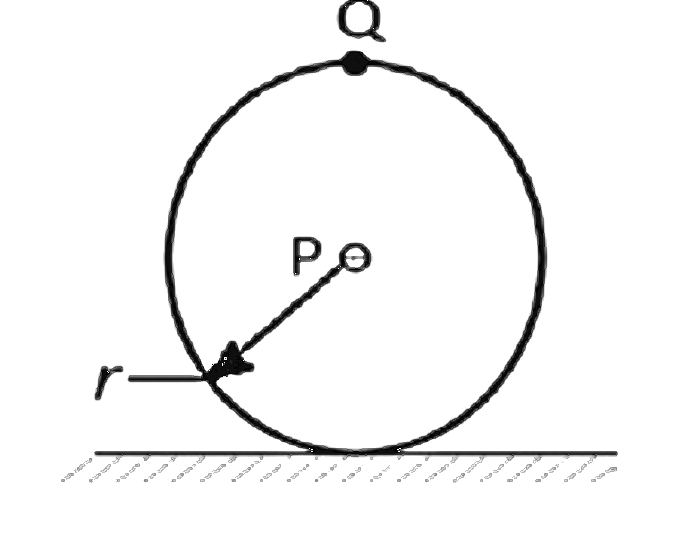
A wheel of radius r rolls without slipping on a horizontal surface shown below. If the velocity of point P is 10 m/s in the horizontal direction, the magnitude of velocity of point Q (in m/s) is ________
Open complete paper
3
2015 · General Aptitude (GA) · Geometry · Cones
Mechanical Engineering (ME) 2015 [Session 2]
From a circular sheet of paper of radius 30 cm, a sector of 10% area is removed. If the remaining part is used to make a conical surface, then the ratio of the radius and height of the cone is ____.
Open complete paper
4
2015 · General Aptitude (GA) · Geometry · Triangles
Mechanical Engineering (ME) 2015 [Session 3]
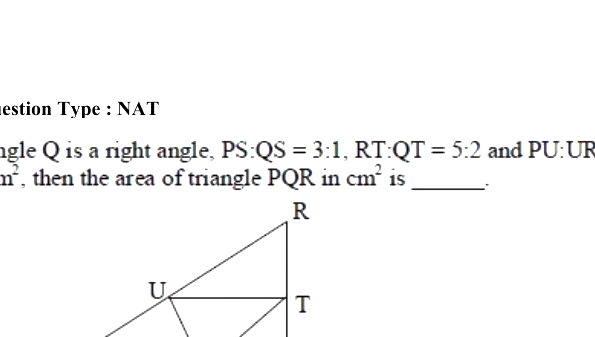
In the given figure angle Q is a right angle, PS : QS = 3:1, RT : QT = 5:2 and PU : UR = 1:1. If area of triangle QTS is 20 cm², then the area of triangle PQR in cm² is ______.

Question diagram

Open complete paper
5
2016 · General Aptitude (GA) · Geometry · Spheres
Mechanical Engineering (ME) 2016 [Session 2]
The volume of a sphere of diameter 1 unit is __________ than the volume of a cube of side 1 unit.
Open complete paper
6
2016 · General Aptitude (GA) · Geometry · Lines
Mechanical Engineering (ME) 2016 [Session 3]
M and N start from the same location. M travels 10 km East and then 10 km North-East. N travels 5 km South and then 4 km South-East. What is the shortest distance (in km) between M and N at the end of their travel?
Open complete paper