My Cart
Your Cart 0

    Your cart is empty.

  • Total (Amount) ₹0.00
Previous year question hub

Wave Optics - Optics - Physics Previous Year Questions

Practice Wave Optics - Optics - Physics previous year questions organised from real papers, with year-wise coverage and clear topic navigation.

10Papers
10Years
26Questions
1Topics

Wave Optics question pattern

Every graph below is calculated only from this selection.

Questions by year

Year-wise coverage for Wave Optics. Each bar uses a separate theme-derived color.

Difficulty distribution

How the classified questions are distributed by difficulty.

Not classified 26 100%

Question type distribution

MCQ, numerical, multiple-select and other formats found in these papers.

Multiple Choices 26 100%

Subject weightage

Top subjects by unique question coverage.

Physics
26 Qs

Most asked topics

Top topics across the included previous year papers.

Optics
26 Qs

Subtopic coverage

Top subtopics inside this exact selection.

Wave Optics
26 Qs

Paper coverage

Question coverage for the most populated papers. Every active PYP paper remains listed below.

KCET 2026
1 Qs
KCET 2025
1 Qs
KCET 2024
2 Qs
KCET 2023
3 Qs
KCET 2022
4 Qs
KCET 2021
3 Qs
KCET 2020
3 Qs
KCET 2019
1 Qs
KCET 2018
4 Qs
KCET 2017
4 Qs

Included previous year papers

Newest papers appear first. Sort by year, question coverage or name.

PaperYear / sessionQuestions in this viewOpen
KCET 202620261View paper
KCET 202520251View paper
KCET 202420242View paper
KCET 202320233View paper
KCET 202220224View paper
KCET 202120213View paper
KCET 202020203View paper
KCET 201920191View paper
KCET 201820184View paper
KCET 201720174View paper

All Wave Optics previous year questions

Practice every matching question in batches of 20, with every available option.

1
2017 · Physics · Optics · Wave Optics
KCET 2017
In a system of two crossed polarisers, it is found that the intensity of light from the second polariser is half from that of first polariser. The angle between their pass axes is
A
$60^{\circ}$
B
$30^{\circ}$
C
$0^{\circ}$
D
$45^{\circ}$
Open complete paper
2
2017 · Physics · Optics · Wave Optics
KCET 2017
According to Huygens' principle, during refraction of light from air to a denser medium
A
Wavelength decreases but speed increases
B
Wavelength increases but speed decreases
C
Wavelength and speed increases
D
Wavelength and speed decreases
Open complete paper
3
2017 · Physics · Optics · Wave Optics
KCET 2017
During scattering of light, the amount of scattering in inversely proportional to................ of wavelength of light.
A
square
B
fourth power
C
half
D
cube
Open complete paper
4
2017 · Physics · Optics · Wave Optics
KCET 2017
In Young's double-slit experiment, if yellow light is replaced by blue light, the interference fringes becomes
A
darker
B
brighter
C
wider
D
narrower
Open complete paper
5
2018 · Physics · Optics · Wave Optics
KCET 2018
In Young's double slit experiment, two wavelengths $\lambda_1=780 \mathrm{~nm}$ and $\lambda_2=520 \mathrm{~nm}$ are used to obtain interference fringes. If the $n^{\mathrm{th}}$ bright band due to $\lambda_1$ coincides with $(n+1)^{\text {th }}$ bright band due to $\lambda_2$, then the value of $n$ is
A
4
B
3
C
2
D
6
Open complete paper
6
2018 · Physics · Optics · Wave Optics
KCET 2018
A plane wavefront of wavelength $\lambda$ is incident on a single slit of width $a$. The angular width of principal maximum is
A
$\frac{\lambda}{a}$
B
$\frac{2 \lambda}{a}$
C
$\frac{a}{\lambda}$
D
$\frac{a}{2 \lambda}$
Open complete paper
7
2018 · Physics · Optics · Wave Optics
KCET 2018
In a Fraunhofer diffraction at a single slit, if yellow light illuminating that slit is replaced by blue light, then diffraction bands
A
remain unchanged
B
become wider
C
disappear
D
become narrower
Open complete paper
8
2018 · Physics · Optics · Wave Optics
KCET 2018
In Young's double slit experiment, slits are separated by 2 mm and the screen is placed at a distance of 1.2 m from the slits. Light consisting of two wavelengths \(6500\mathop A\limits^o\) and \(5200\mathop A\limits^o\) are used to obtain interference fringes. Then, the separation between the fourth bright fringes of two different patterns produced by the two wavelengths is
A
0.312 mm
B
0.123 mm
C
0.213 mm
D
0.412 mm
Open complete paper
9
2019 · Physics · Optics · Wave Optics
KCET 2019

If Young's double slit experiment, using monochromatic light of wavelength \(\lambda\), the intensity of light at a point on the screen where path difference is \(\lambda\) is \(K\) units. The intensity of light at a point where path difference is \(\frac{\lambda}{3}\) is

A
\(K\)
B
\(\frac{K}{4}\)
C
\(4 K\)
D
\(2 K\)
Open complete paper
10
2020 · Physics · Optics · Wave Optics
KCET 2020

Two poles are separated by a distance of \(3.14 \mathrm{~m}\). The resolving power of human eye is \(1 \mathrm{~min}\) of an arc. The maximum distance from which he can identify the two poles distinctly is

A
10.8 km
B
5.4 km
C
188 m
D
376 m
Open complete paper
11
2020 · Physics · Optics · Wave Optics
KCET 2020

Three polaroid sheets \(P_1, P_2\) and \(P_3\) are kept parallel to each other such that the angle between pass axes of \(P_1\) and \(P_2\) is \(45^{\circ}\) and that between \(P_2\) and \(P_3\) is \(45^{\circ}\). If unpolarised beam of light of intensity \(128 \mathrm{~Wm}^{-2}\) is incident on \(P_1\). What is the intensity of light oming out of \(P_3\) ?

A
\(128 \mathrm{~Wm}^{-2}\)
B
zero
C
\(16 \mathrm{~Wm}^{-2}\)
D
\(64 \mathrm{~Wm}^{-2}\)
Open complete paper
12
2020 · Physics · Optics · Wave Optics
KCET 2020

In Young's double slit experiment, the distance between the slits and the screen is \(1.2 \mathrm{~m}\) and the distance between the two slits is \(2.4 \mathrm{~mm}\). If a thin transparent mica sheet of thickness \(1 \mu \mathrm{m}\) and RI 1.5 is introduced between one of the interfering beams, the shift in the position of central bright fringe is

A
2 mm
B
0.5 mm
C
0.125 mm
D
0.25 mm
Open complete paper
13
2021 · Physics · Optics · Wave Optics
KCET 2021

In the Young's double slit experiment a monochromatic source of wavelength \(\lambda\) is used. The intensity of light passing through each slit is \(I_0\). The intensity of light reaching the screen \(S_C\) at a point \(P\), a distance \(x\) from \(O\) is given by (Take, \(d<< D\))
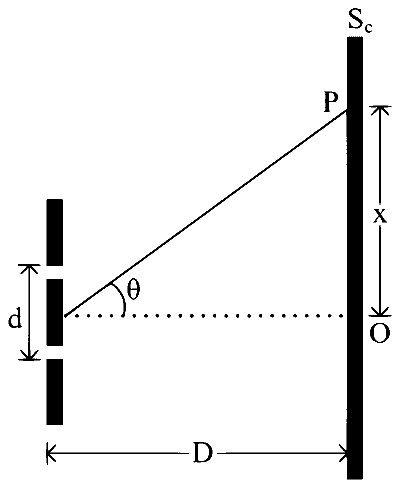
KCET 2021 Physics - Wave Optics Question 17 English

A
\(I_0 \cos ^2\left(\frac{\pi D}{\lambda d} x\right)\)
B
\(4 I_0 \cos ^2\left(\frac{\pi d}{\lambda D} x\right)\)
C
\(I_0 \sin ^2\left(\frac{\pi d}{2 \lambda D} x\right)\)
D
\(4 I_0 \cos \left(\frac{\pi d}{2 \lambda D} x\right)\)
Open complete paper
14
2021 · Physics · Optics · Wave Optics
KCET 2021

Which of the following statements are correct with reference to single slit diffraction pattern?

(I) Fringes are of unequal width.

(II) Fringes are of equal width.

(III) Light energy is conserved.

(IV) Intensities of all bright fringes are equal.

A
Both (I) and (III)
B
Both (I) and (IV)
C
Both (II) and (IV)
D
Both (II) and (III)
Open complete paper
15
2021 · Physics · Optics · Wave Optics
KCET 2021

A slit of width \(a\) is illuminated by red light of wavelength \(6500 \mathop A\limits^o\). If the first diffraction minimum falls at \(30^{\circ}\), then the value of \(a\) is

A
\(6.5 \times 10^{-4} \mathrm{~mm}\)
B
1.3 micron
C
\(3250 \mathop A\limits^o\)
D
\(26 \times 10^{-4} \mathrm{~cm}\)
Open complete paper
16
2022 · Physics · Optics · Wave Optics
KCET 2022

For light diverging from a finite point source,

A
the intensity decreases in proportion to the distance squared
B
the wavefront is parabolic
C
the intensity at the wave front does not depend on the distance
D
the wave front is cylindrical
Open complete paper
17
2022 · Physics · Optics · Wave Optics
KCET 2022

The fringe width for red colour as compared to that for violet colour is approximately

A
2 times
B
4 times
C
8 times
D
3 times
Open complete paper
18
2022 · Physics · Optics · Wave Optics
KCET 2022

When a compact disc (CD) is illuminated by small source of white light coloured bands are observed. This is due to

A
diffraction
B
interference
C
reflection
D
scattering
Open complete paper
19
2022 · Physics · Optics · Wave Optics
KCET 2022

In case of Fraunhoffer diffraction at a single slit, the diffraction pattern on the screen is correct for which of the following statements?

A
Central bright band having alternate dark and bright bands of decreasing intensity on either side.
B
Central dark band having uniform brightness on either side.
C
Central bright band having dark bands on either side.
D
Central dark band having alternate dark and bright bands of decreasing intensity on either side.
Open complete paper
20
2023 · Physics · Optics · Wave Optics
KCET 2023

An unpolarised light of intensity \(I\) is passed through two polaroids kept one after the other with their planes parallel to each other. The intensity of light emerging from second polaroid is \(\frac{I}{4}\). The angle between the pass axes of the polaroids is

A
\(45^{\circ}\)
B
\(0^{\circ}\)
C
\(60^{\circ}\)
D
\(30^{\circ}\)
Open complete paper

Showing 20 of 26 questions