Difficulty distribution
How the classified questions are distributed by difficulty.
38questions
Not classified
38
100%
Your cart is empty.
Practice Ray Optics - Optics - Physics previous year questions organised from real papers, with year-wise coverage and clear topic navigation.
Every graph below is calculated only from this selection.
Year-wise coverage for Ray Optics. Each bar uses a separate theme-derived color.
How the classified questions are distributed by difficulty.
MCQ, numerical, multiple-select and other formats found in these papers.
Top subjects by unique question coverage.
Top topics across the included previous year papers.
Top subtopics inside this exact selection.
Question coverage for the most populated papers. Every active PYP paper remains listed below.
Newest papers appear first. Sort by year, question coverage or name.
| Paper | Year / session | Questions in this view | Open |
|---|---|---|---|
| KCET 2026 | 2026 | 5 | View paper |
| KCET 2025 | 2025 | 5 | View paper |
| KCET 2024 | 2024 | 4 | View paper |
| KCET 2023 | 2023 | 4 | View paper |
| KCET 2022 | 2022 | 5 | View paper |
| KCET 2021 | 2021 | 4 | View paper |
| KCET 2020 | 2020 | 3 | View paper |
| KCET 2019 | 2019 | 3 | View paper |
| KCET 2018 | 2018 | 3 | View paper |
| KCET 2017 | 2017 | 2 | View paper |
Practice every matching question in batches of 20, with every available option.
A point object is moving uniformly towards the pole of a concave mirror of focal length \(25 \mathrm{~cm}\) along its axis as shown below. The speed of the object is \(1 \mathrm{~ms}^{-1}\). At \(t=0\), the distance of the object from the mirror is \(50 \mathrm{~cm}\). The average velocity of the image formed by the mirror between time \(t=0\) and \(t=0.25 \mathrm{~s}\) is

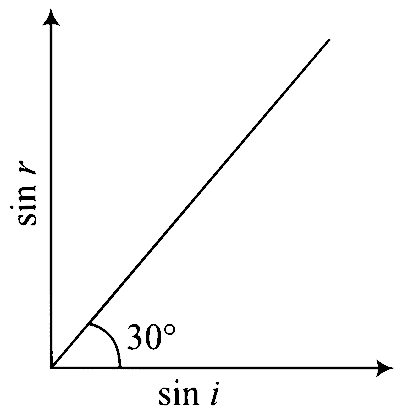
A transparent medium shows relation between \(i\) and \(r\) as shown. If the speed of light in vacuum is \(c\), the Brewster angle for the medium is
A certain prism is found to produce a minimum deviation of \(38^{\circ}\). It produce a deviation of \(44^{\circ}\) when the angle of incidence is either \(42^{\circ}\) or \(62^{\circ}\). What is the angle of incidence when it is undergoing minimum deviation?
An object approaches a convergent lens from the left of the lens with a uniform speed \(5 \mathrm{~m} / \mathrm{s}\) and stops at the focus, the image
The following figure shows a beam of light converging at point \(P\). When a concave lens of focal length \(16 \mathrm{~cm}\) is introduced in the path of the beam at a place shown by dotted line such that \(O P\) becomes the axis of the lens, the beam converges at a distance \(x\) from the lens. The value of \(x\) will be equal to

The refracting angle of prism is \(A\) and refractive index of material of prism is \(\cot \frac{A}{2}\). The angle of minimum deviation is \(A\)
If the refractive index from air to glass is \(\frac{3}{2}\) and that from air to water is \(\frac{4}{3}\), then the ratio of focal lengths of a glass lens in water and in air is
In refraction, light waves are bent on passing from one medium to second medium because, in the second medium
Two thin biconvex lenses have focal lengths \(f_1\) and \(f_2\). A third thin biconcave lens has focal length of \(f_3\). If the two biconvex lenses are in contact, then the total power of the lenses is \(P_1\). If the first convex lens is in contact with the third lens, then the total power is \(P_2\). If the second lens is in contact with the third lens, the total power is \(P_3\), then
The size of the image of an object, which is at infinity, as formed by a convex lens of focal length \(30 \mathrm{~cm}\) is \(2 \mathrm{~cm}\). If a concave lens of focal length \(20 \mathrm{~cm}\) is placed between the convex lens and the image at a distance of \(26 \mathrm{~cm}\) from the lens, the new size of the image is
Focal length of a convex lens will be maximum for
A convex lens of focal length \(f\) is placed somewhere in between an object and a screen. The distance between the object and the screen is \(x\). If the numerical value of the magnification produced by the lens is \(m\), then the focal length of the lens is
A ray of light passes through an equilateral glass prism in such a manner that the angle of incidence is equal to the angle of emergence and each of these angles is equal to \(\frac{3}{4}\) of the angle of the prism. The angle of deviation is
The power of a equi-concave lens is \(-4.5 \mathrm{D}\) and is made of a material of refractive index 1.6, the radii of curvature of the lens is
Consider a glass slab which is silvered at one side and the other side is transparent. Given the refractive index of the glass slab to be 1.5. If a ray of light is incident at an angle of \(45^{\circ}\) on the transparent side, then the deviation of the ray of light from its initial path, when it comes out of the slab is
Showing 20 of 38 questions