Difficulty distribution
How the classified questions are distributed by difficulty.
25questions
Not classified
25
100%
Your cart is empty.
Practice Dual Nature Of Radiation - Modern Physics - Physics previous year questions organised from real papers, with year-wise coverage and clear topic navigation.
Every graph below is calculated only from this selection.
Year-wise coverage for Dual Nature Of Radiation. Each bar uses a separate theme-derived color.
How the classified questions are distributed by difficulty.
MCQ, numerical, multiple-select and other formats found in these papers.
Top subjects by unique question coverage.
Top topics across the included previous year papers.
Top subtopics inside this exact selection.
Question coverage for the most populated papers. Every active PYP paper remains listed below.
Newest papers appear first. Sort by year, question coverage or name.
| Paper | Year / session | Questions in this view | Open |
|---|---|---|---|
| KCET 2026 | 2026 | 2 | View paper |
| KCET 2025 | 2025 | 2 | View paper |
| KCET 2024 | 2024 | 2 | View paper |
| KCET 2023 | 2023 | 3 | View paper |
| KCET 2022 | 2022 | 3 | View paper |
| KCET 2021 | 2021 | 3 | View paper |
| KCET 2020 | 2020 | 3 | View paper |
| KCET 2019 | 2019 | 2 | View paper |
| KCET 2018 | 2018 | 3 | View paper |
| KCET 2017 | 2017 | 2 | View paper |
Practice every matching question in batches of 20, with every available option.

An electron is moving with an initial velocity \(\mathbf{v}=v_0 \hat{\mathbf{i}}\) and is in a uniform magnetic field \(\mathbf{B}=B_0 \hat{\mathbf{j}}\). Then its de-Broglie wavelength
Light of certain frequency and intensity incident on a photosensitive material causes photoelectric effect. If both the frequency and intensity are doubled, the photoelectric saturation current becomes
The de-Broglie wavelength associated with electron of hydrogen atom in this ground state is
A hot filament liberates an electron with zero initial velocity. The anode potential is \(1200 \mathrm{~V}\). The speed of the electron when it strikes the anode is
The following graph represents the variation of photocurrent with anode potential for a metal surface. Here \(I_1, I_2\) and \(I_3\) represents intensities and \(\gamma_1, \gamma_2, \gamma_3\) represent frequency for curves \(1,2\) and \(3\) respectively, then

A proton moving with a momentum \(p_1\) has a kinetic energy \(1 / 8\)th of its rest mass-energy. Another light photon having energy equal to the kinetic energy of the possesses a momentum \(p_2\). Then, the ratio \(\frac{p_1-p_2}{p_1}\) is equal to
According to Einstein's photoelectric equation to the graph between kinetic energy of photoelectrons ejected and the frequency of incident radiation is


The work-function of a metal is 1 eV. Light of wavelength \(3000 \mathop A\limits^o\) is incident on this metal surface. The velocity of emitted photoelectrons will be
The kinetic energy of the photoelectrons increases by \(0.52 \mathrm{~eV}\) when the wavelength of incident light is changed from \(500 \mathrm{~nm}\) to another wavelength which is approximately
In a photo electric experiment, if both the intensity and frequency of the incident light are doubled, then the saturation photoelectric current
The de-Broglie wavelength of a particle of kinetic energy \(K\) is \(\lambda\), the wavelength of the particle, if its kinetic energy \(\frac{K}{4}\) is
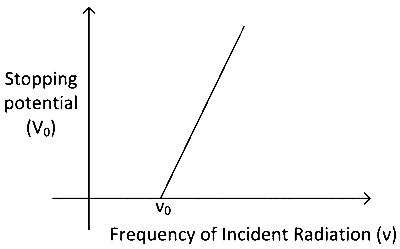
In an experiment to study photoelectric effect the observed variation of stopping potential with frequency of incident radiation is as shown in the figure. The slope and \(y\)-intercept are respectively
The energy gap of an LED is \(2.4 \mathrm{~eV}\). When the LED is switched ON, the momentum of the emitted photons is
A 60 W source emits monochromatic light of wavelength 662.5 nm. The number of photons emitted per second is
The photoelectric work function for photo metal is 2.4 eV . Among the four wavelengths, the wavelength of light for which photoemission does not take place is
Showing 20 of 25 questions