Difficulty distribution
How the classified questions are distributed by difficulty.
9questions
Not classified
9
100%
Your cart is empty.
Practice Simple Harmonic Motion - Mechanics - Physics previous year questions organised from real papers, with year-wise coverage and clear topic navigation.
Every graph below is calculated only from this selection.
Year-wise coverage for Simple Harmonic Motion. Each bar uses a separate theme-derived color.
How the classified questions are distributed by difficulty.
MCQ, numerical, multiple-select and other formats found in these papers.
Top subjects by unique question coverage.
Top topics across the included previous year papers.
Top subtopics inside this exact selection.
Question coverage for the most populated papers. Every active PYP paper remains listed below.
Newest papers appear first. Sort by year, question coverage or name.
| Paper | Year / session | Questions in this view | Open |
|---|---|---|---|
| KCET 2026 | 2026 | 1 | View paper |
| KCET 2025 | 2025 | 1 | View paper |
| KCET 2024 | 2024 | 1 | View paper |
| KCET 2023 | 2023 | 1 | View paper |
| KCET 2022 | 2022 | 1 | View paper |
| KCET 2021 | 2021 | 1 | View paper |
| KCET 2020 | 2020 | 1 | View paper |
| KCET 2019 | 2019 | 1 | View paper |
| KCET 2017 | 2017 | 1 | View paper |
Practice every matching question in batches of 20, with every available option.
A piston is performing S.H.M. in the vertical direction with a frequency of \(0.5 \mathrm{~Hz}\). A block of \(10 \mathrm{~kg}\) is placed on the piston. The maximum amplitude of the system such that the block remains in contact with the piston is
A tray of mass \(12 \mathrm{~kg}\) is supported by two identical springs as shown in figure. When the tray is pressed down slightly and then released, it executes SHM with a time period of \(1.5 \mathrm{~s}\). The spring constant of each spring is

A pendulum oscillates simple harmonically and only if
I. the sizer of the bob of pendulum is negligible in comparison with the length of the pendulum.
II. the angular amplitude is less than \(10^{\circ}\).
Choose the correct option.
The displacement of a particle executing SHM is given by \(x=3 \sin \left[2 \pi t+\frac{\pi}{4}\right]\), where \(x\) is in metre and \(t\) is in seconds. The amplitude and maximum speed of the particles is
A block of mass \(m\) is connected to a light spring of force constant \(k\). The system is placed inside a damping medium of damping constant \(b\). The instantaneous values of displacement, acceleration and energy of the block are \(x, a\) and \(E\) respectively. The initial amplitude of oscillation is \(A\) and \(\omega^{\prime}\) is the angular frequency of oscillations. The incorrect expression related to the damped oscillations is
For a particle executing simple harmonic motion (SHM), at its mean position
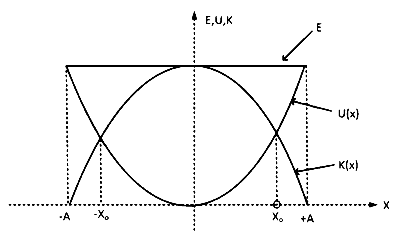
The variations of kinetic energy $K(x)$, potential energy $U(x)$ and total energy as a function of displacement of a particle in SHM is as shown in the figure. The value of $\left|x_0\right|$ is