Difficulty distribution
How the classified questions are distributed by difficulty.
11questions
Not classified
11
100%
Your cart is empty.
Practice Laws Of Motion - Mechanics - Physics previous year questions organised from real papers, with year-wise coverage and clear topic navigation.
Every graph below is calculated only from this selection.
Year-wise coverage for Laws Of Motion. Each bar uses a separate theme-derived color.
How the classified questions are distributed by difficulty.
MCQ, numerical, multiple-select and other formats found in these papers.
Top subjects by unique question coverage.
Top topics across the included previous year papers.
Top subtopics inside this exact selection.
Question coverage for the most populated papers. Every active PYP paper remains listed below.
Newest papers appear first. Sort by year, question coverage or name.
| Paper | Year / session | Questions in this view | Open |
|---|---|---|---|
| KCET 2026 | 2026 | 2 | View paper |
| KCET 2025 | 2025 | 2 | View paper |
| KCET 2024 | 2024 | 1 | View paper |
| KCET 2023 | 2023 | 1 | View paper |
| KCET 2022 | 2022 | 1 | View paper |
| KCET 2019 | 2019 | 1 | View paper |
| KCET 2018 | 2018 | 2 | View paper |
| KCET 2017 | 2017 | 1 | View paper |
Practice every matching question in batches of 20, with every available option.
An object with mass \(5 \mathrm{~kg}\) is acted upon by a force, \(\mathbf{F}=(-3 \hat{\mathbf{i}}-4 \hat{\mathbf{j}}) \mathrm{N}\). If its initial velocity at \(t=0\) is \(\mathbf{v}=(3 \hat{\mathbf{i}}+12 \hat{\mathbf{j}}) \mathrm{m} / \mathrm{s}\), the time at which it will just have a velocity along \(y\)-axis is -
Two masses of \(5 \mathrm{~kg}\) and \(3 \mathrm{~kg}\) are suspended with the help of massless inextensible strings as shown in figure below.

When whole system is going upwards with acceleration \(2 \mathrm{~m} / \mathrm{s}^2\), the value of \(T_1\) is (use, \(g=9.8 \mathrm{~m} / \mathrm{s}^2\))
A body of mass \(10 \mathrm{~kg}\) is kept on a horizontal surface. The coefficient of kinetic friction between the body and the surface is 0.5. A horizontal force of \(60 \mathrm{~N}\) is applied on the body. The resulting acceleration of the body is about
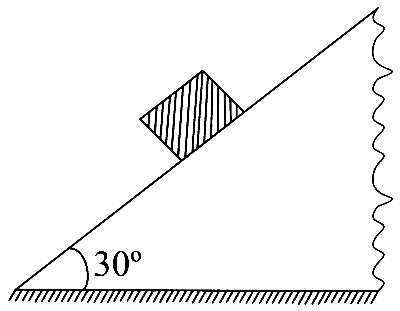
A block of certain mass is placed on a rough inclined plane. The angle between the plane and the horizontal is 30$^\circ$. The coefficients of static and kinetic frictions between the block and the inclined plane are 0.6 and 0.5 respectively. Then, the magnitude of the acceleration of the block is [Take g = 10 ms$^{-2}$]
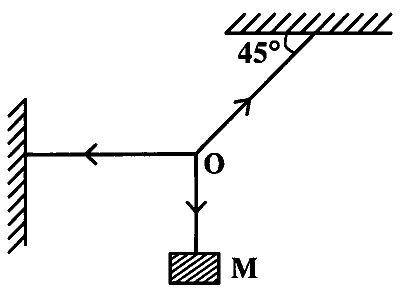
A wooden block of mass M lies on a rough floor. Another wooden block of the same mass is hanging from the point O through strings as shown in the figure. To achieve equilibrium, the co-efficient of static friction between the block on the floor with the floor itself is

A block of certain mass is placed on a rough floor. The coefficients of static and kinetic friction between the block and the floor are 0.4 and 0.25 respectively. A constant horizontal force $\mathrm{F}=20 \mathrm{~N}$ acts on it so that the velocity of the block varies with time according to the following graph. The mass of the block is nearly (Take $\mathrm{g} \simeq 10 \mathrm{~ms}^{-2}$ )