Difficulty distribution
How the classified questions are distributed by difficulty.
28questions
Not classified
28
100%
Your cart is empty.
Practice Heat And Thermodynamics - Mechanics - Physics previous year questions organised from real papers, with year-wise coverage and clear topic navigation.
Every graph below is calculated only from this selection.
Year-wise coverage for Heat And Thermodynamics. Each bar uses a separate theme-derived color.
How the classified questions are distributed by difficulty.
MCQ, numerical, multiple-select and other formats found in these papers.
Top subjects by unique question coverage.
Top topics across the included previous year papers.
Top subtopics inside this exact selection.
Question coverage for the most populated papers. Every active PYP paper remains listed below.
Newest papers appear first. Sort by year, question coverage or name.
| Paper | Year / session | Questions in this view | Open |
|---|---|---|---|
| KCET 2026 | 2026 | 3 | View paper |
| KCET 2025 | 2025 | 3 | View paper |
| KCET 2024 | 2024 | 3 | View paper |
| KCET 2023 | 2023 | 4 | View paper |
| KCET 2022 | 2022 | 1 | View paper |
| KCET 2021 | 2021 | 3 | View paper |
| KCET 2020 | 2020 | 3 | View paper |
| KCET 2019 | 2019 | 2 | View paper |
| KCET 2018 | 2018 | 3 | View paper |
| KCET 2017 | 2017 | 3 | View paper |
Practice every matching question in batches of 20, with every available option.
One mole of \(\mathrm{O}_2\) gas is heated at constant pressure starting at \(27^{\circ} \mathrm{C}\). How much energy must be added to the gas as to double its volume?
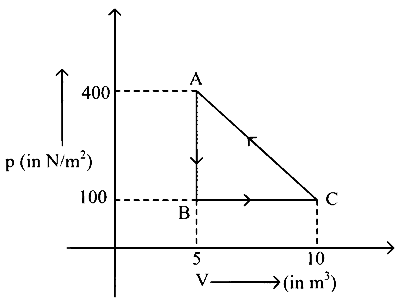
A thermodynamic system undergoes a cyclic process \(A B C\) as shown in the diagram. The work done by the system per cycle is
A sphere, a cube and a thin circular plate all of same material and same mass initially heated to same high temperature are allowed to cool down under similar conditions. Then, the
In an adiabatic expansion of an ideal gas the product of pressure and volume
A certain amount of heat energy is supplied to a monoatomic ideal gas which expands at constant pressure. What fraction of the heat energy is converted into work?
A number of Carnot engines are operated at identical cold reservoir temperatures \((T_L)\). However, their hot reservoir temperatures are kept different. A graph of the efficiency of the engines versus hot reservoir temperature \((T_H)\) is plotted. The correct graphical representation is


Which of the following curves represent the variation of coefficient of volume expansion of an ideal gas at constant pressure?


A gas mixture contains monoatomic and diatomic molecules of 2 moles each. The mixture has a total internal energy of (symbols have usual meanings)
"Heat cannot be flow itself from a body at lower temperature to a body at higher temperature". This statement corresponds to
Pressure of ideal gas at constant volume is proportional to .........
\(100 \mathrm{~g}\) of ice at \(0^{\circ} \mathrm{C}\) is mixed with \(100 \mathrm{~g}\) of water at \(100^{\circ} \mathrm{C}\). The final temperature of the mixture is
[Take, \(L_f=3.36 \times 10^5 \mathrm{~J} \mathrm{~kg}^{-1}\) and \(S_w=4.2 \times 10^3 \mathrm{~J} \mathrm{~kg}^{-1} \mathrm{~K}^{-1} \text { ] }\)
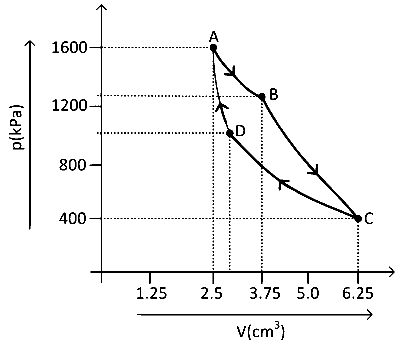
The \(p\)-\(V\) diagram of a Carnot's engine is shown in the graph below. The engine uses 1 mole of an ideal gas as working substance. From the graph, the area enclosed by the \(p\)-\(V\) diagram is [The heat supplied to the gas is 8000 J]
The speed of sound in an ideal gas at a given temperature \(T\) is \(v\). The rms speed of gas molecules at that temperature is \(v_{\text {rms }}\). The ratio of the velocities \(v\) and \(v_{\text {rms }}\) for helium and oxygen gases are \(X\) and \(X^{\prime}\) respectively. Then, \(\frac{X}{X^{\prime}}\) is equal to
A solid cube of mass $m$ at a temperature $\theta_0$ is heated at a constant rate. It becomes liquid at temperature $\theta_1$ and vapour at temperature $\theta_2$. Let $s_1$ and $s_2$ be specific heats in its solid and liquid states respectively. If $L_f$ and $L_v$ are latent heats of fusion and vaporisation respectively, then the minimum heat energy supplied to the cube until it vaporises is
Showing 20 of 28 questions