Difficulty distribution
How the classified questions are distributed by difficulty.
21questions
Not classified
21
100%
Your cart is empty.
Practice Electromagnetic Induction - Electromagnetism - Physics previous year questions organised from real papers, with year-wise coverage and clear topic navigation.
Every graph below is calculated only from this selection.
Year-wise coverage for Electromagnetic Induction. Each bar uses a separate theme-derived color.
How the classified questions are distributed by difficulty.
MCQ, numerical, multiple-select and other formats found in these papers.
Top subjects by unique question coverage.
Top topics across the included previous year papers.
Top subtopics inside this exact selection.
Question coverage for the most populated papers. Every active PYP paper remains listed below.
Newest papers appear first. Sort by year, question coverage or name.
| Paper | Year / session | Questions in this view | Open |
|---|---|---|---|
| KCET 2026 | 2026 | 2 | View paper |
| KCET 2025 | 2025 | 1 | View paper |
| KCET 2024 | 2024 | 3 | View paper |
| KCET 2023 | 2023 | 3 | View paper |
| KCET 2022 | 2022 | 2 | View paper |
| KCET 2021 | 2021 | 2 | View paper |
| KCET 2020 | 2020 | 2 | View paper |
| KCET 2019 | 2019 | 1 | View paper |
| KCET 2018 | 2018 | 2 | View paper |
| KCET 2017 | 2017 | 3 | View paper |
Practice every matching question in batches of 20, with every available option.
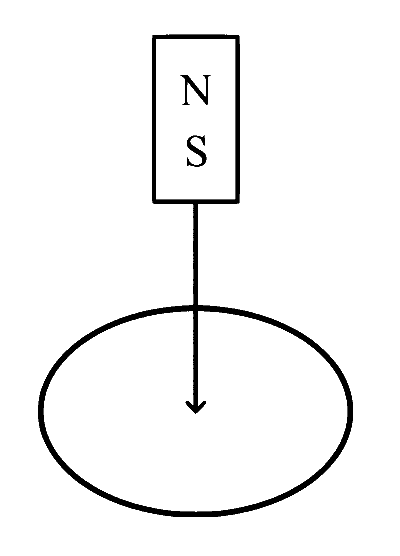
A bar magnet is allowed to fall vertically through a copper coil placed in a horizontal plane. The magnet falls with a net acceleration, is
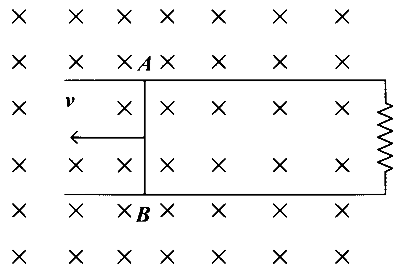
Consider the situation given in figure. The wire \(A B\) is slid on the fixed rails with a constant velocity. If the wire \(A B\) is replaced by a semicircular wire, the magnitude of the induced current will
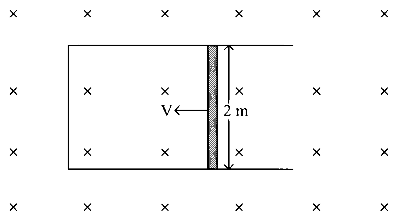
A rod of length \(2 \mathrm{~m}\) slides with a speed of \(5 \mathrm{~ms}^{-1}\) on a rectangular conducting frame as shown in figure. There exists a uniform magnetic filed of \(0.04 \mathrm{~T}\) perpendicular to the plane of the figure. If the resistance of the rod is \(3 \Omega\). The current through the rod is
The current in a coil of inductance \(0.2 \mathrm{H}\) changes from \(5 \mathrm{~A}\) to \(2 \mathrm{~A}\) in \(0.5 \mathrm{~s}\). The magnitude of the average induced emf in the coil is
The physical quantity which is measure in the unit of wb \(\mathrm{A}^{-1}\) is
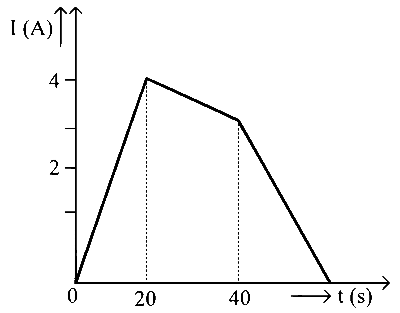
The current following through an inductance coil of self-inductance \(6 \mathrm{~mH}\) at different time instants is as shown. The emf induced between \(t=20 \mathrm{~s}\) and \(t=40 \mathrm{~s}\) is nearly
A long solenoid has 500 turns, when a current of \(2 \mathrm{~A}\) is passed through it, the resulting magnetic flux linked with each turn of the solenoid is \(4 \times 10^{-3} \mathrm{~Wb}\), then self induction of the solenoid is
A magnetic field of flux densiity \(1.0 \mathrm{~Wb} \mathrm{~m}^{-2}\) acts normal to a 80 turn coil of \(0.01 \mathrm{~m}^2\) area. If this coil is removed from the field in \(0.2 \mathrm{~s}\), then the emf induced in it is
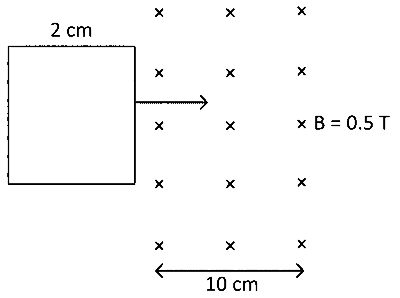
A square loop of side \(2 \mathrm{~cm}\) enters a magnetic field with a constant speed of \(2 \mathrm{~cm} \mathrm{~s}^{-1}\) as shown. The front edge enters the field at \(t=0 \mathrm{~s}\). Which of the following graph correctly depicts the induced emf in the loop?
(Take clockwise direction positive)


A metallic rod of length \(1 \mathrm{~m}\) held along east-west direction is allowed to fall down freely. Given horizontal component of earth's magnetic field \(B_H=3 \times 10^{-5} \mathrm{~T}\). the emf induced in the rod at an instant \(t=2 \mathrm{~s}\) after it is released is
(Take, \(g=10 \mathrm{~ms}^{-2}\) )
The current in a coil changes from \(2 \mathrm{~A}\) to \(5 \mathrm{~A}\) in \(0.3 \mathrm{~s}\). The magnitude of emf induced in the coil is \(1.0 \mathrm{~V}\). The value of self-inductance of the coil is
An induced current of 2 A flows through a coil. The resistance of the coil is $10 \Omega$. What is the change in magnetic flux associated with the coil in 1 ms ?
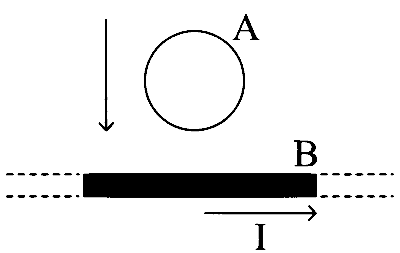
In the figure, a conducting ring of certain resistance is falling towards a current carrying straight long conductor. The ring and conductor are in the same plane. Then, the
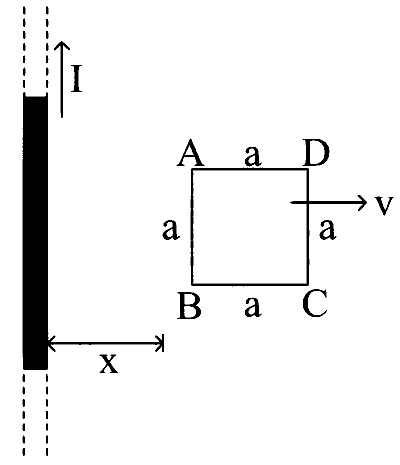
A square loop of side length $a$ is moving away from an infinitely long current carrying conductor at a constant speed $v$ as shown. Let $x$ be the instantaneous distance between the long conductor and side $A B$. The mutual inductance $M$ of the square loop-long conductor pair changes with time $t$ according to which of the following graphs?


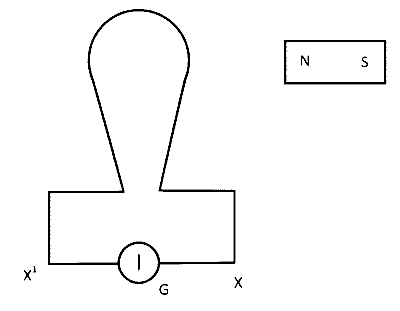
When a bar magnet is pushed towards the coil, along its axis, as shown in the figure, the galvanometer pointer deflects towards X . When this magnet is pulled away from the coil, the galvanometer pointer
Showing 20 of 21 questions