My Cart
Your Cart 0

    Your cart is empty.

  • Total (Amount) ₹0.00
Previous year question hub

Linear Programming - Algebra - Mathematics Previous Year Questions

Practice Linear Programming - Algebra - Mathematics previous year questions organised from real papers, with year-wise coverage and clear topic navigation.

9Papers
9Years
14Questions
1Topics

Linear Programming question pattern

Every graph below is calculated only from this selection.

Questions by year

Year-wise coverage for Linear Programming. Each bar uses a separate theme-derived color.

Difficulty distribution

How the classified questions are distributed by difficulty.

Not classified 14 100%

Question type distribution

MCQ, numerical, multiple-select and other formats found in these papers.

Multiple Choices 14 100%

Subject weightage

Top subjects by unique question coverage.

Mathematics
14 Qs

Most asked topics

Top topics across the included previous year papers.

Algebra
14 Qs

Subtopic coverage

Top subtopics inside this exact selection.

Linear Programming
14 Qs

Paper coverage

Question coverage for the most populated papers. Every active PYP paper remains listed below.

KCET 2025
2 Qs
KCET 2024
1 Qs
KCET 2023
1 Qs
KCET 2022
2 Qs
KCET 2021
1 Qs
KCET 2020
2 Qs
KCET 2019
1 Qs
KCET 2018
2 Qs
KCET 2017
2 Qs

Included previous year papers

Newest papers appear first. Sort by year, question coverage or name.

PaperYear / sessionQuestions in this viewOpen
KCET 202520252View paper
KCET 202420241View paper
KCET 202320231View paper
KCET 202220222View paper
KCET 202120211View paper
KCET 202020202View paper
KCET 201920191View paper
KCET 201820182View paper
KCET 201720172View paper

All Linear Programming previous year questions

Practice every matching question in batches of 20, with every available option.

1
2017 · Mathematics · Algebra · Linear Programming
KCET 2017
The shaded region in the figure is the solution set of the inequations KCET 2017 Mathematics - Linear Programming Question 6 English
A
$5 x+4 y \leq 20, x \leq 6, y \leq 3, x \geq 0, y \geq 0$
B
$5 x+4 y \geq 20, x \geq 6, y \leq 3, x \geq 0, y \geq 0$
C
$5 x+4 y \geq 20, x \leq 6, y \leq 3, x \geq 0, y \geq 0$
D
$5 x+4 y \geq 20, x \leq 6, y \geq 3, x \geq 0, y \geq 0$
Open complete paper
2
2017 · Mathematics · Algebra · Linear Programming
KCET 2017
If an LPP admits optimal solution at two consecutive vertices of a feasible region, then
A
the LPP under consideration is not solvable
B
the LPP under consideration must be reconstructed
C
the required optimal solution is at the mid-point of the line joining two points
D
the optimal solution occurs at every point on the line joining these two points
Open complete paper
3
2018 · Mathematics · Algebra · Linear Programming
KCET 2018
The feasible region of an LPP is shown in the figure. If $z=3 x+9 y$, then the minimum value of $z$ occurs at KCET 2018 Mathematics - Linear Programming Question 8 English
A
$(5,5)$
B
$(0,10)$
C
$(0,20)$
D
$(15,15)$
Open complete paper
4
2018 · Mathematics · Algebra · Linear Programming
KCET 2018
For the LPP, maximize $z=x+4 y$ subject to the constraints $x+2 y \leq 2, x+2 y \geq 8, x, y \geq 0$
A
$z_{\max }=4$
B
$z_{\text {max }}=8$
C
$z_{\max }=16$
D
has no feasible solution
Open complete paper
5
2019 · Mathematics · Algebra · Linear Programming
KCET 2019

The shaded region in the figure is the solution set of the inequations.

KCET 2019 Mathematics - Linear Programming Question 10 English

A
\(4 x+5 y \leq 20,3 x+10 y \leq 30, x \leq 6, x, y \geq 0\)
B
\(4 x+5 y \geq 20,3 x+10 y \leq 30, x \leq 6, x, y \geq 0\)
C
\(4 x+5 y \leq 20,3 x+10 y \leq 30, x \geq 6, x, y \geq 0\)
D
\(4 x+5 y \geq 20,3 x+10 y \leq 30, x \geq 6, x, y \geq 0\)
Open complete paper
6
2020 · Mathematics · Algebra · Linear Programming
KCET 2020

The feasible region of an LPP is shown in the figure. If \(z=11 x+7 y\), then the maximum value of \(Z\) occurs at
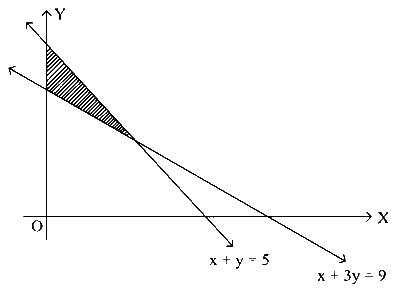
KCET 2020 Mathematics - Linear Programming Question 11 English

A
(0, 5)
B
(3, 3)
C
(5, 0)
D
(3, 2)
Open complete paper
7
2020 · Mathematics · Algebra · Linear Programming
KCET 2020

Corner points of the feasible region determined by the system of linear constraints are \((0,3),(1,1)\) and \((3,0)\). Let \(z=p x=q y\), where, \(p, q>0\). Condition on \(p\) and \(q\), so that the minimum of \(z\) occurs at \((3,0)\) and \((1,1)\) is

A
\(p=2 q\)
B
\(p=\frac{q}{2}\)
C
\(p=3 q\)
D
\(p=q\)
Open complete paper
8
2021 · Mathematics · Algebra · Linear Programming
KCET 2021

The shaded region is the solution set of the inequalities
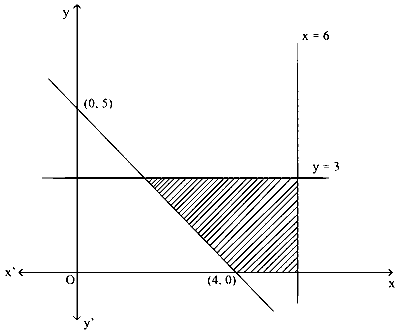
KCET 2021 Mathematics - Linear Programming Question 13 English

A
\(5 x+4 y \geq 20, x \leq 6, y \geq 3, x \geq 0, y \geq 0\)
B
\(5 x+4 y \leq 20, x \leq 6, y \leq 3, x \geq 0, y \geq 0\)
C
\(5 x+4 y \geq 20, x \leq 6, y \leq 3, x \geq 0, y \geq 0\)
D
\(5 x+4 y \geq 20, x \geq 6, y \leq 3, x \geq 0, y \geq 0\)
Open complete paper
9
2022 · Mathematics · Algebra · Linear Programming
KCET 2022

A dietician has to develop a special diet using two foods \(X\) and \(Y\). Each packet (containing \(30 \mathrm{~g}\) ) of food. \(X\) contains 12 units of calcium, 4 units of iron, 6 units of cholesterol and 6 units of vitamin A. Each packet of the same quantity of food Y contains 3 units of calcium, 20 units of iron, 4 units of cholesterol and 3 units of vitamin A. The diet requires at least 240 units of calcium, atleast 460 units of iron and atmost 300 units of cholesterol. The corner points of the feasible region are

A
\((2,72),(40,15),(15,20)\)
B
\((2,72),(15,20),(0,23)\)
C
\((0,23),(40,15),(2,72)\)
D
\((2,72),(40,15),(115,0)\)
Open complete paper
10
2022 · Mathematics · Algebra · Linear Programming
KCET 2022

The corner points of the feasible region of an LPP are \((0,2),(3,0),(6,0),(6,8)\) and \((0,5)\), then the minimum value of \(z=4 x+6 y\) occurs at

A
Finite number of points
B
Infinite number of points
C
Only one point
D
Only two points
Open complete paper
11
2023 · Mathematics · Algebra · Linear Programming
KCET 2023

The shaded region in the figure given is the solution of which of the inequations?
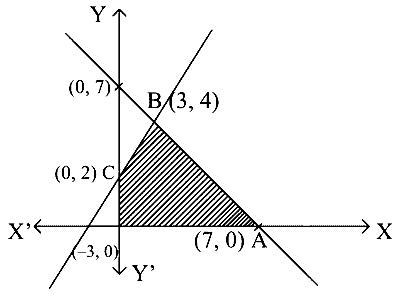
KCET 2023 Mathematics - Linear Programming Question 16 English

A
\(x+y \geq 7,2 x-3 y+6 \leq 0, x \geq 0, y \geq 0\)
B
\(x+y \geq 7,2 x-3 y+6 \geq 0, x \geq 0, y \geq 0\)
C
\(x+y \leq 7,2 x-3 y+6 \leq 0, x \geq 0, y \geq 0\)
D
\(x+y \leq 7,2 x-3 y+6 \geq 0, x \geq 0, y \geq 0\)
Open complete paper
12
2024 · Mathematics · Algebra · Linear Programming
KCET 2024

Corner points of the feasible region for an LPP are $(0,2),(3,0),(6,0),(6,8)$ and $(0,5)$. Let $Z=4 x+6 y$ be the objective function. The minimum value of $z$ occurs at

A
Only $(0,2)$
B
Only $(3,0)$
C
The mid-point of the line segment joining the points $(0,2)$ and $(3,0)$
D
Any point on the line segment joining the points $(0,2)$ and $(3,0)$
Open complete paper
13
2025 · Mathematics · Algebra · Linear Programming
KCET 2025

The maximum value of $\mathrm{z}=3 \mathrm{x}+4 \mathrm{y}$, subject to the constraints $\mathrm{x}+\mathrm{y} \leq 40, \mathrm{x}+2 \mathrm{y} \leq 60$ and $\mathrm{x}, \mathrm{y} \geq 0$ is

A
130
B
120
C
140
D
40
Open complete paper
14
2025 · Mathematics · Algebra · Linear Programming
KCET 2025

Consider the following statements:

Statement (I): In a LPP, the objective function is always linear.

Statement (II): Ina LPP, the linear inequalities on variables are called constraints. Which of the following is correct?

A
Statement (I) is true, Statement (II) is true
B
Statement (I) is true, Statement (II) is false
C
Both Statements (I) and (II) are false
D
Statement (I) is false, Statement (II) is true
Open complete paper