My Cart
Your Cart 0

    Your cart is empty.

  • Total (Amount) ₹0.00
Previous year question hub

Thermodynamics - Physical Chemistry - Chemistry Previous Year Questions

Practice Thermodynamics - Physical Chemistry - Chemistry previous year questions organised from real papers, with year-wise coverage and clear topic navigation.

7Papers
7Years
11Questions
1Topics

Thermodynamics question pattern

Every graph below is calculated only from this selection.

Questions by year

Year-wise coverage for Thermodynamics. Each bar uses a separate theme-derived color.

Difficulty distribution

How the classified questions are distributed by difficulty.

Not classified 11 100%

Question type distribution

MCQ, numerical, multiple-select and other formats found in these papers.

Multiple Choices 11 100%

Subject weightage

Top subjects by unique question coverage.

Chemistry
11 Qs

Most asked topics

Top topics across the included previous year papers.

Physical Chemistry
11 Qs

Subtopic coverage

Top subtopics inside this exact selection.

Thermodynamics
11 Qs

Paper coverage

Question coverage for the most populated papers. Every active PYP paper remains listed below.

KCET 2025
3 Qs
KCET 2024
1 Qs
KCET 2023
3 Qs
KCET 2022
1 Qs
KCET 2020
1 Qs
KCET 2019
1 Qs
KCET 2017
1 Qs

Included previous year papers

Newest papers appear first. Sort by year, question coverage or name.

PaperYear / sessionQuestions in this viewOpen
KCET 202520253View paper
KCET 202420241View paper
KCET 202320233View paper
KCET 202220221View paper
KCET 202020201View paper
KCET 201920191View paper
KCET 201720171View paper

All Thermodynamics previous year questions

Practice every matching question in batches of 20, with every available option.

1
2017 · Chemistry · Physical Chemistry · Thermodynamics
KCET 2017
A reaction has both $\Delta H$ and $\Delta S$ -ve. The rate of reaction
A
increases with increases in temperature
B
cannot be predicted for change in temperature
C
increases with decreases in temperature
D
remains unaffected by change in temperature
Open complete paper
2
2019 · Chemistry · Physical Chemistry · Thermodynamics
KCET 2019

The reaction in which \(\Delta H=\Delta U\) is

A
\(\mathrm{N}_2(g)+\mathrm{O}_2(g) \rightarrow 2 \mathrm{NO}(g)\)
B
\(\mathrm{CaCO}_3(\mathrm{s}) \rightarrow \mathrm{CaO}(\mathrm{s})+\mathrm{CO}_2(\mathrm{g})\)
C
\(\mathrm{N}_2(g)+3 \mathrm{H}_2(g) \rightarrow 2 \mathrm{NH}_3(g)\)
D
\(\mathrm{CH}_4(g)+2 \mathrm{O}_2(g) \rightarrow \mathrm{CO}_2(g)+2 \mathrm{H}_2 \mathrm{O}(l)\)
Open complete paper
3
2020 · Chemistry · Physical Chemistry · Thermodynamics
KCET 2020

When the same quantity of heat is absorbed by a system at two different temperatures \(T_1\) and \(T_2\), such that \(T_1>T_2\), change in entropies are \(\Delta S_1\) and \(\Delta S_2\) respectively. Then

A
\(\Delta S_1<\Delta S_2\)
B
\(\Delta S_1=\Delta S_2\)
C
\(S_1>S_2\)
D
\(\Delta S_2<\Delta S_1\)
Open complete paper
4
2022 · Chemistry · Physical Chemistry · Thermodynamics
KCET 2022

The work done when 2 moles of an ideal gas expands rèversibly and isothermally from a volume of \(1 \mathrm{~L}\) to \(10 \mathrm{~L}\) at \(300 \mathrm{~K}\) is (\(R=0.0083 \mathrm{~kJ} \mathrm{~K} \mathrm{~mol}^{-1}\))

A
5.8 kJ
B
0.115 kJ
C
58.5 kJ
D
11.5 kJ
Open complete paper
5
2023 · Chemistry · Physical Chemistry · Thermodynamics
KCET 2023

A gas at a pressure of \(2 \mathrm{~atm}\) is heated from \(25^{\circ} \mathrm{C}\) to \(323^{\circ} \mathrm{C}\) and simultaneously compressed of \(\frac{2}{3}\)rd of its original value. Then the final pressure is

A
1.33 atm
B
6 atm
C
2 atm
D
4 atm
Open complete paper
6
2023 · Chemistry · Physical Chemistry · Thermodynamics
KCET 2023

Lattice enthalpy for \(\mathrm{NaCl}\) is \(+788 \mathrm{~kJ} \mathrm{~mol}^{-1}\) and \(\Delta H_{\text {hyd }}^{\circ}=-784 \mathrm{~kJ} \mathrm{~mol}^{-1}\). Enthalpy of solution of \(\mathrm{NaCl}\) is

A
\(+572 \mathrm{~kJ} \mathrm{~mol}^{-1}\)
B
\(+4 \mathrm{~kJ} \mathrm{~mol}^{-1}\)
C
\(-572 \mathrm{~kJ} \mathrm{~mol}^{-1}\)
D
\(-4 \mathrm{~kJ} \mathrm{~mol}^{-1}\)
Open complete paper
7
2023 · Chemistry · Physical Chemistry · Thermodynamics
KCET 2023

Temperature of \(25^{\circ} \mathrm{C}\) in Fahrenheit and Kelvin scale respectively are

A
\(77^{\circ} \mathrm{F}\) and \(298.15 \mathrm{~K}\)
B
\(17^{\circ} \mathrm{F}\) and \(298.15 \mathrm{~K}\)
C
\(45^{\circ} \mathrm{F}\) and \(260.15 \mathrm{~K}\)
D
\(47^{\circ} \mathrm{F}\) and \(312.15 \mathrm{~K}\)
Open complete paper
8
2024 · Chemistry · Physical Chemistry · Thermodynamics
KCET 2024

From the diagram $(Z)=\frac{V_{\text {real }}}{V_{\text {ideal }}}$
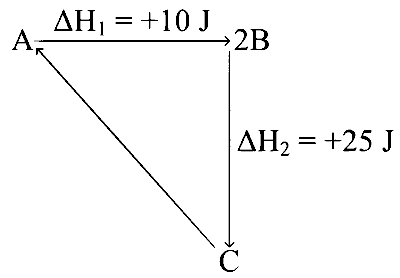
KCET 2024 Chemistry - Thermodynamics Question 8 English

$\Delta_r H$ for the reaction, $C \rightarrow A$ is

A
$+35$ J
B
$-15$ J
C
$-35$ J
D
$+15$ J
Open complete paper
9
2025 · Chemistry · Physical Chemistry · Thermodynamics
KCET 2025

Given below are two statements.

Statement-I : Adiabatic work done is positive when work is done on the system and internal energy of the system increases.

Statement - II : No work is done during free expansion of an ideal gas.

In the light of the above statements, choose the correct answer from the options given below.

A
Both statements - I and Statement - II are false
B
Statement - I is true but statement - II is false
C
Statement - I is false but statement - II is true
D
Both statements - I and Statement - II are true.
Open complete paper
10
2025 · Chemistry · Physical Chemistry · Thermodynamics
KCET 2025

Which one of the following reactions has $\Delta \mathrm{H}=\Delta \mathrm{U}$ ?

A
$\mathrm{CaCO}_3(\mathrm{~s}) \xrightarrow{\Delta} \mathrm{CaO}(\mathrm{s})+\mathrm{CO}_2(\mathrm{~g})$
B
$\mathrm{C}_6 \mathrm{H}_6(\mathrm{I})+\frac{15}{2} \mathrm{O}_2(\mathrm{~g}) \longrightarrow 6 \mathrm{CO}_2(\mathrm{~g})+3 \mathrm{H}_2 \mathrm{O}(\mathrm{I})$
C
$2 \mathrm{HI}(\mathrm{g}) \rightleftharpoons \mathrm{H}_2(\mathrm{~g})+\mathrm{I}_2(\mathrm{~g})$
D
$\mathrm{N}_2(\mathrm{~g})+3 \mathrm{H}_2(\mathrm{~g}) \rightleftharpoons 2 \mathrm{NH}_3(\mathrm{~g})$
Open complete paper
11
2025 · Chemistry · Physical Chemistry · Thermodynamics
KCET 2025

Identify the incorrect statements among the following:

(a) All enthalpies of fusion are positive

(b) The magnitude of enthalpy change does not depend on the strength of the intermolecular interactions in the substance undergoing phase transformations.

(c) When a chemical reaction is reversed, the value of $\Delta \mathrm{rH}^{\circ}$ is reversed in sign.

(d) The change in enthalpy is dependent of path between initial state (reactants) and final state (products)

(e) For most of the ionic compounds, $\Delta_{\text {sol }} \mathrm{H}^{\circ}$ is negative

A
a, b and d
B
b, d and e
C
a, d and e
D
a and e only
Open complete paper