Difficulty distribution
How the classified questions are distributed by difficulty.
Your cart is empty.
Practice Capacitor - Electricity - Physics previous year questions organised from real papers, with year-wise coverage and clear topic navigation.
Every graph below is calculated only from this selection.
Year-wise coverage for Capacitor. Each bar uses a separate theme-derived color.
How the classified questions are distributed by difficulty.
MCQ, numerical, multiple-select and other formats found in these papers.
Top subjects by unique question coverage.
Top topics across the included previous year papers.
Top subtopics inside this exact selection.
Question coverage for the most populated papers. Every active PYP paper remains listed below.
Newest papers appear first. Sort by year, question coverage or name.
| Paper | Year / session | Questions in this view | Open |
|---|---|---|---|
| JEE Advanced 2026 Paper 2 Online | 2026 | 1 | View paper |
| JEE ADVANCED 2024 PAPER 1 ONLINE | 2024 | 1 | View paper |
| JEE ADVANCED 2023 PAPER 1 ONLINE | 2023 | 2 | View paper |
| JEE ADVANCED 2022 PAPER 1 ONLINE | 2022 | 1 | View paper |
| JEE ADVANCED 2021 PAPER 1 ONLINE | 2021 | 2 | View paper |
| JEE ADVANCED 2020 PAPER 2 OFFLINE | 2020 | 1 | View paper |
| JEE ADVANCED 2019 PAPER 1 OFFLINE | 2019 | 1 | View paper |
| JEE ADVANCED 2018 PAPER 1 OFFLINE | 2018 | 1 | View paper |
| JEE ADVANCED 2017 PAPER 2 OFFLINE | 2017 | 2 | View paper |
| JEE ADVANCED 2015 PAPER 2 OFFLINE | 2015 | 1 | View paper |
| JEE ADVANCED 2014 PAPER 1 OFFLINE | 2014 | 1 | View paper |
| JEE ADVANCED 2013 PAPER 1 OFFLINE | 2013 | 1 | View paper |
| IIT JEE 2012 PAPER 2 OFFLINE | 2012 | 1 | View paper |
| IIT JEE 2011 PAPER 1 OFFLINE | 2011 | 1 | View paper |
| IIT JEE 2010 PAPER 2 OFFLINE | 2010 | 1 | View paper |
| IIT JEE 2007 PAPER 1 OFFLINE | 2007 | 2 | View paper |
| IIT JEE 2006 | 2006 | 1 | View paper |
| IIT JEE 2005 MAINS | 2005 | 1 | View paper |
Practice every matching question in batches of 20, with every available option.
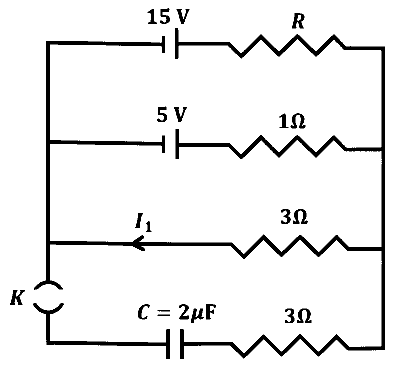
In the given circuit, the switch S is closed at time \(t=0\). The charge Q on the capacitor at any instant t is given by \(Q(t)=Q_0(1-e^{-\alpha t})\). Find the value of Q\(_0\) and \(\alpha\) in terms of given parameters shown in the circuit.

In the following circuits, it is given that $\mathrm{R}_1=1 \Omega, \mathrm{R}_2=2 \Omega, \mathrm{C}_1=2 \mu \mathrm{~F}$ and $\mathrm{C}_2=4 \mu \mathrm{~F}$.
The time constants (in $\mu \mathrm{s}$ ) for the circuits I, II, III are, rcspectively.A circuit is connected as shown in the figure with the switch S open. When the switch is closed, the total amount of charge that flows from Y to X is

Column I gives certain situations in which a straight metallic wire of resistance R is used and Column II gives some resulting effects. Match the statements in Column I with the statements in Column II and indicate your answer by darkening appropriate bubbles in the 4 \(\times\) 4 matrix given in the ORS.
| Column I | Column II | ||
|---|---|---|---|
| (A) | A charged capacitor is connected to the ends of the wire | (P) | A constant current flows through the wire |
| (B) | The wire is moved perpendicular to its length with a constant velocity in a uniform magnetic field perpendicular to the plane of motion | (Q) | Thermal energy is generated in the wire |
| (C) | The wire is placed in a constant electric field that has a direction along the length of the wire. | (R) | A constant potential difference develops between the ends of the wire |
| (D) | A battery of constant emf is connected to the ends of the wire | (S) | Charges of constant magnitude appear at the ends of the wire |
At time t = 0, a battery of 10 V is connected across points A and B in the given circuit. If the capacitors have no charge initially, at what time (in seconds) does the voltage across them becomes 4 V? (Take ln5 = 1.6, ln3 = 1.1)


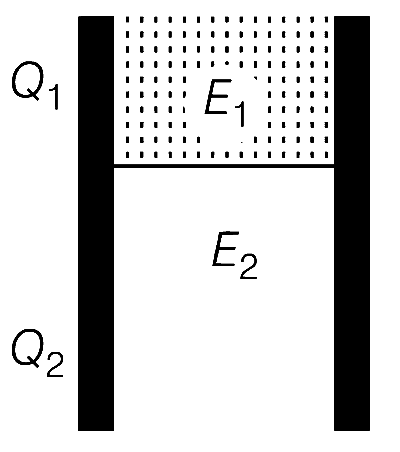
A medium having dielectric constant $K>1$ fills the space between the plates of a parallel plate capacitor. The plates have large area, and the distance between them is $d$. The capacitor is connected to a battery of voltage $V$, as shown in Figure (a). Now, both the plates are moved by a distance of $\frac{d}{2}$ from their original positions, as shown in Figure (b).

In the process of going from the configuration depicted in Figure (a) to that in Figure (b), which of the following statement(s) is(are) correct?


Showing 20 of 22 questions