My Cart
Your Cart 0

    Your cart is empty.

  • Total (Amount) ₹0.00
Previous year question hub

Markov Chains and Stationary Distributions - Stochastic Processes - Statistics Previous Year Questions

Practice Markov Chains and Stationary Distributions - Stochastic Processes - Statistics previous year questions organised from real papers, with year-wise coverage and clear topic navigation.

8Papers
8Years
19Questions
1Topics

Markov Chains and Stationary Distributions question pattern

Every graph below is calculated only from this selection.

Questions by year

Compare question counts across years.

Difficulty distribution

How the classified questions are distributed by difficulty.

Medium 14 73.7%
Easy 5 26.3%

Question type distribution

MCQ, numerical, multiple-select and other formats found in these papers.

Numerical Answer Type (NAT) 11 57.9%
MCQ 6 31.6%
MSQ 2 10.5%

Subject weightage

Top subjects by unique question coverage.

Statistics
19 Qs

Most asked topics

Top topics across the included previous year papers.

Stochastic Processes
19 Qs

Subtopic coverage

Top subtopics inside this exact selection.

Markov Chains and Stationary Distributions
19 Qs

Paper coverage

Question coverage for the most populated papers. Every active PYP paper remains listed below.

Statistics (ST) 2026
1 Qs
Statistics (ST) 2025
1 Qs
Statistics (ST) 2024
2 Qs
Statistics (ST) 2023
2 Qs
Statistics (ST) 2022
4 Qs
Statistics (ST) 2021
2 Qs
Statistics (ST) 2020
3 Qs
Statistics (ST) 2019
4 Qs

Included previous year papers

Newest papers appear first. Search these papers or sort by year and name.

Paper nameYearPDFAttempt
Statistics (ST) 20262026
1 questions in this view
2026
Statistics (ST) 20252025
1 questions in this view
2025
Statistics (ST) 20242024
2 questions in this view
2024
Statistics (ST) 20232023
2 questions in this view
2023
Statistics (ST) 20222022
4 questions in this view
2022
Statistics (ST) 20212021
2 questions in this view
2021
Statistics (ST) 20202020
3 questions in this view
2020
Statistics (ST) 20192019
4 questions in this view
2019

All Markov Chains and Stationary Distributions previous year questions

Practice every matching question in batches of 20, with every available option.

1
2019 · Statistics · Stochastic Processes · Markov Chains and Stationary Distributions
Statistics (ST) 2019
Consider a discrete time Markov chain on the state space {1,2,3} with one-step transition probability matrix \(\begin{pmatrix} 1 & 2 & 3 \\ 1 & 0.7 & 0.3 & 0 \\ 2 & 0 & 0.6 & 0.4 \\ 3 & 0 & 0 & 1 \end{pmatrix}\). Which of the following statements is true?
Open complete paper
2
2019 · Statistics · Stochastic Processes · Markov Chains and Stationary Distributions
Statistics (ST) 2019
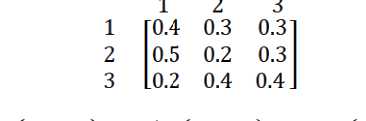
Let \( \{X_n\}_{n \geq 0} \) be a discrete time Markov chain on the state space \( \{1,2,3\} \) with one-step transition probability matrix
123
10.40.30.3
20.50.20.3
30.20.40.4
and initial distribution \( P(X_0 = 1) = 0.5, P(X_0 = 2) = 0.2, P(X_0 = 3) = 0.3 \). Then \( P(X_1 = 2, X_2 = 3, X_3 = 1) \) (rounded off to three decimal places) is equal to ...

Question diagram

Open complete paper
3
2019 · Statistics · Stochastic Processes · Markov Chains and Stationary Distributions
Statistics (ST) 2019
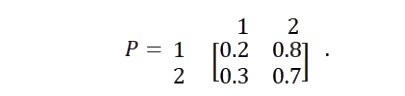
Consider a discrete time Markov chain on the state space {1,2} with one-step transition probability matrix \[ P = \begin{pmatrix} 0.2 & 0.8 \\ 0.3 & 0.7 \end{pmatrix} \] Then \(\lim_{n\to\infty} P^n\) is

Question diagram

Open complete paper
4
2019 · Statistics · Stochastic Processes · Markov Chains and Stationary Distributions
Statistics (ST) 2019
Consider a discrete time Markov chain on the state space \( \{1,2,3\} \) with one-step transition probability matrix
123
100.20.8
20.500.5
30.60.40
. Then the period of the Markov chain is ...
Open complete paper
5
2020 · Statistics · Stochastic Processes · Markov Chains and Stationary Distributions
Statistics (ST) 2020
Let \( \{X_n\}_{n \geq 0} \) be a homogeneous Markov chain with state space {0,1} and one-step transition probability matrix
\[ P = \begin{bmatrix} \frac{1}{2} & \frac{1}{2} \\ \frac{2}{3} & \frac{1}{3} \end{bmatrix} \]. If \( P(X_0 = 0) = \frac{1}{3} \), then
\( 27 \times E(X_2) = \) ___________ (correct up to two decimal places).
Open complete paper
6
2020 · Statistics · Stochastic Processes · Markov Chains and Stationary Distributions
Statistics (ST) 2020
Let $\{X_n\}_{n \geq 0}$ be a homogeneous Markov chain whose state space is $\{0,1,2\}$ and whose one-step transition probability matrix is $P = \begin{bmatrix} 0 & 1 & 0 \\ 0.3 & 0 & 0.7 \\ 0 & 1 & 0 \end{bmatrix}$. Then $\lim_{n \to \infty} P(X_{2n} = 2 \mid X_0 = 2) =$ ______________ (correct up to one decimal place).
Open complete paper
7
2020 · Statistics · Stochastic Processes · Markov Chains and Stationary Distributions
Statistics (ST) 2020
Consider a homogeneous Markov chain $\{X_n\}_{n \geq 0}$ with state space $\{0,1,2,3\}$ and one-step transition probability matrix $P = \begin{bmatrix} \frac{1}{2} & \frac{1}{2} & 0 & 0 \\ \frac{1}{2} & \frac{1}{4} & \frac{1}{4} & 0 \\ 0 & 0 & \frac{1}{4} & \frac{3}{4} \\ 0 & 0 & 0 & 1 \end{bmatrix}$. Assume that $P(X_0 = 1) = 1$. Let $p$ be the probability that state 0 will be visited before state 3. Then $6 \times p =$ ______________
Open complete paper
8
2021 · Statistics · Stochastic Processes · Markov Chains and Stationary Distributions
Statistics (ST) 2021
Let \(\{X_n\}_{n \ge 0}\) be a time-homogeneous discrete time Markov chain with state space \(\{0,1\}\) and transition probability matrix \[\begin{bmatrix} 0.25 & 0.75 \\ 0.75 & 0.25 \end{bmatrix}.\] If \(P(X_0 = 0) = P(X_0 = 1) = 0.5\), then \[\sum_{k=1}^{100} E[(X_{2k})^{2k}]\] equals __________
Open complete paper
9
2021 · Statistics · Stochastic Processes · Markov Chains and Stationary Distributions
Statistics (ST) 2021
Let {X_n}_{n≥0} be a time-homogeneous discrete time Markov chain with either finite or countable state space S. Then which one of the following statements is true?
Open complete paper
10
2022 · Statistics · Stochastic Processes · Markov Chains and Stationary Distributions
Statistics (ST) 2022
Let \( \{X(t)\\}_{t \geq 0} \) be a linear pure death process with death rate \( \mu_i = 5i, \; i = 0, 1, ..., N, \; N \geq 1 \). Suppose that \( p_i(t) = P(X(t) = i) \). Then the system of forward Kolmogorov’s equations is
Open complete paper
11
2022 · Statistics · Stochastic Processes · Markov Chains and Stationary Distributions
Statistics (ST) 2022
Consider the following transition matrices \(P_1\) and \(P_2\) of two Markov chains:
\(P_1 = \begin{bmatrix} 1 & 0 & 0 \\ 1/3 & 1/2 & 1/6 \\ 0 & 0 & 1 \end{bmatrix}\) and \(P_2 = \begin{bmatrix} 1/6 & 1/3 & 1/2 \\ 1/4 & 0 & 3/4 \\ 0 & 1 & 0 \end{bmatrix}\).
Then which one of the following statements is true?
Open complete paper
12
2022 · Statistics · Stochastic Processes · Markov Chains and Stationary Distributions
Statistics (ST) 2022
A company sometimes stops payments of quarterly dividends. If the company pays the quarterly dividend, the probability that the next one will be paid is 0.7. If the company stops the quarterly dividend, the probability that the next quarterly dividend will not be paid is 0.5. Then the probability (rounded off to three decimal places) that the company will not pay quarterly dividend in the long run is ________
Open complete paper
13
2022 · Statistics · Stochastic Processes · Markov Chains and Stationary Distributions
Statistics (ST) 2022

In a laboratory experiment, the behavior of cats are studied for a particular food preference between two foods A and B. For an experiment, 70% of the cats that had food A will prefer food A, and 50% of the cats that had food B will prefer food A. The experiment is repeated under identical conditions. If 40% of the cats had food A in the first experiment, then the percentage (rounded off to one decimal place) of cats those will prefer food A in the third experiment, is ______

Open complete paper
14
2023 · Statistics · Stochastic Processes · Markov Chains and Stationary Distributions
Statistics (ST) 2023
Let \( \{X_n\}_{n \geq 1} \) be a Markov chain with state space \( \{1, 2, 3\} \) and transition probability matrix
\[ \begin{bmatrix} \frac{1}{2} & \frac{1}{4} & \frac{1}{4} \\ \frac{1}{3} & \frac{1}{3} & \frac{1}{3} \\ 0 & \frac{1}{2} & \frac{1}{2} \end{bmatrix} \]
Then \( P(X_2 = 1 | X_1 = 1, X_3 = 2) \) (rounded off to two decimal places) equals ______________
Open complete paper
15
2023 · Statistics · Stochastic Processes · Markov Chains and Stationary Distributions
Statistics (ST) 2023
Consider a birth-death process on the state space \(\{0, 1, 2, 3\}\). The birth rates are given by \(\lambda_0 = 1, \lambda_1 = 1, \lambda_2 = 2\) and \(\lambda_3 = 0\). The death rates are given by \(\mu_0 = 0, \mu_1 = 1, \mu_2 = 1\) and \(\mu_3 = 1\). If \([\pi_0, \pi_1, \pi_2, \pi_3]\) is the unique stationary distribution, then \(\pi_0 + 2\pi_1 + 3\pi_2 + 4\pi_3\) (rounded off to two decimal places) equals ______________
Open complete paper
16
2024 · Statistics · Stochastic Processes · Markov Chains and Stationary Distributions
Statistics (ST) 2024
Let {X_n}_{n≥1} be a time homogeneous discrete time Markov chain with state space {0, 1, 2} and transition probability matrix \[ \begin{pmatrix} \frac{1}{2} & \frac{1}{2} & 0 \\ \frac{1}{2} & \frac{1}{2} & 0 \\ \frac{1}{3} & \frac{1}{3} & \frac{1}{3} \end{pmatrix} \] Which of the following statements is/are true?
Open complete paper
17
2024 · Statistics · Stochastic Processes · Markov Chains and Stationary Distributions
Statistics (ST) 2024
Let \(\{X_n\}_{n \geq 1}\) be a time homogeneous discrete time Markov chain with state space \(\{0, 1, 2\}\) and transition probability matrix \(\begin{bmatrix} 0 & \frac{1}{2} & \frac{1}{2} \\ \frac{1}{2} & \frac{1}{4} & \frac{1}{4} \\ \frac{1}{2} & \frac{1}{4} & \frac{1}{4} \end{bmatrix}\). If \(P(X_0 = 0) = P(X_0 = 1) = \frac{1}{4}\), then \(32 E(X_2)\) equals ______________ (in integer).
Open complete paper
18
2025 · Statistics · Stochastic Processes · Markov Chains and Stationary Distributions
Statistics (ST) 2025
Consider a Markov chain \(\{X_n: n = 1, 2, ...\}\) with state space \(S = \{1, 2, 3\}\) and transition probability matrix \(P = \begin{pmatrix} 0 & 1/2 & 1/2 \\ 1/3 & 0 & 2/3 \\ 2/5 & 3/5 & 0 \end{pmatrix}\). Define \(\pi = \left(\frac{18}{67}, \frac{24}{67}, \frac{25}{67}\right)\). Which of the following options is/are correct?
Open complete paper
19
2026 · Statistics · Stochastic Processes · Markov Chains and Stationary Distributions
Statistics (ST) 2026
Let \(\{X_n: n \ge 0\}\) be a homogeneous Markov chain with state space \(S = \{1, 2, ..., 7\}\) and transition probability matrix
\[P = \begin{pmatrix} \frac{1}{3} & 0 & \frac{2}{3} & 0 & 0 & 0 & 0 \\ 0 & \frac{1}{3} & 0 & \frac{1}{3} & 0 & \frac{1}{3} & 0 \\ \frac{1}{2} & 0 & \frac{1}{2} & 0 & 0 & 0 & 0 \\ 0 & \frac{1}{2} & 0 & \frac{1}{4} & 0 & \frac{1}{4} & 0 \\ \frac{1}{2} & 0 & 0 & 0 & \frac{1}{4} & \frac{1}{4} & 0 \\ 0 & \frac{2}{3} & 0 & \frac{1}{6} & 0 & \frac{1}{6} & 0 \\ \frac{1}{3} & \frac{1}{3} & 0 & 0 & 0 & 0 & \frac{1}{3} \end{pmatrix}.\]
Then which of the following statements is correct?
Open complete paper