My Cart
Your Cart 0

    Your cart is empty.

  • Total (Amount) ₹0.00
Previous year question hub

Joint Distributions - Statistics Previous Year Questions

Practice Joint Distributions - Statistics previous year questions organised from real papers, with year-wise coverage and clear topic navigation.

8Papers
8Years
36Questions
1Topics

Joint Distributions question pattern

Every graph below is calculated only from this selection.

Questions by year

Compare question counts across years.

Difficulty distribution

How the classified questions are distributed by difficulty.

Medium 27 75%
Easy 8 22.2%
Hard 1 2.8%
Question type distribution

MCQ, numerical, multiple-select and other formats found in these papers.

Numerical Answer Type (NAT) 19 52.8%
MCQ 15 41.7%
MSQ 2 5.6%

Subject weightage

Top subjects by unique question coverage.

Statistics
36 Qs

Most asked topics

Top topics across the included previous year papers.

Joint Distributions
36 Qs

Subtopic coverage

Top subtopics inside this exact selection.

Joint, Marginal and Conditional Distributions
29 Qs
Order Statistics and Sampling Distributions
7 Qs

Paper coverage

Question coverage for the most populated papers. Every active PYP paper remains listed below.

Statistics (ST) 2026
2 Qs
Statistics (ST) 2025
3 Qs
Statistics (ST) 2024
3 Qs
Statistics (ST) 2023
4 Qs
Statistics (ST) 2022
5 Qs
Statistics (ST) 2021
5 Qs
Statistics (ST) 2020
8 Qs
Statistics (ST) 2019
6 Qs

Browse by subtopics

Open a focused page built from the same verified paper data.

Included previous year papers

Newest papers appear first. Search these papers or sort by year and name.

Paper nameYearPDFAttempt
Statistics (ST) 20262026
2 questions in this view
2026
Statistics (ST) 20252025
3 questions in this view
2025
Statistics (ST) 20242024
3 questions in this view
2024
Statistics (ST) 20232023
4 questions in this view
2023
Statistics (ST) 20222022
5 questions in this view
2022
Statistics (ST) 20212021
5 questions in this view
2021
Statistics (ST) 20202020
8 questions in this view
2020
Statistics (ST) 20192019
6 questions in this view
2019

Sample previous year questions

A varied preview from the papers represented in this selection, with every available option.

1
2019 · Statistics · Joint Distributions · Order Statistics and Sampling Distributions
Statistics (ST) 2019
Let \(X_1, ..., X_n\) be a random sample from uniform distribution defined over \((0, \theta)\), where \(\theta > 0\) and \(n \geq 2\). Let \(X_{(1)} = \min\{X_1, ..., X_n\}\) and \(X_{(n)} = \max\{X_1, ..., X_n\}\). Then the covariance between \(X_{(n)}\) and \(X_{(1)}/X_{(n)}\) is
Open complete paper
2
2020 · Statistics · Joint Distributions · Joint, Marginal and Conditional Distributions
Statistics (ST) 2020
Let the joint probability mass function of (X, Y, Z) be
\[ P(X = x, Y = y, Z = z) = \frac{10!}{x! y! z! k!} (0.2)^x (0.3)^y (0.4)^z (0.1)^k, \]
where \( k = 10 - x - y - z; \; x, y, z = 0, 1, ..., 10; \; x + y + z \leq 10 \).
Then the variance of the random variable \( Y + Z \) equals ___________ (correct up to one decimal place).
Open complete paper
3
2021 · Statistics · Joint Distributions · Order Statistics and Sampling Distributions
Statistics (ST) 2021
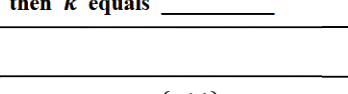
If the marginal probability density function of the $k^{th}$ order statistic of a random sample of size $8$ from a uniform distribution on $[0,2]$ is \(f(x) = \begin{cases} \frac{7}{32} x^6 (2 - x), & 0 < x < 2, \\ 0, & \text{otherwise}, \end{cases}\) then $k$ equals ________

Question diagram

Open complete paper
4
2022 · Statistics · Joint Distributions · Joint, Marginal and Conditional Distributions
Statistics (ST) 2022
Let \( (X, Y, Z) \) be a random vector with the joint probability density function
\( f_{X,Y,Z}(x, y, z) = \begin{cases} \frac{1}{3}(2x + 3y + z), & 0 < x < 1, 0 < y < 1, 0 < z < 1, \\ 0, & \text{elsewhere}. \end{cases} \)
Then which one of the following points is on the regression surface of \( X \) on \( (Y, Z) \)?
Open complete paper
5
2023 · Statistics · Joint Distributions · Joint, Marginal and Conditional Distributions
Statistics (ST) 2023
Let \((X, Y)\) have joint probability density function
\(f(x, y) = \begin{cases} 8xy & \text{if } 0 < x < y < 1 \\ 0 & \text{otherwise}. \end{cases}\) If \(E(X \mid Y = y_0) = \frac{1}{2}\), then \(y_0\) equals
Open complete paper
6
2024 · Statistics · Joint Distributions · Joint, Marginal and Conditional Distributions
Statistics (ST) 2024
Let \((X, Y)\) have a bivariate normal distribution with \(E(X) = E(Y) = 0\). Denote the conditional variance of \(X\) given \(Y = 1\) by \(Var(X|Y = 1)\) and the conditional variance of \(Y\) given \(X = 2\) by \(Var(Y|X = 2)\). If \(\frac{E(Y|X=2)}{E(X|Y=1)} = 8\) then \(\frac{Var(Y|X=2)}{Var(X|Y=1)}\) equals __________ (in integer).
Open complete paper