My Cart
Your Cart 0

    Your cart is empty.

  • Total (Amount) ₹0.00
Previous year question hub

Oil and Gas Well Testing - Petroleum Engineering Previous Year Questions

Practice Oil and Gas Well Testing - Petroleum Engineering previous year questions organised from real papers, with year-wise coverage and clear topic navigation.

10Papers
10Years
32Questions
1Topics

Oil and Gas Well Testing question pattern

Every graph below is calculated only from this selection.

Questions by year

Compare question counts across years.

Difficulty distribution

How the classified questions are distributed by difficulty.

Medium 29 90.6%
Easy 3 9.4%

Question type distribution

MCQ, numerical, multiple-select and other formats found in these papers.

Numerical Answer Type (NAT) 14 43.8%
MCQ 12 37.5%
MSQ 6 18.8%

Subject weightage

Top subjects by unique question coverage.

Petroleum Engineering
32 Qs

Most asked topics

Top topics across the included previous year papers.

Oil and Gas Well Testing
32 Qs

Subtopic coverage

Top subtopics inside this exact selection.

Drawdown, Buildup and Type-curve Analysis
27 Qs
Diffusivity and Pressure-transient Analysis
4 Qs
Injection, Interference and Gas-well Testing
1 Qs

Paper coverage

Question coverage for the most populated papers. Every active PYP paper remains listed below.

Petroleum Engineering (PE) 2026
4 Qs
Petroleum Engineering (PE) 2025
6 Qs
Petroleum Engineering (PE) 2024
2 Qs
Petroleum Engineering (PE) 2023
3 Qs
Petroleum Engineering (PE) 2022
4 Qs
Petroleum Engineering (PE) 2021
3 Qs
Petroleum Engineering (PE) 2020
3 Qs
Petroleum Engineering (PE) 2018
2 Qs
Petroleum Engineering (PE) 2017
2 Qs
Petroleum Engineering (PE) 2016
3 Qs

Browse by subtopics

Open a focused page built from the same verified paper data.

Included previous year papers

Newest papers appear first. Search these papers or sort by year and name.

Paper nameYearPDFAttempt
Petroleum Engineering (PE) 20262026
4 questions in this view
2026
Petroleum Engineering (PE) 20252025
6 questions in this view
2025
Petroleum Engineering (PE) 20242024
2 questions in this view
2024
Petroleum Engineering (PE) 20232023
3 questions in this view
2023
Petroleum Engineering (PE) 20222022
4 questions in this view
2022
Petroleum Engineering (PE) 20212021
3 questions in this view
2021
Petroleum Engineering (PE) 20202020
3 questions in this view
2020
Petroleum Engineering (PE) 20182018
2 questions in this view
2018
Petroleum Engineering (PE) 20172017
2 questions in this view
2017
Petroleum Engineering (PE) 20162016
3 questions in this view
2016

Sample previous year questions

A varied preview from the papers represented in this selection, with every available option.

1
2016 · Petroleum Engineering · Oil and Gas Well Testing · Injection, Interference and Gas-well Testing
Petroleum Engineering (PE) 2016
Interference tests can be used for
I. determining communication between two or more wells.
II. mature oil wells having skin damage.
III. determining permeability in tested wells.
IV. providing inputs for secondary and tertiary oil recovery methods
Open complete paper
2
2017 · Petroleum Engineering · Oil and Gas Well Testing · Drawdown, Buildup and Type-curve Analysis
Petroleum Engineering (PE) 2017

An oil emulsion having 15% water cut by weight is being treated in a horizontal heater-treater unit at the rate of 6000 kg/hr. The inlet temperature of the emulsion is 30°C and operating temperature of the heater-treater is 40°C. The specific heat capacity of water and oil are 1 kcal/kg°C and 0.5 kcal/kg°C, respectively. Assuming 10% of the total heat input is lost to the surroundings, the total heat energy required to break the emulsion in the heater-treater unit is ______ kcal/hr. (write answer with one decimal place)

Open complete paper
3
2018 · Petroleum Engineering · Oil and Gas Well Testing · Drawdown, Buildup and Type-curve Analysis
Petroleum Engineering (PE) 2018
Oil flow rate and flowing bottom-hole pressure (FBHP) recorded with time during a multi-rate well test are shown.
Let \(k\) is the reservoir permeability, \(h\) is the formation thickness and \(\mu\) is the viscosity of the oil. \(\Delta P_D(t)\) is constant-rate dimensionless pressure drop as a function of time. The total pressure drop till time, t, where t > t1, will be:
Open complete paper
4
2020 · Petroleum Engineering · Oil and Gas Well Testing · Drawdown, Buildup and Type-curve Analysis
Petroleum Engineering (PE) 2020

A drawdown test is conducted at a constant flow rate in an oil well for a reservoir with constant compressibility. Which one of the following is valid for semi steady state condition?

Open complete paper
5
2021 · Petroleum Engineering · Oil and Gas Well Testing · Drawdown, Buildup and Type-curve Analysis
Petroleum Engineering (PE) 2021
An Ideal Pressure Buildup Test yields a single straight line for all times, when shut-in Bottom-Hole Pressure (\(P_{ws}\)) is plotted against \(\log_{10}\left(\frac{t_p+\Delta t}{\Delta t}\right)\). Here \(t_p\) is the well production time and \(\Delta t\) is the time elapsed since shut-in. However, in an actual Pressure Buildup Test, a non-linear curve is obtained which can be logically divided into distinct regions.
Choose the INCORRECT option from the following.
Open complete paper
6
2022 · Petroleum Engineering · Oil and Gas Well Testing · Diffusivity and Pressure-transient Analysis
Petroleum Engineering (PE) 2022
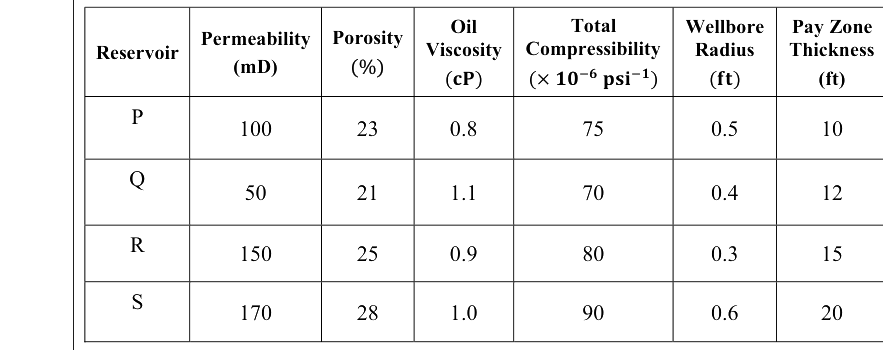
Flow tests are conducted for oil well in reservoirs P, Q, R and S having different parameters as given in the following table. In all the four cases the wells are tested at 1200 stb/day.
ReservoirPermeability (mD)Porosity (%)Oil Viscosity (cP)Total Compressibility (× 10-6 psi-1)Wellbore Radius (ft)Pay Zone Thickness (ft)
P100230.8750.510
Q50211.1700.412
R150250.9800.315
S170281.0900.620

Identify the reservoir in which the pressure transient reaches earliest at a point 2000 ft away from the wellbore.

Question diagram

Open complete paper