My Cart
Your Cart 0

    Your cart is empty.

  • Total (Amount) ₹0.00
Previous year question hub

Geological Carbon Dioxide Storage - Latest Trends in Petroleum Engineering - Petroleum Engineering Previous Year Questions

Practice Geological Carbon Dioxide Storage - Latest Trends in Petroleum Engineering - Petroleum Engineering previous year questions organised from real papers, with year-wise coverage and clear topic navigation.

4Papers
4Years
4Questions
1Topics

Geological Carbon Dioxide Storage question pattern

Every graph below is calculated only from this selection.

Questions by year

Compare question counts across years.

Difficulty distribution

How the classified questions are distributed by difficulty.

Medium 3 75%
Easy 1 25%

Question type distribution

MCQ, numerical, multiple-select and other formats found in these papers.

MCQ 3 75%
MSQ 1 25%

Subject weightage

Top subjects by unique question coverage.

Petroleum Engineering
4 Qs

Most asked topics

Top topics across the included previous year papers.

Latest Trends in Petroleum Engineering
4 Qs

Subtopic coverage

Top subtopics inside this exact selection.

Geological Carbon Dioxide Storage
4 Qs

Paper coverage

Question coverage for the most populated papers. Every active PYP paper remains listed below.

Petroleum Engineering (PE) 2023
1 Qs
Petroleum Engineering (PE) 2021
1 Qs
Petroleum Engineering (PE) 2018
1 Qs
Petroleum Engineering (PE) 2017
1 Qs

Included previous year papers

Newest papers appear first. Search these papers or sort by year and name.

Paper nameYearPDFAttempt
Petroleum Engineering (PE) 20232023
1 questions in this view
2023
Petroleum Engineering (PE) 20212021
1 questions in this view
2021
Petroleum Engineering (PE) 20182018
1 questions in this view
2018
Petroleum Engineering (PE) 20172017
1 questions in this view
2017

All Geological Carbon Dioxide Storage previous year questions

Practice every matching question in batches of 20, with every available option.

1
2017 · Petroleum Engineering · Latest Trends in Petroleum Engineering · Geological Carbon Dioxide Storage
Petroleum Engineering (PE) 2017
Match the following:
(P) Aquifer      (I) Slows down the movement of water and not good for water (or CO2) injection
(Q) Aquitard      (II) Evaporite rocks, such as halides or anhydrite, retarding upward movement of water/CO2
(R) Aquicludes      (III) Preferentially stores CO2 but not water
                         (IV) Rocks with sufficient permeability to conduct water, into which water (or CO2) may be injected
Open complete paper
2
2018 · Petroleum Engineering · Latest Trends in Petroleum Engineering · Geological Carbon Dioxide Storage
Petroleum Engineering (PE) 2018

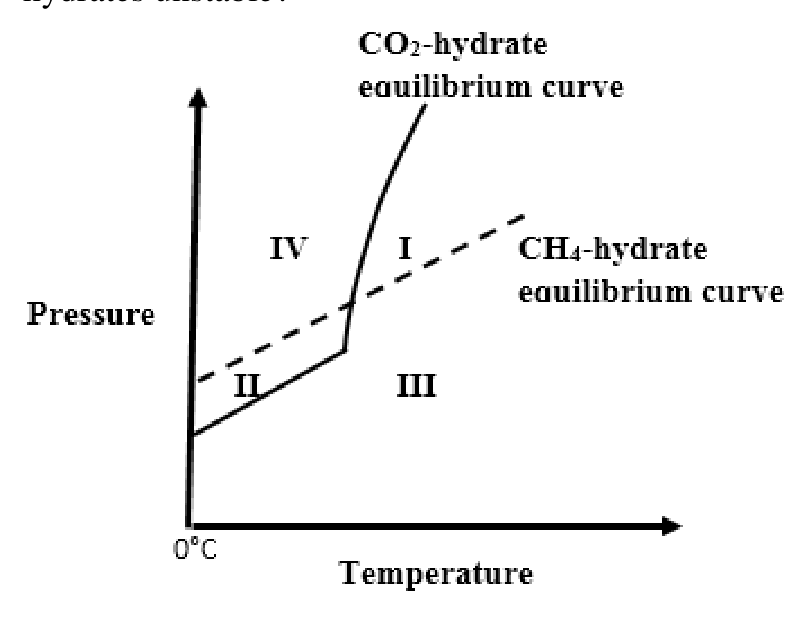
The CH4-hydrate equilibrium curve (dashed) and CO2-hydrate equilibrium curve (solid) on a pressure-temperature plane above 0°C are shown in the figure. The two curves divide the plane in four non-overlapping regions. In which region are CO2-hydrates stable and CH4-hydrates unstable?

Source question diagram

Open complete paper
3
2021 · Petroleum Engineering · Latest Trends in Petroleum Engineering · Geological Carbon Dioxide Storage
Petroleum Engineering (PE) 2021
When CO2 and liquid water are brought in contact with each other, they may form solid hydrates. The three-phase hydrate boundary is shown in the Pressure -Temperature plot given below.
Identify the correct statements.
G = Gas Phase, H = Hydrate Phase, L = Liquid Phase
Open complete paper
4
2023 · Petroleum Engineering · Latest Trends in Petroleum Engineering · Geological Carbon Dioxide Storage
Petroleum Engineering (PE) 2023
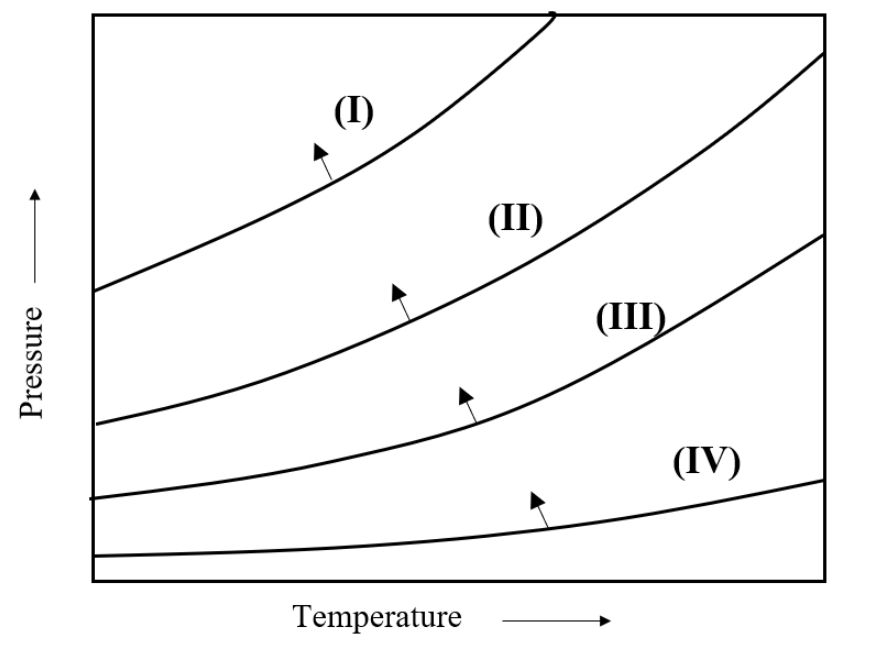
Schematic of phase diagrams for a pure gas hydrate system of methane (CH4), carbon dioxide (CO2), hydrogen sulphide (H2S) and nitrogen (N2) between the lower and upper quadruple points are shown in figure. Arrowheads indicate the stable hydrate region for a particular gas hydrate system.

Match the phase diagram with the corresponding pure gas hydrate.

Question source image

Open complete paper