My Cart
Your Cart 0

    Your cart is empty.

  • Total (Amount) ₹0.00
Previous year question hub

Molecular Taxonomy and Phylogeny - Microbial Taxonomy and Diversity - Life Sciences Previous Year Questions

Practice Molecular Taxonomy and Phylogeny - Microbial Taxonomy and Diversity - Life Sciences previous year questions organised from real papers, with year-wise coverage and clear topic navigation.

6Papers
6Years
6Questions
1Topics

Molecular Taxonomy and Phylogeny question pattern

Every graph below is calculated only from this selection.

Questions by year

Compare question counts across years.

Difficulty distribution

How the classified questions are distributed by difficulty.

Easy 4 66.7%
Medium 2 33.3%

Question type distribution

MCQ, numerical, multiple-select and other formats found in these papers.

MCQ 4 66.7%
Numerical Answer Type (NAT) 1 16.7%
MSQ 1 16.7%

Subject weightage

Top subjects by unique question coverage.

Life Sciences
6 Qs

Most asked topics

Top topics across the included previous year papers.

Microbial Taxonomy and Diversity
6 Qs

Subtopic coverage

Top subtopics inside this exact selection.

Molecular Taxonomy and Phylogeny
6 Qs

Paper coverage

Question coverage for the most populated papers. Every active PYP paper remains listed below.

Life Sciences (XL) 2025
1 Qs
Life Sciences (XL) 2021
1 Qs
Life Sciences (XL) 2019
1 Qs
Life Sciences (XL) 2016
1 Qs
Life Sciences (XL) 2012
1 Qs
Life Sciences (XL) 2009
1 Qs

Included previous year papers

Newest papers appear first. Search these papers or sort by year and name.

Paper nameYearPDFAttempt
Life Sciences (XL) 20252025
1 questions in this view
2025
Life Sciences (XL) 20212021
1 questions in this view
2021
Life Sciences (XL) 20192019
1 questions in this view
2019
Life Sciences (XL) 20162016
1 questions in this view
2016
Life Sciences (XL) 20122012
1 questions in this view
2012
Life Sciences (XL) 20092009
1 questions in this view
2009

All Molecular Taxonomy and Phylogeny previous year questions

Practice every matching question in batches of 20, with every available option.

1
2009 · Life Sciences · Microbial Taxonomy and Diversity · Molecular Taxonomy and Phylogeny
Life Sciences (XL) 2009
Which one of the following is NOT the criterion for using ribosomal RNAs as evolutionary chronometers ?
Open complete paper
2
2012 · Life Sciences · Microbial Taxonomy and Diversity · Molecular Taxonomy and Phylogeny
Life Sciences (XL) 2012
Bergey's Manual of Systematic Bacteriology groups bacteria into species according to their
Open complete paper
3
2016 · Life Sciences · Microbial Taxonomy and Diversity · Molecular Taxonomy and Phylogeny
Life Sciences (XL) 2016
Which one of the following is the most appropriate technique to determine the relatedness of two bacterial species?
Open complete paper
4
2019 · Life Sciences · Microbial Taxonomy and Diversity · Molecular Taxonomy and Phylogeny
Life Sciences (XL) 2019
When grouping bacteria using numerical taxonomy approach, many characteristics are determined for each strain. If all characteristics are same, then the % similarity is 100. When comparing two bacterial strains, if 72 characteristics are the same and 44 characteristics are different, the % similarity (round off to 2 decimal places) between the two strains is ____.
Open complete paper
5
2021 · Life Sciences · Microbial Taxonomy and Diversity · Molecular Taxonomy and Phylogeny
Life Sciences (XL) 2021
Which of the following method(s) can be applied to identify a bacterial species?
Open complete paper
6
2025 · Life Sciences · Microbial Taxonomy and Diversity · Molecular Taxonomy and Phylogeny
Life Sciences (XL) 2025

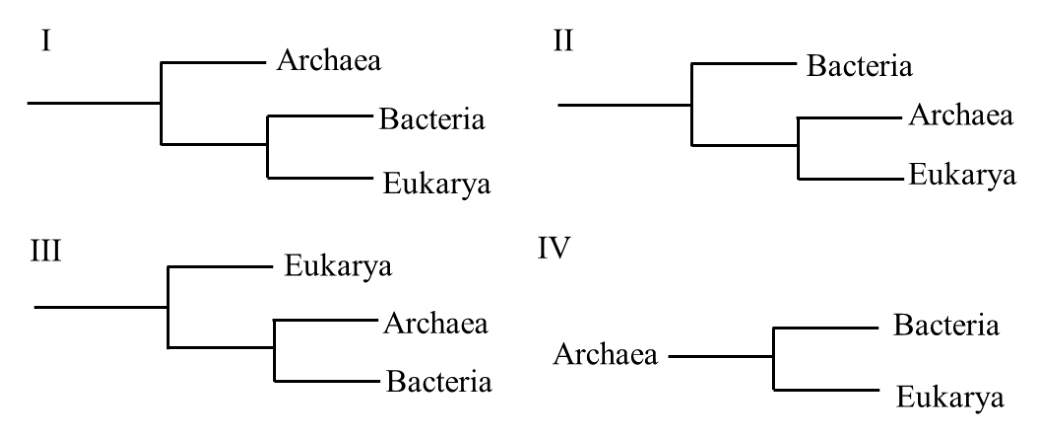
Carl Woese established that short subunit rRNA sequences can be used to reveal evolutionary relationships between various organisms. Based on this, which one of the following options is the established phylogenetic arrangement of the three domains of life?

Source question diagram

Open complete paper