My Cart
Your Cart 0

    Your cart is empty.

  • Total (Amount) ₹0.00
Previous year question hub

Vibrations - Engineering Sciences Previous Year Questions

Practice Vibrations - Engineering Sciences previous year questions organised from real papers, with year-wise coverage and clear topic navigation.

18Papers
18Years
30Questions
1Topics

Vibrations question pattern

Every graph below is calculated only from this selection.

Questions by year

Compare question counts across years.

Difficulty distribution

How the classified questions are distributed by difficulty.

Medium 20 66.7%
Easy 10 33.3%

Question type distribution

MCQ, numerical, multiple-select and other formats found in these papers.

MCQ 23 76.7%
Numerical Answer Type (NAT) 6 20%
MSQ 1 3.3%

Subject weightage

Top subjects by unique question coverage.

Engineering Sciences
30 Qs

Most asked topics

Top topics across the included previous year papers.

Vibrations
30 Qs

Subtopic coverage

Top subtopics inside this exact selection.

Free and Forced Vibration with Damping
30 Qs

Paper coverage

Question coverage for the most populated papers. Every active PYP paper remains listed below.

Engineering Sciences (XE) 2026
2 Qs
Engineering Sciences (XE) 2025
3 Qs
Engineering Sciences (XE) 2024
1 Qs
Engineering Sciences (XE) 2023
1 Qs
Engineering Sciences (XE) 2022
1 Qs
Engineering Sciences (XE) 2021
2 Qs
Engineering Sciences (XE) 2020
1 Qs
Engineering Sciences (XE) 2019
1 Qs
Engineering Sciences (XE) 2018
2 Qs
Engineering Sciences (XE) 2017
2 Qs
Engineering Sciences (XE) 2016
2 Qs
Engineering Sciences (XE) 2013
1 Qs
Engineering Sciences (XE) 2012
2 Qs
Engineering Sciences (XE) 2011
1 Qs
Engineering Sciences (XE) 2010
1 Qs
Engineering Sciences (XE) 2009
1 Qs
Engineering Sciences (XE) 2008
4 Qs
Engineering Sciences (XE) 2007
2 Qs

Browse by subtopics

Open a focused page built from the same verified paper data.

Included previous year papers

Newest papers appear first. Search these papers or sort by year and name.

Paper nameYearPDFAttempt
Engineering Sciences (XE) 20262026
2 questions in this view
2026
Engineering Sciences (XE) 20252025
3 questions in this view
2025
Engineering Sciences (XE) 20242024
1 questions in this view
2024
Engineering Sciences (XE) 20232023
1 questions in this view
2023
Engineering Sciences (XE) 20222022
1 questions in this view
2022
Engineering Sciences (XE) 20212021
2 questions in this view
2021
Engineering Sciences (XE) 20202020
1 questions in this view
2020
Engineering Sciences (XE) 20192019
1 questions in this view
2019
Engineering Sciences (XE) 20182018
2 questions in this view
2018
Engineering Sciences (XE) 20172017
2 questions in this view
2017
Engineering Sciences (XE) 20162016
2 questions in this view
2016
Engineering Sciences (XE) 20132013
1 questions in this view
2013
Engineering Sciences (XE) 20122012
2 questions in this view
2012
Engineering Sciences (XE) 20112011
1 questions in this view
2011
Engineering Sciences (XE) 20102010
1 questions in this view
2010
Engineering Sciences (XE) 20092009
1 questions in this view
2009
Engineering Sciences (XE) 20082008
4 questions in this view
2008
Engineering Sciences (XE) 20072007
2 questions in this view
2007

Sample previous year questions

A varied preview from the papers represented in this selection, with every available option.

1
2007 · Engineering Sciences · Vibrations · Free and Forced Vibration with Damping
Engineering Sciences (XE) 2007

A transistor oscillator uses a 3-section R-C phase shift circuit. Each section uses same R and C values. The gain of the circuit is adjusted for oscillation. The required oscillation frequency is 10 k rad/s. The suitable R-C combination is

Open complete paper
2
2008 · Engineering Sciences · Vibrations · Free and Forced Vibration with Damping
Engineering Sciences (XE) 2008

If a mass attached to the free end of a linear spring is so constrained that it executes vertical undamped oscillations, its acceleration at the instant when it occupies the static equilibrium position is

Open complete paper
3
2009 · Engineering Sciences · Vibrations · Free and Forced Vibration with Damping
Engineering Sciences (XE) 2009
In the ensuing Simple Harmonic Motion of the body, the magnitude of maximum acceleration is
Open complete paper
4
2010 · Engineering Sciences · Vibrations · Free and Forced Vibration with Damping
Engineering Sciences (XE) 2010

A spring-mass system shown in the figure is vibrating with very small amplitude. The natural frequency of the system is

Open complete paper
5
2011 · Engineering Sciences · Vibrations · Free and Forced Vibration with Damping
Engineering Sciences (XE) 2011
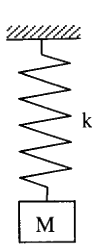
A simple mass-spring system shown has a natural frequency of 5 Hz. The static deflection of the spring due to the mass is (acceleration due to gravity is 9.81 m/s² and mass of the spring is negligible)

Question diagram

Open complete paper
6
2012 · Engineering Sciences · Vibrations · Free and Forced Vibration with Damping
Engineering Sciences (XE) 2012
A rocket in the atmosphere is accelerating upwards with acceleration \(a\) m/s². The natural frequency of a spring-mass system (with mass \(m\) kg and spring constant \(k\) N/m), suspended vertically inside the rocket, is (take \(g\) m/s² to be the acceleration due to gravity)
Open complete paper